


Community hub
Recent from talks
Contribute something to knowledge base
Content stats: 0 posts, 0 articles, 1 media, 0 notes
Members stats: 0 subscribers, 0 contributors, 0 moderators, 0 supporters
Subscribers
Supporters
Contributors
Moderators
Hub AI
Pandora (computer) AI simulator
(@Pandora (computer)_simulator)
Hub AI
Pandora (computer) AI simulator
(@Pandora (computer)_simulator)
Pandora (computer)
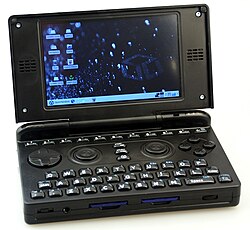
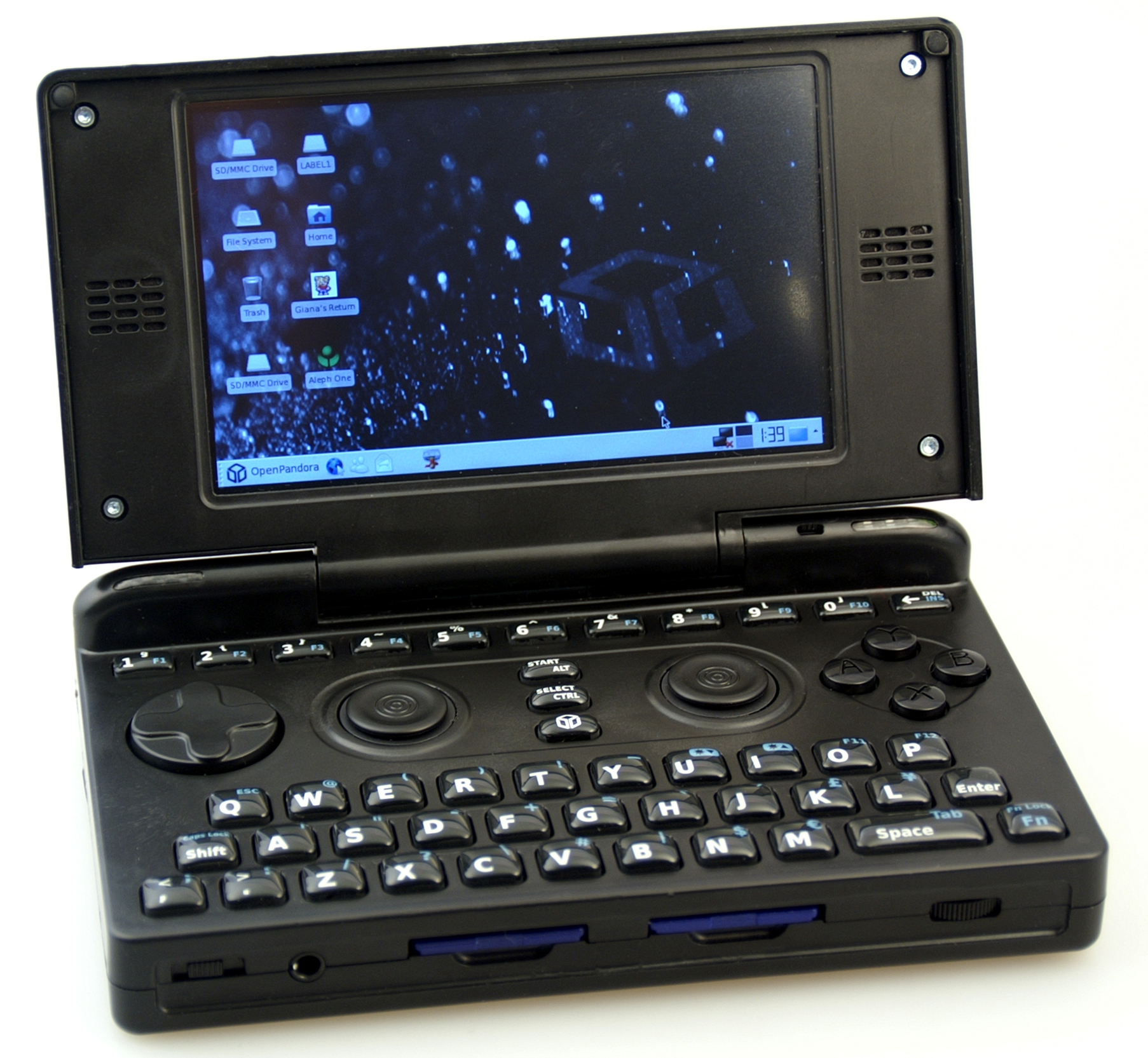
The Pandora is a handheld gaming computer developed and produced by OpenPandora, which is made up of former distributors and community members of the GP32 and GP2X handhelds. Originally released in 2010, it was designed to take advantage of existing free and open-source software and to be a target for homebrew development. The Pandora runs Linux and uses an ARM processor. Until 2013, multiple batches of slightly updated Pandora variants were produced. In 2014, development of a redesigned and upgraded successor, named DragonBox Pyra, began.
Development of the Pandora began when Craig Rothwell, Fatih Kilic, Michael Mrozek and (later) Michael Weston teamed up and planned a portable system that would excel in the areas where they thought the GP32 and GP2X systems (from Game Park and GamePark Holdings respectively) were flawed. The Pandora was designed based on ideas and suggestions contributed by GP32X forum members, with the goal of creating the ultimate open source handheld device. When announcing the system, the designers of Pandora stated that it would be more powerful than any handheld video game console that had yet existed.
The final case and keymat design was made by Dave Cancilier (DaveC), who was known on the forums for custom hardware modifications.
In February 2008 the Pandora wiki had already been created; as of 2014, it contains a thousand pages and is translated with the MediaWiki Translate extension.
The initial development and setup costs were funded through a crowdfunding approach where early supporters provided enough money to support a production run, and when the console made it into production, each supporter would receive the device they paid for (what actually ended up happening due to cost overruns is that the early supporters received devices as later sales recouped the initial investment costs). OpenPandora began taking payments on September 30, 2008 and began shipping to customers on May 21, 2010. In late 2011, after production problems, OpenPandora shifted its production from Texas to Germany, delaying production, and the device was upgraded from 256 MB to 512 MB RAM.
As of September 3, 2012, 4600 units had been shipped and 400 early supporters were still waiting to receive a console, as these pre-orders are only fulfilled when sales to new customers are made. Since June 2012, a new 1 GHz model has been made available in limited amounts during the summer 2012. Due to the shortage of previous 600 MHz chips, this new model has become the de facto standard in 2013.
In March 2013, the pre-order queue of the German OpenPandora GmbH company (owned by Michael Mrozek aka EvilDragon) was finally cleared. The remaining pre-order queue of the UK OpenPandora Ltd. company (owned by Craig Rothwell) turned out to be significantly larger than originally reported, and the UK company has requested to be struck off. This means that the original pre-orderers at the UK company are unlikely to ever get their unit from the UK company. Also because of this, buyers have lost their money. Although there is no legal connection between the two companies, the German OpenPandora GmbH company is trying to help those UK customers by offering them significant discounts (if they decide to buy a unit from the German company instead of waiting for the UK company) and by organizing community donations to get them peer-funded units.
As of December 2, 2013, about 6000 units have been shipped. On November 19, 2013, it was announced that production of the final Pandora batch had begun. About 7500 Pandoras have been made and sold altogether between 2010 and 2014, with further production made impossible due to shortage of Wi-Fi chips.
Pandora (computer)
The Pandora is a handheld gaming computer developed and produced by OpenPandora, which is made up of former distributors and community members of the GP32 and GP2X handhelds. Originally released in 2010, it was designed to take advantage of existing free and open-source software and to be a target for homebrew development. The Pandora runs Linux and uses an ARM processor. Until 2013, multiple batches of slightly updated Pandora variants were produced. In 2014, development of a redesigned and upgraded successor, named DragonBox Pyra, began.
Development of the Pandora began when Craig Rothwell, Fatih Kilic, Michael Mrozek and (later) Michael Weston teamed up and planned a portable system that would excel in the areas where they thought the GP32 and GP2X systems (from Game Park and GamePark Holdings respectively) were flawed. The Pandora was designed based on ideas and suggestions contributed by GP32X forum members, with the goal of creating the ultimate open source handheld device. When announcing the system, the designers of Pandora stated that it would be more powerful than any handheld video game console that had yet existed.
The final case and keymat design was made by Dave Cancilier (DaveC), who was known on the forums for custom hardware modifications.
In February 2008 the Pandora wiki had already been created; as of 2014, it contains a thousand pages and is translated with the MediaWiki Translate extension.
The initial development and setup costs were funded through a crowdfunding approach where early supporters provided enough money to support a production run, and when the console made it into production, each supporter would receive the device they paid for (what actually ended up happening due to cost overruns is that the early supporters received devices as later sales recouped the initial investment costs). OpenPandora began taking payments on September 30, 2008 and began shipping to customers on May 21, 2010. In late 2011, after production problems, OpenPandora shifted its production from Texas to Germany, delaying production, and the device was upgraded from 256 MB to 512 MB RAM.
As of September 3, 2012, 4600 units had been shipped and 400 early supporters were still waiting to receive a console, as these pre-orders are only fulfilled when sales to new customers are made. Since June 2012, a new 1 GHz model has been made available in limited amounts during the summer 2012. Due to the shortage of previous 600 MHz chips, this new model has become the de facto standard in 2013.
In March 2013, the pre-order queue of the German OpenPandora GmbH company (owned by Michael Mrozek aka EvilDragon) was finally cleared. The remaining pre-order queue of the UK OpenPandora Ltd. company (owned by Craig Rothwell) turned out to be significantly larger than originally reported, and the UK company has requested to be struck off. This means that the original pre-orderers at the UK company are unlikely to ever get their unit from the UK company. Also because of this, buyers have lost their money. Although there is no legal connection between the two companies, the German OpenPandora GmbH company is trying to help those UK customers by offering them significant discounts (if they decide to buy a unit from the German company instead of waiting for the UK company) and by organizing community donations to get them peer-funded units.
As of December 2, 2013, about 6000 units have been shipped. On November 19, 2013, it was announced that production of the final Pandora batch had begun. About 7500 Pandoras have been made and sold altogether between 2010 and 2014, with further production made impossible due to shortage of Wi-Fi chips.
Recent media
Recent media