



Community hub
Community hub
Recent from talks
Knowledge base stats:
Talk channels stats:
Members stats:
Papal bull
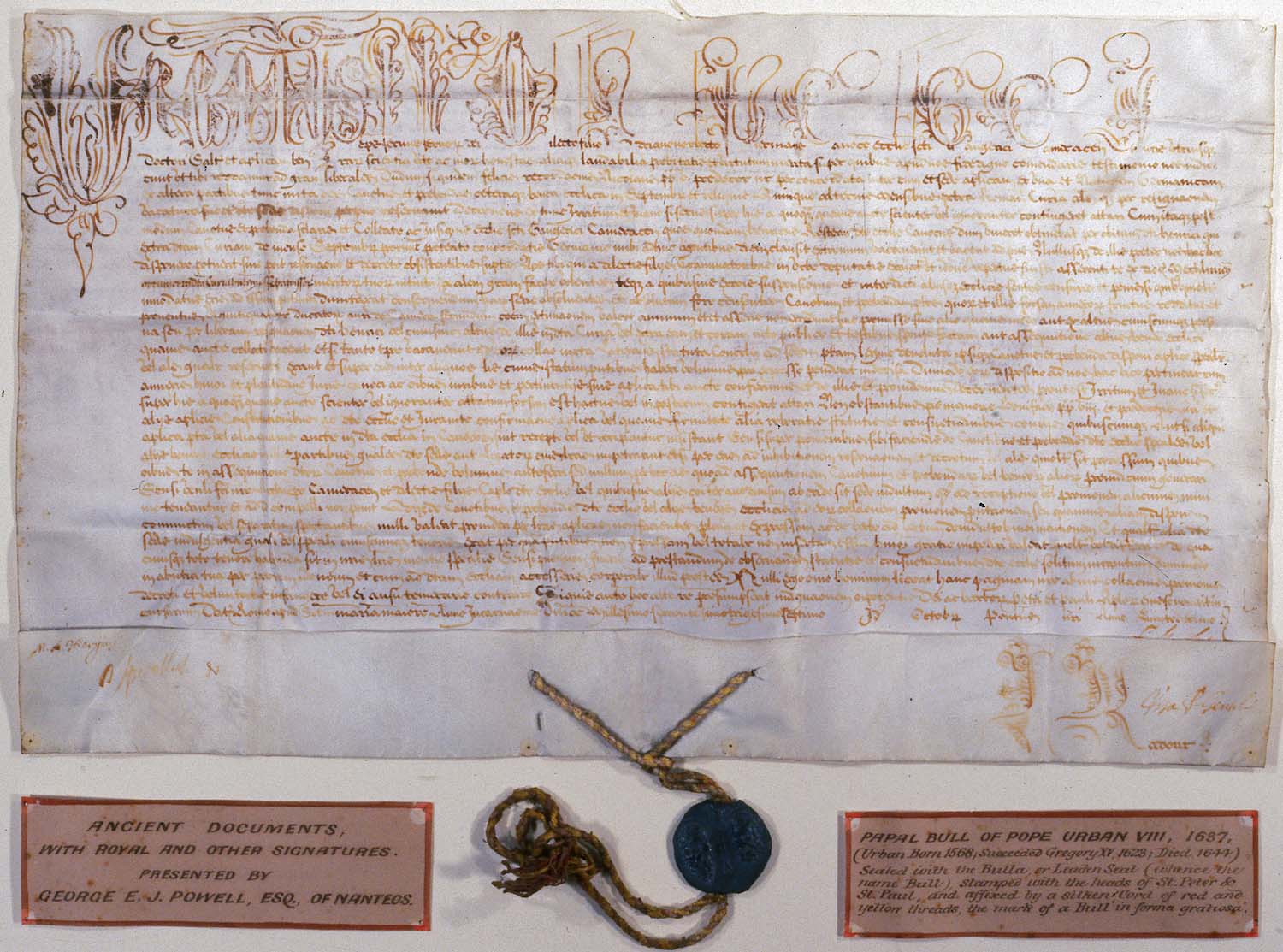
A papal bull is a type of public decree, letters patent, or charter issued by the pope of the Catholic Church. It is named after the leaden seal (bulla) traditionally appended to authenticate it.
Papal bulls have been in use at least since the 6th century, but the phrase was not used until around the end of the 13th century, and then only internally for unofficial administrative purposes. However, it had become official by the 15th century, when one of the offices of the Apostolic Chancery was named the "register of bulls" ("registrum bullarum").
By the accession of Pope Leo IX in 1048, a clear distinction developed between two classes of bulls of greater and less solemnity. The majority of the "great bulls" now in existence are in the nature of confirmations of property or charters of protection accorded to monasteries and religious institutions. In an era when there was much fabrication of such documents, those who procured bulls from Rome wished to ensure that the authenticity of their bull was above suspicion. A papal confirmation, under certain conditions, could be pleaded as itself constituting sufficient evidence of title in cases where the original deed had been lost or destroyed.
Since the 12th century, papal bulls have carried a leaden seal with the heads of the apostles Saint Peter and Saint Paul on one side and the pope's name on the other. Papal bulls were originally issued by the pope for many kinds of communication of a public nature, but by the 13th century, papal bulls were only used for the most formal or solemn of occasions. Papyrus seems to have been used almost uniformly as the material for these documents until the early years of the eleventh century, after which it was rapidly superseded by a rough kind of parchment.
Modern scholars have retroactively used the word "bull" to describe any elaborate papal document issued in the form of a decree or privilege, solemn or simple, and to some less elaborate ones issued in the form of a letter. Popularly, the name is used for any papal document that contains a metal seal.
Today, the bull is the only written communication in which the pope will refer to himself as "Episcopus Servus Servorum Dei" ("Bishop, Servant of the Servants of God").
While papal bulls always used to bear a metal seal, they now do so only on the most solemn occasions. A papal bull is today the most formal type of public decree or letters patent issued by the Vatican Chancery in the name of the pope.
A bull's format formerly began with one line in tall, elongated letters containing three elements: the pope's name, the papal title "Episcopus Servus Servorum Dei" ("Bishop, Servant of the Servants of God"), and its incipit, i.e., the first few Latin words from which the bull took its title for record-keeping purposes, but which might not be directly indicative of the bull's purpose.
Hub AI
Papal bull AI simulator
(@Papal bull_simulator)
Papal bull
A papal bull is a type of public decree, letters patent, or charter issued by the pope of the Catholic Church. It is named after the leaden seal (bulla) traditionally appended to authenticate it.
Papal bulls have been in use at least since the 6th century, but the phrase was not used until around the end of the 13th century, and then only internally for unofficial administrative purposes. However, it had become official by the 15th century, when one of the offices of the Apostolic Chancery was named the "register of bulls" ("registrum bullarum").
By the accession of Pope Leo IX in 1048, a clear distinction developed between two classes of bulls of greater and less solemnity. The majority of the "great bulls" now in existence are in the nature of confirmations of property or charters of protection accorded to monasteries and religious institutions. In an era when there was much fabrication of such documents, those who procured bulls from Rome wished to ensure that the authenticity of their bull was above suspicion. A papal confirmation, under certain conditions, could be pleaded as itself constituting sufficient evidence of title in cases where the original deed had been lost or destroyed.
Since the 12th century, papal bulls have carried a leaden seal with the heads of the apostles Saint Peter and Saint Paul on one side and the pope's name on the other. Papal bulls were originally issued by the pope for many kinds of communication of a public nature, but by the 13th century, papal bulls were only used for the most formal or solemn of occasions. Papyrus seems to have been used almost uniformly as the material for these documents until the early years of the eleventh century, after which it was rapidly superseded by a rough kind of parchment.
Modern scholars have retroactively used the word "bull" to describe any elaborate papal document issued in the form of a decree or privilege, solemn or simple, and to some less elaborate ones issued in the form of a letter. Popularly, the name is used for any papal document that contains a metal seal.
Today, the bull is the only written communication in which the pope will refer to himself as "Episcopus Servus Servorum Dei" ("Bishop, Servant of the Servants of God").
While papal bulls always used to bear a metal seal, they now do so only on the most solemn occasions. A papal bull is today the most formal type of public decree or letters patent issued by the Vatican Chancery in the name of the pope.
A bull's format formerly began with one line in tall, elongated letters containing three elements: the pope's name, the papal title "Episcopus Servus Servorum Dei" ("Bishop, Servant of the Servants of God"), and its incipit, i.e., the first few Latin words from which the bull took its title for record-keeping purposes, but which might not be directly indicative of the bull's purpose.