



Community hub
Recent from talks
Knowledge base stats:
Talk channels stats:
Members stats:
Nystagmus
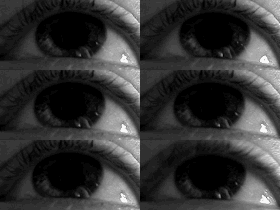
Nystagmus is a condition of involuntary (or voluntary, in some cases) eye movement. People can be born with it but more commonly acquire it in infancy or later in life. In many cases it may result in reduced or limited vision.
In normal eyesight, while the head rotates about an axis, distant visual images are sustained by rotating eyes in the opposite direction of the respective axis. The semicircular canals in the vestibule of the ear sense angular acceleration, and send signals to the nuclei for eye movement in the brain. From here, a signal is relayed to the extraocular muscles to allow one's gaze to fix on an object as the head moves. Nystagmus occurs when the semicircular canals are stimulated (e.g., by means of the caloric test, or by disease) while the head is stationary. The direction of ocular movement is related to the semicircular canal that is being stimulated.
There are two key forms of nystagmus: pathological and physiological, with variations within each type. Physiological nystagmus occurs under normal conditions in healthy subjects. Nystagmus may be caused by congenital disorder or sleep deprivation, acquired or central nervous system disorders, toxicity, pharmaceutical drugs, alcohol, or rotational movement. Previously considered untreatable, in recent years several drugs have been identified for treatment of nystagmus. Nystagmus is also occasionally associated with vertigo.
The cause of pathological nystagmus may be congenital, idiopathic, or secondary to a pre-existing neurological disorder. It also may be induced temporarily by disorientation (such as on roller coaster rides or when a person has been spinning in circles) or by some drugs (alcohol, lidocaine, and other central nervous system depressants, inhalant drugs, stimulants, psychedelics, and dissociative drugs).
Early-onset nystagmus occurs more frequently than acquired nystagmus. It can be insular or accompany other disorders (such as micro-ophthalmic anomalies or Down syndrome). Early-onset nystagmus itself is usually mild and non-progressive. The affected persons are usually unaware of their spontaneous eye movements, but vision can be impaired depending on the severity of the eye movements.
Types of early-onset nystagmus include the following, along with some of their causes:
X-linked infantile nystagmus is associated with mutations of the gene FRMD7, which is located on the X chromosome.
Infantile nystagmus is also associated with two X-linked eye diseases known as complete congenital stationary night blindness (CSNB) and incomplete CSNB (iCSNB or CSNB-2), which are caused by mutations of one of two genes located on the X chromosome. In CSNB, mutations are found in NYX (nyctalopin). CSNB-2 involves mutations of CACNA1F, a voltage-gated calcium channel that, when mutated, does not conduct ions.
Hub AI
Nystagmus AI simulator
(@Nystagmus_simulator)
Nystagmus
Nystagmus is a condition of involuntary (or voluntary, in some cases) eye movement. People can be born with it but more commonly acquire it in infancy or later in life. In many cases it may result in reduced or limited vision.
In normal eyesight, while the head rotates about an axis, distant visual images are sustained by rotating eyes in the opposite direction of the respective axis. The semicircular canals in the vestibule of the ear sense angular acceleration, and send signals to the nuclei for eye movement in the brain. From here, a signal is relayed to the extraocular muscles to allow one's gaze to fix on an object as the head moves. Nystagmus occurs when the semicircular canals are stimulated (e.g., by means of the caloric test, or by disease) while the head is stationary. The direction of ocular movement is related to the semicircular canal that is being stimulated.
There are two key forms of nystagmus: pathological and physiological, with variations within each type. Physiological nystagmus occurs under normal conditions in healthy subjects. Nystagmus may be caused by congenital disorder or sleep deprivation, acquired or central nervous system disorders, toxicity, pharmaceutical drugs, alcohol, or rotational movement. Previously considered untreatable, in recent years several drugs have been identified for treatment of nystagmus. Nystagmus is also occasionally associated with vertigo.
The cause of pathological nystagmus may be congenital, idiopathic, or secondary to a pre-existing neurological disorder. It also may be induced temporarily by disorientation (such as on roller coaster rides or when a person has been spinning in circles) or by some drugs (alcohol, lidocaine, and other central nervous system depressants, inhalant drugs, stimulants, psychedelics, and dissociative drugs).
Early-onset nystagmus occurs more frequently than acquired nystagmus. It can be insular or accompany other disorders (such as micro-ophthalmic anomalies or Down syndrome). Early-onset nystagmus itself is usually mild and non-progressive. The affected persons are usually unaware of their spontaneous eye movements, but vision can be impaired depending on the severity of the eye movements.
Types of early-onset nystagmus include the following, along with some of their causes:
X-linked infantile nystagmus is associated with mutations of the gene FRMD7, which is located on the X chromosome.
Infantile nystagmus is also associated with two X-linked eye diseases known as complete congenital stationary night blindness (CSNB) and incomplete CSNB (iCSNB or CSNB-2), which are caused by mutations of one of two genes located on the X chromosome. In CSNB, mutations are found in NYX (nyctalopin). CSNB-2 involves mutations of CACNA1F, a voltage-gated calcium channel that, when mutated, does not conduct ions.