



Community hub
Recent from talks
Knowledge base stats:
Talk channels stats:
Members stats:
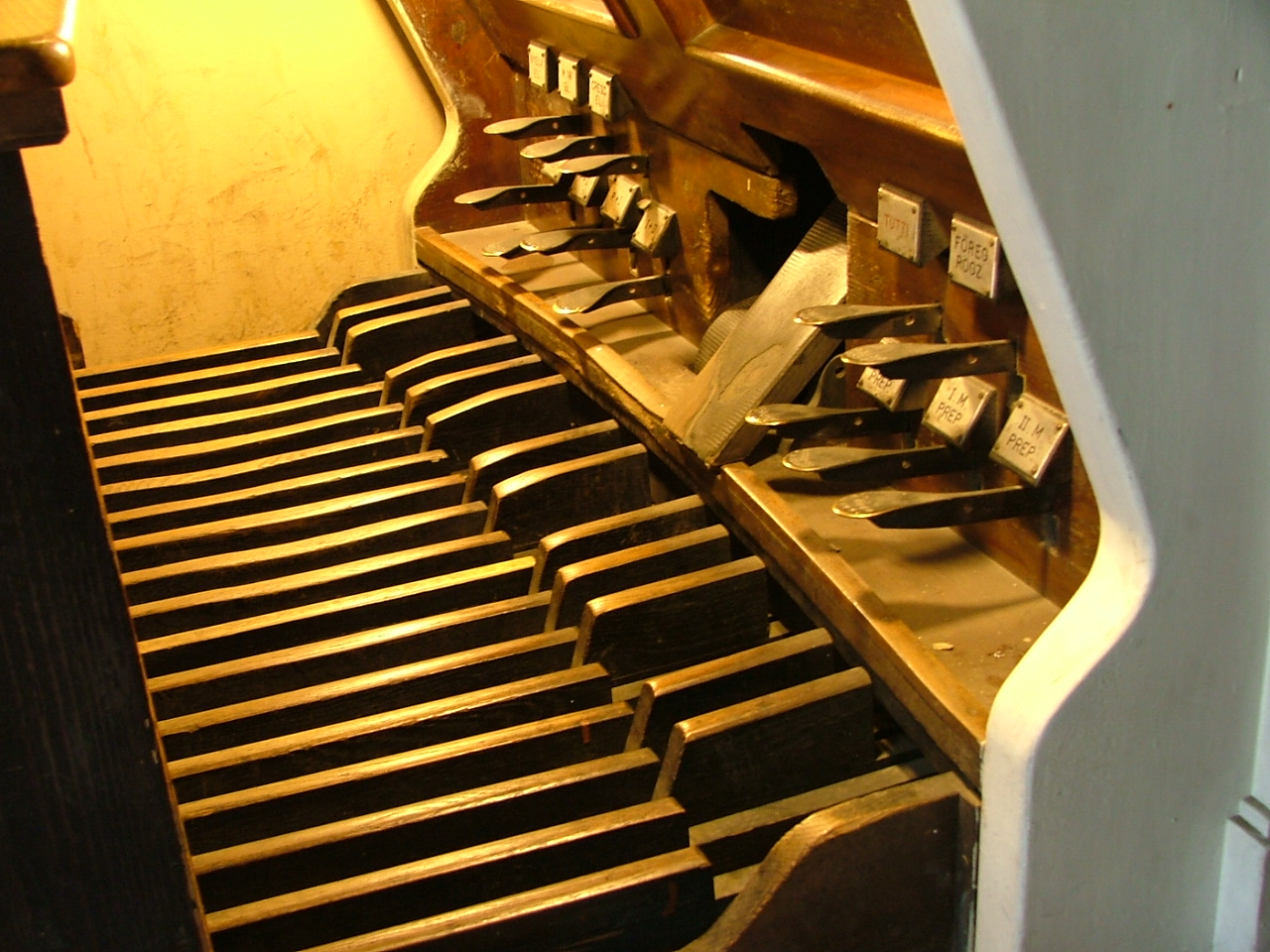
Pedal keyboard
A pedalboard (also called a pedal keyboard, pedal clavier, or, with electronic instruments, a bass pedalboard) is a keyboard played with the feet that is usually used to produce the low-pitched bass line of a piece of music. A pedalboard has long, narrow lever-style keys laid out in the same semitone scalar pattern as a manual keyboard, with longer keys for C, D, E, F, G, A, and B, and shorter, raised keys for C♯, D♯, F♯, G♯ and A♯. Training in pedal technique is part of standard organ pedagogy in church music and art music.
Pedalboards are found at the base of the console of most pipe organs, pedal pianos, theatre organs, and electronic organs. Standalone pedalboards such as the 1970s-era Moog Taurus bass pedals are occasionally used in progressive rock and fusion music. In the 21st century, MIDI pedalboard controllers are used with synthesizers, electronic Hammond-style organs, and with digital pipe organs. Pedalboards are also used with pedal pianos and with some harpsichords, clavichords, and carillons (church bells).
The first use of pedals on a pipe organ grew out of the need to hold bass drone notes, to support the polyphonic musical styles that predominated in the Renaissance. Indeed, the term pedal point, which refers to a prolonged bass tone under changing upper harmonies, derives from the use of the organ pedalboard to hold sustained bass notes. These earliest pedals were wooden stubs nicknamed mushrooms, which were placed at the height of the feet. These pedals, which used simple pull-downs connected directly to the manual keys, are found in organs dating to the 13th century. The pedals on French organs were composed of short stubs of wood projecting out of the floor, which were mounted in pedalboards that could be either flat or tilted. Organists were unable to play anything but simple bass lines or slow-moving plainsong melodies on these short stub-type pedals. Organist E. Power Biggs, in the liner notes for his album Organs of Spain noted that "One can learn to play them, but fluent pedal work is impossible".
There were two approaches used for the accidental notes (colloquially referred to as the "black" notes). The first approach can be seen in the 1361 Halberstadt organ, which uses shorter black keys placed above the white keys. Other organs positioned the black keys on the same level and depth as the white keys. The first pedal keyboards only had three or four notes. Eventually, organ designers augmented this range by using eight notes, an approach now called a "short octave" keyboard, because it does not include accidental notes such as C♯, D♯, F♯, G♯, and A♯. The 17th-century north German organ builder Arp Schnitger used an F♯ and G♯ in the lowest octave of the manuals and pedal keyboards, but not a C♯ and D♯. From the 16th to 18th centuries, short octave keyboards were also used in the lowest octave of upper manual keyboards.
By the 14th century, organ designers were building separate windchests for the pedal division, to supply the pipes with the large amount of wind that bass notes need to speak. These windchests were often built into tall structures called "organ towers". Until the 15th century, most pedal keyboards only triggered the existing Hauptwerk pipes already used by the upper manual keyboards. Beginning in the 15th century, some organ designers began giving pedal keyboards their own set of pipes and stops. In the 15th and 16th centuries, the pedal division usually consisted of a few 8′ ranks and a single 16′ rank. By the early 17th century, pedal divisions became more complex, with a richer variety of pipes and tones. Nevertheless, the pedal division was usually inconsistent from one country to another.
By the beginning of the 17th century, organ designers began to give pedalboards on large organs a larger range, encompassing twenty-eight to thirty notes. As well, German organ designers began to use longer, narrower pedals, with a wider space between the pedals. By this point, most pedals were given a smoother lever-action by including a fulcrum at the back of each pedal. These design changes allowed performers to play more complex, fast-moving pedal lines. This gave rise to the dramatic pedal solos found in German organ works from composers from the North German organ school, such as Dieterich Buxtehude, Johann Adam Reincken and J.S. Bach. In Bach's organ music the cantus firmus melody, which is usually a hymn tune, is often performed in the pedal, using a reed stop to make it stand out.
Several sources, including an encyclopedia on the organ, claim that the pedalboard design improvements of the 17th century allowed the organist to actuate the pedals either with the toe of the foot or with the heel. However, organist Ton Koopman argues that "Bach's complete oeuvre [can be played] with the pedal technique of his time, in other words without the use of the heel." Koopman claims that in "Bach's day toe and heel pedalling was not yet known, as is evident from his organ works, in which all the pedal parts can be played with the toe." What evolved as the "German" pedal technique in the late 18th and early 19th century promoted heel-and-toe pedaling, while the "French" style was predicated on the "toe only" pedal technique.
In the 17th and 18th centuries, pedalboards were rare in England. A critic for the New York Times in 1895 argued that this may explain why Handel's published organ works are generally lighter-sounding than those of J.S. Bach. In the 17th and 18th centuries, the pedal part of organ music was rarely given its own staff. Instead, the organ part would be put into two staves, which were mostly used for the upper and lower manual parts. When the composer wanted a part played with the pedal keyboard, they marked Pedal, Ped., or simply P. Often, composers omitted these signs, and player had to decide if the range of all the parts or the lowest part was appropriate for the pedal keyboard. This lack of specification is in keeping with many other aspects of Baroque musical performance practice, such as the use of improvised chords by organists and harpsichord players in the figured bass tradition and the use of improvised ornaments by solo singers and instrumentalists.
Hub AI
Pedal keyboard AI simulator
(@Pedal keyboard_simulator)
Pedal keyboard
A pedalboard (also called a pedal keyboard, pedal clavier, or, with electronic instruments, a bass pedalboard) is a keyboard played with the feet that is usually used to produce the low-pitched bass line of a piece of music. A pedalboard has long, narrow lever-style keys laid out in the same semitone scalar pattern as a manual keyboard, with longer keys for C, D, E, F, G, A, and B, and shorter, raised keys for C♯, D♯, F♯, G♯ and A♯. Training in pedal technique is part of standard organ pedagogy in church music and art music.
Pedalboards are found at the base of the console of most pipe organs, pedal pianos, theatre organs, and electronic organs. Standalone pedalboards such as the 1970s-era Moog Taurus bass pedals are occasionally used in progressive rock and fusion music. In the 21st century, MIDI pedalboard controllers are used with synthesizers, electronic Hammond-style organs, and with digital pipe organs. Pedalboards are also used with pedal pianos and with some harpsichords, clavichords, and carillons (church bells).
The first use of pedals on a pipe organ grew out of the need to hold bass drone notes, to support the polyphonic musical styles that predominated in the Renaissance. Indeed, the term pedal point, which refers to a prolonged bass tone under changing upper harmonies, derives from the use of the organ pedalboard to hold sustained bass notes. These earliest pedals were wooden stubs nicknamed mushrooms, which were placed at the height of the feet. These pedals, which used simple pull-downs connected directly to the manual keys, are found in organs dating to the 13th century. The pedals on French organs were composed of short stubs of wood projecting out of the floor, which were mounted in pedalboards that could be either flat or tilted. Organists were unable to play anything but simple bass lines or slow-moving plainsong melodies on these short stub-type pedals. Organist E. Power Biggs, in the liner notes for his album Organs of Spain noted that "One can learn to play them, but fluent pedal work is impossible".
There were two approaches used for the accidental notes (colloquially referred to as the "black" notes). The first approach can be seen in the 1361 Halberstadt organ, which uses shorter black keys placed above the white keys. Other organs positioned the black keys on the same level and depth as the white keys. The first pedal keyboards only had three or four notes. Eventually, organ designers augmented this range by using eight notes, an approach now called a "short octave" keyboard, because it does not include accidental notes such as C♯, D♯, F♯, G♯, and A♯. The 17th-century north German organ builder Arp Schnitger used an F♯ and G♯ in the lowest octave of the manuals and pedal keyboards, but not a C♯ and D♯. From the 16th to 18th centuries, short octave keyboards were also used in the lowest octave of upper manual keyboards.
By the 14th century, organ designers were building separate windchests for the pedal division, to supply the pipes with the large amount of wind that bass notes need to speak. These windchests were often built into tall structures called "organ towers". Until the 15th century, most pedal keyboards only triggered the existing Hauptwerk pipes already used by the upper manual keyboards. Beginning in the 15th century, some organ designers began giving pedal keyboards their own set of pipes and stops. In the 15th and 16th centuries, the pedal division usually consisted of a few 8′ ranks and a single 16′ rank. By the early 17th century, pedal divisions became more complex, with a richer variety of pipes and tones. Nevertheless, the pedal division was usually inconsistent from one country to another.
By the beginning of the 17th century, organ designers began to give pedalboards on large organs a larger range, encompassing twenty-eight to thirty notes. As well, German organ designers began to use longer, narrower pedals, with a wider space between the pedals. By this point, most pedals were given a smoother lever-action by including a fulcrum at the back of each pedal. These design changes allowed performers to play more complex, fast-moving pedal lines. This gave rise to the dramatic pedal solos found in German organ works from composers from the North German organ school, such as Dieterich Buxtehude, Johann Adam Reincken and J.S. Bach. In Bach's organ music the cantus firmus melody, which is usually a hymn tune, is often performed in the pedal, using a reed stop to make it stand out.
Several sources, including an encyclopedia on the organ, claim that the pedalboard design improvements of the 17th century allowed the organist to actuate the pedals either with the toe of the foot or with the heel. However, organist Ton Koopman argues that "Bach's complete oeuvre [can be played] with the pedal technique of his time, in other words without the use of the heel." Koopman claims that in "Bach's day toe and heel pedalling was not yet known, as is evident from his organ works, in which all the pedal parts can be played with the toe." What evolved as the "German" pedal technique in the late 18th and early 19th century promoted heel-and-toe pedaling, while the "French" style was predicated on the "toe only" pedal technique.
In the 17th and 18th centuries, pedalboards were rare in England. A critic for the New York Times in 1895 argued that this may explain why Handel's published organ works are generally lighter-sounding than those of J.S. Bach. In the 17th and 18th centuries, the pedal part of organ music was rarely given its own staff. Instead, the organ part would be put into two staves, which were mostly used for the upper and lower manual parts. When the composer wanted a part played with the pedal keyboard, they marked Pedal, Ped., or simply P. Often, composers omitted these signs, and player had to decide if the range of all the parts or the lowest part was appropriate for the pedal keyboard. This lack of specification is in keeping with many other aspects of Baroque musical performance practice, such as the use of improvised chords by organists and harpsichord players in the figured bass tradition and the use of improvised ornaments by solo singers and instrumentalists.