


Community hub
Recent from talks
Contribute something
Nothing was collected or created yet.
Perfect hash function
View on Wikipedia

In computer science, a perfect hash function h for a set S is a hash function that maps distinct elements in S to a set of m integers, with no collisions. In mathematical terms, it is an injective function.
Perfect hash functions may be used to implement a lookup table with constant worst-case access time. A perfect hash function can, as any hash function, be used to implement hash tables, with the advantage that no collision resolution has to be implemented. In addition, if the keys are not in the data and if it is known that queried keys will be valid, then the keys do not need to be stored in the lookup table, saving space.
Disadvantages of perfect hash functions are that S needs to be known for the construction of the perfect hash function. Non-dynamic perfect hash functions need to be re-constructed if S changes. For frequently changing S dynamic perfect hash functions may be used at the cost of additional space.[1] The space requirement to store the perfect hash function is in O(n) where n is the number of keys in the structure.
The important performance parameters for perfect hash functions are the evaluation time, which should be constant, the construction time, and the representation size.
Application
[edit]A perfect hash function with values in a limited range can be used for efficient lookup operations, by placing keys from S (or other associated values) in a lookup table indexed by the output of the function. One can then test whether a key is present in S, or look up a value associated with that key, by looking for it at its cell of the table. Each such lookup takes constant time in the worst case.[2] With perfect hashing, the associated data can be read or written with a single access to the table.[3]
Performance of perfect hash functions
[edit]The important performance parameters for perfect hashing are the representation size, the evaluation time, the construction time, and additionally the range requirement (average number of buckets per key in the hash table).[4] The evaluation time can be as fast as O(1), which is optimal.[2][4] The construction time needs to be at least O(n), because each element in S needs to be considered, and S contains n elements. This lower bound can be achieved in practice.[4]

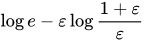
The lower bound for the representation size depends on m and n. Let m = (1+ε) n and h a perfect hash function. A good approximation for the lower bound is Bits per element. For minimal perfect hashing, ε = 0, the lower bound is log e ≈ 1.44 bits per element.[4]
Construction
[edit]A perfect hash function for a specific set S that can be evaluated in constant time, and with values in a small range, can be found by a randomized algorithm in a number of operations that is proportional to the size of S. The original construction of Fredman, Komlós & Szemerédi (1984) uses a two-level scheme to map a set S of n elements to a range of O(n) indices, and then map each index to a range of hash values. The first level of their construction chooses a large prime p (larger than the size of the universe from which S is drawn), and a parameter k, and maps each element x of S to the index

If k is chosen randomly, this step is likely to have collisions, but the number of elements ni that are simultaneously mapped to the same index i is likely to be small. The second level of their construction assigns disjoint ranges of O(ni2) integers to each index i. It uses a second set of linear modular functions, one for each index i, to map each member x of S into the range associated with g(x).[2]
As Fredman, Komlós & Szemerédi (1984) show, there exists a choice of the parameter k such that the sum of the lengths of the ranges for the n different values of g(x) is O(n). Additionally, for each value of g(x), there exists a linear modular function that maps the corresponding subset of S into the range associated with that value. Both k, and the second-level functions for each value of g(x), can be found in polynomial time by choosing values randomly until finding one that works.[2]
The hash function itself requires storage space O(n) to store k, p, and all of the second-level linear modular functions. Computing the hash value of a given key x may be performed in constant time by computing g(x), looking up the second-level function associated with g(x), and applying this function to x. A modified version of this two-level scheme with a larger number of values at the top level can be used to construct a perfect hash function that maps S into a smaller range of length n + o(n).[2]
A more recent method for constructing a perfect hash function is described by Belazzougui, Botelho & Dietzfelbinger (2009) as "hash, displace, and compress". Here a first-level hash function g is also used to map elements onto a range of r integers. An element x ∈ S is stored in the Bucket Bg(x).[4]
Then, in descending order of size, each bucket's elements are hashed by a hash function of a sequence of independent fully random hash functions (Φ1, Φ2, Φ3, ...), starting with Φ1. If the hash function does not produce any collisions for the bucket, and the resulting values are not yet occupied by other elements from other buckets, the function is chosen for that bucket. If not, the next hash function in the sequence is tested.[4]
To evaluate the perfect hash function h(x) one only has to save the mapping σ of the bucket index g(x) onto the correct hash function in the sequence, resulting in h(x) = Φσ(g(x)).[4]
Finally, to reduce the representation size, the (σ(i))0 ≤ i < r are compressed into a form that still allows the evaluation in O(1).[4]
This approach needs linear time in n for construction, and constant evaluation time. The representation size is in O(n), and depends on the achieved range. For example, with m = 1.23n Belazzougui, Botelho & Dietzfelbinger (2009) achieved a representation size between 3.03 bits/key and 1.40 bits/key for their given example set of 10 million entries, with lower values needing a higher computation time. The space lower bound in this scenario is 0.88 bits/key.[4]
 | This section is missing information about RecSplit & "fingerprinting" recsplit paper. (March 2023) |
Pseudocode
[edit]algorithm hash, displace, and compress is (1) Split S into buckets Bi := g−1({i})∩S,0 ≤ i < r (2) Sort buckets Bi in falling order according to size |Bi| (3) Initialize array T[0...m-1] with 0's (4) for all i ∈[r], in the order from (2), do (5) for l ← 1,2,... (6) repeat forming Ki ← {Φl(x)|x ∈ Bi} (6) until |Ki|=|Bi| and Ki∩{j|T[j]=1}= ∅ (7) let σ(i):= the successful l (8) for all j ∈ Ki let T[j]:= 1 (9) Transform (σi)0≤i<r into compressed form, retaining O(1) access.
Space lower bounds
[edit]The use of O(n) words of information to store the function of Fredman, Komlós & Szemerédi (1984) is near-optimal: any perfect hash function that can be calculated in constant time requires at least a number of bits that is proportional to the size of S.[5]
For minimal perfect hash functions the information theoretic space lower bound is
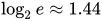
bits/key.[4]
For perfect hash functions, it is first assumed that the range of h is bounded by n as m = (1+ε) n. With the formula given by Belazzougui, Botelho & Dietzfelbinger (2009) and for a universe whose size |U| = u tends towards infinity, the space lower bounds is

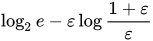
bits/key, minus log(n) bits overall.[4]
Extensions
[edit]Dynamic perfect hashing
[edit]Using a perfect hash function is best in situations where there is a frequently queried large set, S, which is seldom updated. This is because any modification of the set S may cause the hash function to no longer be perfect for the modified set. Solutions which update the hash function any time the set is modified are known as dynamic perfect hashing,[1] but these methods are relatively complicated to implement.
Minimal perfect hash function
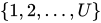
[edit]A minimal perfect hash function is a perfect hash function that maps n keys to n consecutive integers – usually the numbers from 0 to n − 1 or from 1 to n. A more formal way of expressing this is: Let j and k be elements of some finite set S. Then h is a minimal perfect hash function if and only if h(j) = h(k) implies j = k (injectivity) and there exists an integer a such that the range of h is a..a + |S| − 1. It has been proven that a general purpose minimal perfect hash scheme requires at least bits/key.[4] Assuming that is a set of size containing integers in the range , it is known how to efficiently construct an explicit minimal perfect hash function from to that uses space bits and that supports constant evaluation time.[6] In practice, there are minimal perfect hashing schemes that use roughly 1.56 bits/key if given enough time.[7][8]


![{\displaystyle [1,2^{o(n)}]}](https://wikimedia.org/api/rest_v1/media/math/render/svg/f0ac67d15f0cd602c935e60c92e1d2cf4bb68bff)


k-perfect hashing
[edit]A hash function is k-perfect if at most k elements from S are mapped onto the same value in the range. The "hash, displace, and compress" algorithm can be used to construct k-perfect hash functions by allowing up to k collisions. The changes necessary to accomplish this are minimal, and are underlined in the adapted pseudocode below:
(4) for all i ∈[r], in the order from (2), do
(5)     for l ← 1,2,...
(6)         repeat forming Ki ← {Φl(x)|x ∈ Bi}
(6)         until |Ki|=|Bi| and Ki∩{j|T[j]=k}= ∅
(7)     let σ(i):= the successful l
(8)     for all j ∈ Ki set T[j]←T[j]+1
Order preservation
[edit]A minimal perfect hash function F is order preserving if keys are given in some order a1, a2, ..., an and for any keys aj and ak, j < k implies F(aj) < F(ak).[9] In this case, the function value is just the position of each key in the sorted ordering of all of the keys. A simple implementation of order-preserving minimal perfect hash functions with constant access time is to use an (ordinary) perfect hash function to store a lookup table of the positions of each key. This solution uses bits, which is optimal in the setting where the comparison function for the keys may be arbitrary.[10] However, if the keys a1, a2, ..., an are integers drawn from a universe , then it is possible to construct an order-preserving hash function using only bits of space.[11] Moreover, this bound is known to be optimal.[12]


Related constructions
[edit]While well-dimensioned hash tables have amortized average O(1) time (amortized average constant time) for lookups, insertions, and deletion, most hash table algorithms suffer from possible worst-case times that take much longer. A worst-case O(1) time (constant time even in the worst case) would be better for many applications (including network router and memory caches).[13]: 41
Few hash table algorithms support worst-case O(1) lookup time (constant lookup time even in the worst case). The few that do include: perfect hashing; dynamic perfect hashing; cuckoo hashing; hopscotch hashing; and extendible hashing.[13]: 42–69
A simple alternative to perfect hashing, which also allows dynamic updates, is cuckoo hashing. This scheme maps keys to two or more locations within a range (unlike perfect hashing which maps each key to a single location) but does so in such a way that the keys can be assigned one-to-one to locations to which they have been mapped. Lookups with this scheme are slower, because multiple locations must be checked, but nevertheless take constant worst-case time.[14]
References
[edit]- ^ a b Dietzfelbinger, Martin; Karlin, Anna; Mehlhorn, Kurt; Meyer auf der Heide, Friedhelm; Rohnert, Hans; Tarjan, Robert E. (1994), "Dynamic perfect hashing: upper and lower bounds", SIAM Journal on Computing, 23 (4): 738–761, doi:10.1137/S0097539791194094, MR 1283572.
- ^ a b c d e Fredman, Michael L.; Komlós, János; Szemerédi, Endre (1984), "Storing a Sparse Table with O(1) Worst Case Access Time", Journal of the ACM, 31 (3): 538, doi:10.1145/828.1884, MR 0819156, S2CID 5399743
- ^ Lu, Yi; Prabhakar, Balaji; Bonomi, Flavio (2006), "Perfect Hashing for Network Applications", 2006 IEEE International Symposium on Information Theory, pp. 2774–2778, doi:10.1109/ISIT.2006.261567, ISBN 1-4244-0505-X, S2CID 1494710
- ^ a b c d e f g h i j k l Belazzougui, Djamal; Botelho, Fabiano C.; Dietzfelbinger, Martin (2009), "Hash, displace, and compress" (PDF), Algorithms - ESA 2009 (PDF), Lecture Notes in Computer Science, vol. 5757, Berlin: Springer, pp. 682–693, CiteSeerX 10.1.1.568.130, doi:10.1007/978-3-642-04128-0_61, ISBN 978-3-642-04127-3, MR 2557794.
- ^ Fredman, Michael L.; Komlós, János (1984), "On the size of separating systems and families of perfect hash functions", SIAM Journal on Algebraic and Discrete Methods, 5 (1): 61–68, doi:10.1137/0605009, MR 0731857.
- ^ Hagerup, Torben; Tholey, Torsten (2001), "Efficient Minimal Perfect Hashing in Nearly Minimal Space", STACS 2001, Berlin, Heidelberg: Springer Berlin Heidelberg, pp. 317–326, doi:10.1007/3-540-44693-1_28, ISBN 978-3-540-41695-1, retrieved 2023-11-12
- ^ Esposito, Emmanuel; Mueller Graf, Thomas; Vigna, Sebastiano (2020), "RecSplit: Minimal Perfect Hashing via Recursive Splitting", 2020 Proceedings of the Symposium on Algorithm Engineering and Experiments (ALENEX), Proceedings, pp. 175–185, arXiv:1910.06416, doi:10.1137/1.9781611976007.14.
- ^ minimal-perfect-hash (GitHub)
- ^ Jenkins, Bob (14 April 2009), "order-preserving minimal perfect hashing", in Black, Paul E. (ed.), Dictionary of Algorithms and Data Structures, U.S. National Institute of Standards and Technology, retrieved 2013-03-05
- ^ Fox, Edward A.; Chen, Qi Fan; Daoud, Amjad M.; Heath, Lenwood S. (July 1991), "Order-preserving minimal perfect hash functions and information retrieval" (PDF), ACM Transactions on Information Systems, 9 (3), New York, NY, USA: ACM: 281–308, doi:10.1145/125187.125200, S2CID 53239140.
- ^ Belazzougui, Djamal; Boldi, Paolo; Pagh, Rasmus; Vigna, Sebastiano (November 2008), "Theory and practice of monotone minimal perfect hashing", Journal of Experimental Algorithmics, 16, Art. no. 3.2, 26pp, doi:10.1145/1963190.2025378, S2CID 2367401.
- ^ Assadi, Sepehr; Farach-Colton, Martín; Kuszmaul, William (January 2023), "Tight Bounds for Monotone Minimal Perfect Hashing", Proceedings of the 2023 Annual ACM-SIAM Symposium on Discrete Algorithms (SODA), Philadelphia, PA: Society for Industrial and Applied Mathematics, pp. 456–476, arXiv:2207.10556, doi:10.1137/1.9781611977554.ch20, ISBN 978-1-61197-755-4, retrieved 2023-04-27
- ^ a b Timothy A. Davis. "Chapter 5 Hashing": subsection "Hash Tables with Worst-Case O(1) Access"
- ^ Pagh, Rasmus; Rodler, Flemming Friche (2004), "Cuckoo hashing", Journal of Algorithms, 51 (2): 122–144, doi:10.1016/j.jalgor.2003.12.002, MR 2050140.
Further reading
[edit]- Richard J. Cichelli. Minimal Perfect Hash Functions Made Simple, Communications of the ACM, Vol. 23, Number 1, January 1980.
- Thomas H. Cormen, Charles E. Leiserson, Ronald L. Rivest, and Clifford Stein. Introduction to Algorithms, Third Edition. MIT Press, 2009. ISBN 978-0262033848. Section 11.5: Perfect hashing, pp. 267, 277–282.
- Fabiano C. Botelho, Rasmus Pagh and Nivio Ziviani. "Perfect Hashing for Data Management Applications".
- Fabiano C. Botelho and Nivio Ziviani. "External perfect hashing for very large key sets". 16th ACM Conference on Information and Knowledge Management (CIKM07), Lisbon, Portugal, November 2007.
- Djamal Belazzougui, Paolo Boldi, Rasmus Pagh, and Sebastiano Vigna. "Monotone minimal perfect hashing: Searching a sorted table with O(1) accesses". In Proceedings of the 20th Annual ACM-SIAM Symposium On Discrete Mathematics (SODA), New York, 2009. ACM Press.
- Marshall D. Brain and Alan L. Tharp. "Near-perfect Hashing of Large Word Sets". Software—Practice and Experience, vol. 19(10), 967-078, October 1989. John Wiley & Sons.
- Douglas C. Schmidt, GPERF: A Perfect Hash Function Generator, C++ Report, SIGS, Vol. 10, No. 10, November/December, 1998.
- Hans-Peter Lehmann, Thomas Mueller, Rasmus Pagh, Giulio Ermanno Pibiri, Peter Sanders, Sebastiano Vigna, Stefan Walzer, "Modern Minimal Perfect Hashing: A Survey", arXiv:2506.06536, June 2025. Discusses post-1997 developments in the field.
External links
[edit]- gperf is an open source C and C++ perfect hash generator (very fast, but only works for small sets)
- Minimal Perfect Hashing (bob algorithm) by Bob Jenkins
- cmph: C Minimal Perfect Hashing Library, open source implementations for many (minimal) perfect hashes (works for big sets)
- Sux4J: open source monotone minimal perfect hashing in Java
- MPHSharp: perfect hashing methods in C#
- BBHash: minimal perfect hash function in header-only C++
- Perfect::Hash, perfect hash generator in Perl that makes C code. Has a "prior art" section worth looking at.
Perfect hash function
View on GrokipediaFundamentals
Definition
A perfect hash function for a finite set of keys is defined as a hash function that is injective, mapping each distinct element in to a unique integer in the range with no collisions among elements of .[6] This ensures that every key in hashes to a distinct slot, enabling constant-time lookups without the need for collision resolution mechanisms like chaining or open addressing.[7] Perfect hash functions are specifically tailored for static sets , meaning the set of keys is predefined, fixed, and unchanging after the function is constructed; the hash function itself is typically generated in advance using complete knowledge of .[8] For efficiency, the range size is often chosen to be approximately equal to or slightly larger, allowing for compact storage while maintaining the injectivity property.[2] As a simple illustration, consider the set . A perfect hash function could assign , , and , with , resulting in a minimal perfect hash that bijectively maps to the range without collisions.Properties
A perfect hash function for a static set of keys is injective on , ensuring that for all distinct .[4] This injectivity guarantees collision-free mapping to a range of size , where the pigeonhole principle necessitates to avoid forcing at least two keys into the same slot.[9] The evaluation of enables constant-time lookups in the worst case, as each key hashes directly to a unique index in an array of size , allowing immediate access without probing or chaining.[4] This O(1) performance stems from the direct indexing after hashing, contrasting with general hash tables that may require additional collision resolution steps.[10] Perfect hash functions require space for the underlying hash table, typically storing to slots to accommodate the keys, in addition to the space needed to represent the hash function parameters themselves.[4] Minimal perfect hashes achieve exactly slots when , optimizing space for dense storage while maintaining injectivity.[11] These functions are inherently static, designed for a fixed set with no native support for insertions or deletions; any change to requires recomputing and rebuilding the entire hash function and table.[10] This limitation arises from the construction process, which tailors specifically to the given keys to ensure perfect injectivity.[11] Many constructions of perfect hash functions incorporate randomization, selecting hash parameters from a universal family to achieve injectivity with high probability during the build phase, thereby enabling efficient probabilistic algorithms for table creation.[4] This randomized approach succeeds in producing a valid with probability approaching 1 as grows, balancing construction time with reliability.[10]Applications
Traditional Uses
Perfect hash functions have been traditionally employed in database indexing for static lookup tables, enabling fast key-value retrieval without the need for collision resolution mechanisms such as chaining or open addressing. In relational databases, they map fixed sets of keys to unique indices, reducing query times to constant worst-case performance by ensuring no collisions occur during access. This approach is particularly beneficial for data warehouses where foreign keys, such as geographical coordinates, can be compressed into hash values, avoiding expensive joins and minimizing storage overhead for unchanging datasets.[12] In compiler design, perfect hash functions are utilized for symbol tables to map reserved keywords or tokens to indices, facilitating constant-time checks during syntax analysis. By providing an injective mapping for a static set of identifiers, they guarantee O(1) worst-case lookup time, which is essential for efficient lexical processing in production compilers. This eliminates the overhead of probing or linked lists, making them ideal for environments where the symbol set remains fixed throughout compilation.[13] Network routing applications leverage perfect hash functions for static routing tables in routers, performing efficient IP address lookups to forward packets without collision-induced delays. These functions enable wire-speed operations by minimizing memory accesses to a single probe, supporting high-throughput tasks like route lookups and packet classification on large, unchanging address sets. For instance, in flow state maintenance, they encode millions of entries compactly, approaching information-theoretic space bounds while maintaining predictable performance.[14] A representative example is their use in spell-checkers, where a perfect hash function maps a fixed dictionary of words to unique slots, allowing O(1) existence queries to verify spelling rapidly without collision handling. This static mapping ensures minimal space usage and fast retrieval for unchanging word lists, underscoring the broader benefit of perfect hashing in eliminating collision resolution entirely for predefined key sets.[15]Modern Applications
In big data processing frameworks like Apache Spark and Hadoop, perfect hash functions facilitate efficient partitioning of static datasets and accelerate joins on predefined keys by ensuring collision-free mappings for known key sets, thereby minimizing overhead in distributed environments. For instance, the Hadoop Perfect File (HPF) employs perfect hashing to enable direct metadata access without additional indirection, reducing latency for large-scale file operations on static data structures. This approach is particularly valuable for partitioning immutable datasets, where keys such as user IDs or file identifiers remain fixed, allowing for O(1) lookups during join operations across clusters. In machine learning, perfect hash functions support static embedding of categorical features by providing collision-free mappings in high-dimensional spaces, which is essential for models like decision trees and ranking systems to maintain accuracy without resolution overhead. A notable application appears in large-scale ranking models, such as LinkedIn's LiRank, where minimal perfect hashing converts string-based ID features (e.g., user or item identifiers) to dense integer indices, achieving up to 100x memory reduction in vocabulary lookups while preserving model performance.[16] Similarly, ensemble deep learning models for prediction tasks utilize perfect hashing to store categorical values efficiently, cutting memory consumption and enabling scalable training on sparse datasets without collisions.[17] In AI model serving, particularly for natural language processing pipelines, perfect hash functions aid tensor indexing of static vocabularies, such as those in BERT tokenizers, by compressing lookup tables while guaranteeing O(1) access times. The CARAMEL structure, for example, leverages compressed static functions akin to minimal perfect hashing to represent tokenized text matrices, achieving 1.25-16x space savings on datasets like MSMarco and enabling faster inference in resource-constrained serving environments.[18] In bioinformatics, perfect hash functions are used for efficient storage and retrieval of k-mer sequences from genomic data. They enable collision-free indexing of static sets of short DNA substrings (k-mers), supporting fast membership queries and space-efficient representation in applications like genome assembly, read mapping, and variant detection, where large unchanging datasets require optimal query performance.[19]Construction Methods
Basic Approaches
One foundational method for constructing perfect hash functions is the two-level hashing scheme, which partitions the input set of elements into buckets using a first-level hash function and ensures injectivity within each bucket via second-level functions. In this approach, the first-level hash maps elements to buckets, ideally with small bucket sizes to facilitate perfect secondary hashing. For each bucket , a dedicated second-level hash maps its elements injectively to a small range, such as where is the bucket size, avoiding collisions within the bucket while the overall structure guarantees no global collisions.[4] The construction often employs a trial-and-error process to select suitable hash functions, particularly when using universal hashing families. Randomly chosen first-level hashes are tested until the resulting buckets satisfy a condition like for some constant , ensuring the total space remains ; this succeeds with constant probability (e.g., at least ), yielding expected construction time. For the second level, similar trials find collision-free for each small bucket, with expected time per bucket. In the two-level scheme, a suitable choice of keeps bucket sizes small with high probability, enabling secondary perfect hashing.[4] For small sets where is limited (e.g., up to a few hundred elements), deterministic construction via exhaustive search over simple polynomial hash functions is feasible and avoids randomization. Consider keys as integers in a universe , and search over linear forms where is a prime slightly larger than (e.g., the next prime after ), enumerating pairs from until the mapping is injective on . This brute-force method succeeds in polynomial time for small , as the search space is manageable and existence is guaranteed by the pigeonhole principle for sufficiently large .[20] The seminal historical approach, introduced by Fredman, Komlós, and Szemerédi in 1984, formalized the two-level scheme with universal hashing to achieve space and expected construction time with high probability, enabling constant-time lookups for static sets while bounding the maximum bucket size to whp. This method laid the groundwork for efficient perfect hashing in practice, influencing subsequent developments in data structure design.[4]Advanced Algorithms
One advanced technique for constructing perfect hash functions involves recursive or multilevel schemes that build upon basic two-level approaches to enhance space efficiency, particularly for large static sets. In the multilevel adaptive hashing method proposed by Broder and Karlin in 1990, the key set is partitioned into smaller subsets at each level using universal hash functions, with subsequent levels recursively applying perfect hashing to resolve collisions within those subsets. This hierarchical structure allows for amortized space usage close to the information-theoretic minimum of approximately bits per key, where is the number of keys, by limiting the depth of recursion and rebalancing subtrees as needed during construction. The expected construction time is , with lookup time remaining constant, making it suitable for scenarios where initial space overhead must be minimized without sacrificing performance.[21] Graph-based approaches model the perfect hashing problem as finding a collision-free assignment in a bipartite graph, where one partite set represents the keys and the other represents the hash slots, with edges defined by possible hash function outputs. For instance, in cuckoo hashing derivatives like the Hash, Displace, and Compress (CHD) algorithm by Belazzougui, Botelho, and Dietzfelbinger (2009), keys are initially hashed into buckets, and a bipartite matching is computed to displace and reassign keys to ensure no collisions, using random hash functions to generate candidate edges. This method achieves expected linear construction time and space as low as approximately 2.7 bits per key for minimal perfect hashing (m = n). Such techniques excel in scalability for dense graphs, avoiding exhaustive search through iterative augmenting path finding similar to Hopcroft-Karp algorithms.[22] Recent advances leverage succinct data structures to approach near-minimal space bounds while maintaining fast construction and query times. The 2009 work by Belazzougui et al. on CHD integrates succinct representations of the matching graph, enabling perfect hash functions that use only 0.67 bits per key for load factor α = 0.5 (m = 2n), with extensions in subsequent research incorporating rank-select queries on bit vectors for constant-time access. Building on this, 2021 developments, such as those in PTHash by Pibiri and Venturini, refine fingerprint-based methods with succinct encodings to reduce space to 2.6 bits per key on average for minimal cases, supporting parallel construction for sets up to billions of elements. Recent works as of 2025, including RecSplit and SHArc, achieve near-optimal space close to 1.44 bits per key with practical construction times. These approaches prioritize theoretical optimality, with failure probabilities bounded by the graph's expansion properties.[23][5] Randomized algorithms form the backbone of many advanced constructions, offering tunable failure probabilities to balance space and reliability. A typical scheme selects hash functions from a universal family such that the probability of any two keys colliding is , leading to an overall failure probability of for the entire set; setting yields a constant success probability greater than 1/2, with retries ensuring high reliability. Construction proceeds in expected time via sequential trial of hash pairs until a collision-free mapping is found, often accelerated by peeling or splitting techniques in graph models. This probabilistic framework underpins scalable implementations without deterministic guarantees, but with overwhelmingly low failure rates in practice. A notable example of these advanced methods in application is BBHash, a parallel implementation from the late 2010s onward, optimized for terabyte-scale static sets in genomic data indexing. BBHash employs a binary splitting variant of recursive hashing with Bloom filter-inspired bucketing to construct minimal perfect hash functions for up to k-mers in under 7 minutes on multi-core systems, achieving space efficiency of about 2.7 bits per key while enabling fast lookups for sequence alignment tasks. Its design integrates randomized selection with succinct storage, making it particularly effective for bioinformatics pipelines handling massive, unstructured datasets.[24]Implementation Examples
One common implementation approach for perfect hash functions is the two-level hashing scheme, originally proposed by Fredman, Komlós, and Szemerédi, which constructs a hash table with a top-level hash function partitioning the key set into buckets and secondary hash functions ensuring no collisions within each bucket.[4] This method achieves expected linear construction time by randomly selecting the top-level function and iteratively trying secondary functions until perfection is achieved for small buckets.[4] The following pseudocode outlines the build process for a two-level perfect hash function h over a static set S of n keys, assuming a universal hash family for selection:function build_phf(S):
m = O(n) // Number of primary buckets, typically 3n or similar
repeat:
select random h1 from universal family: U → [0, m-1]
buckets = empty list of m lists
for each key x in S:
append x to buckets[h1(x)]
if max bucket size r ≤ some small constant (e.g., 10):
break // Likely to succeed with high probability
for i = 0 to m-1:
if buckets[i] non-empty:
repeat:
select random h2_i from universal family: U → [0, r_i^2 - 1] where r_i = |buckets[i]|
secondary_table_i = array of size r_i^2
collisions = false
for each x in buckets[i]:
pos = h2_i(x)
if secondary_table_i[pos] occupied:
collisions = true
break
secondary_table_i[pos] = x // Or index of x
if no collisions:
break // Perfect for this bucket
return h where h(x) = h1(x) * max_r^2 + h2_{h1(x)}(x)
function build_phf(S):
    m = O(n)  // Number of primary buckets, typically 3n or similar
    repeat:
        select random h1 from universal family: U → [0, m-1]
        buckets = empty list of m lists
        for each key x in S:
            append x to buckets[h1(x)]
        if max bucket size r ≤ some small constant (e.g., 10):
            break  // Likely to succeed with high probability
    for i = 0 to m-1:
        if buckets[i] non-empty:
            repeat:
                select random h2_i from universal family: U → [0, r_i^2 - 1] where r_i = |buckets[i]|
                secondary_table_i = array of size r_i^2
                collisions = false
                for each x in buckets[i]:
                    pos = h2_i(x)
                    if secondary_table_i[pos] occupied:
                        collisions = true
                        break
                    secondary_table_i[pos] = x  // Or index of x
                if no collisions:
                    break  // Perfect for this bucket
    return h where h(x) = h1(x) * max_r^2 + h2_{h1(x)}(x)
def find_perfect_hash(S, m):
    n = len(S)
    for p in primes_greater_than(max(S)):  # e.g., next primes after max key
        for a in range(1, p):
            for b in range(p):
                h_values = [( (a * x + b) % p ) % m for x in S]
                if len(set(h_values)) == n:  # No collisions
                    return [lambda](/page/Lambda) x: ( (a * x + b) % p ) % m, a, b, p
    return None  # Retry with larger primes if needed

S = [10, 100, 32, 45]
h, a, b, p = find_perfect_hash(S, 4)
# Verified example with p=47, a=5, b=1: h(10)=0, h(100)=3, h(32)=2, h(45)=1 (distinct)
def find_perfect_hash(S, m):
    n = len(S)
    for p in primes_greater_than(max(S)):  # e.g., next primes after max key
        for a in range(1, p):
            for b in range(p):
                h_values = [( (a * x + b) % p ) % m for x in S]
                if len(set(h_values)) == n:  # No collisions
                    return [lambda](/page/Lambda) x: ( (a * x + b) % p ) % m, a, b, p
    return None  # Retry with larger primes if needed

S = [10, 100, 32, 45]
h, a, b, p = find_perfect_hash(S, 4)
# Verified example with p=47, a=5, b=1: h(10)=0, h(100)=3, h(32)=2, h(45)=1 (distinct)
def verify_perfect(h, S):
    hashes = [h(s) for s in S]
    return len(set(hashes)) == len(S) and max(hashes) < table_size  # Also check range if minimal
def verify_perfect(h, S):
    hashes = [h(s) for s in S]
    return len(set(hashes)) == len(S) and max(hashes) < table_size  # Also check range if minimal
Theoretical Analysis
Performance Characteristics
Perfect hash functions offer strictly O(1) worst-case evaluation time for computing h(x) and performing lookups, regardless of the set size n, due to their collision-free mapping that enables direct array access without additional probing or resolution steps.[4] This constant-time performance holds across implementations, as the hash computation typically involves a fixed number of arithmetic operations independent of n.[27] Construction time for perfect hash functions depends on the algorithm's design. Randomized methods, exemplified by the Fredman-Komlós-Szemerédi (FKS) scheme, achieve expected O(n) time by iteratively selecting hash functions and building auxiliary tables.[4] Some early deterministic constructions incur O(n^2) worst-case time, while modern derandomized approaches achieve O(n log n).[28] Modern variants like SIMDRecSplit further optimize expected construction to linear time with high practical throughput, processing up to 10 million keys per second on multi-core systems.[27] In practice, perfect hash functions deliver high lookup throughput for static datasets on contemporary hardware. Implementations such as PtrHash achieve approximately 40 million queries per second at 2.2 bits per key on Intel i7 processors, leveraging SIMD instructions for rapid evaluation.[27] Empirical benchmarks from 2023-2024 studies demonstrate that perfect hashing outperforms standard hash tables by 1.7x to 3.1x in query speed for n ≈ 10^6, particularly in memory-bound workloads like database joins and aggregations, where reduced cache misses contribute to the gains.[29] A key trade-off in perfect hashing lies between construction speed and representation size: algorithms prioritizing rapid building, such as PtrHash with approximately 80 million keys per second, tend to use more space (e.g., 3 bits per key), while space-minimal methods like CONSENSUS-RecSplit (1.44 bits per key) require proportionally longer construction to optimize density.[27] This balance allows selection based on application constraints, with faster builders suiting one-time preprocessing and compact representations favoring space-constrained environments.[27]Space Bounds
A perfect hash function for a static set of n keys into a range of size m ≥ n must distinguish among P(m, n) = m! / (m - n)! possible injective mappings, implying a lower bound of at least \log_2 P(m, n) bits on the space required to represent the function. When m ≫ n, this bound simplifies to approximately n \log_2 m bits total, or \log_2 m bits per key. For the minimal case where m = n, the bound becomes \log_2 (n!) bits, which by Stirling's approximation is roughly n \log_2 n bits naively, though more precise expansions reveal additional terms. For minimal perfect hashing (m = n), information-theoretic analysis establishes a tighter worst-case lower bound of approximately 1.44 n bits total (or 1.44 bits per key), arising from the fundamental limits on encoding injective mappings for arbitrary key sets drawn from large universes. This bound, derived from counting arguments on the size of separating systems necessary to ensure perfect hashing across possible sets, demonstrates that there exist key sets for which no representation of a minimal perfect hash function can use less space. The entropy argument underlying this impossibility result considers the uniform distribution over random injections: any description must capture at least the irreducible entropy associated with distinguishing n! possible permutations, with the dominant constant term yielding \log_2 e \cdot n \approx 1.44 n bits after accounting for higher-order contributions in the expansion. In the general case (m > n), a related lower bound on space per key is given by \frac{1}{n} \log_2 \binom{m}{n} \approx \log_2 e \cdot \left(1 + \frac{1}{n} + \cdots \right) bits for large n, reflecting the minimal bits needed to select and assign distinct positions under high load factors approaching 1. Advanced construction methods, such as those based on acyclic random graphs or recursive splitting, achieve upper bounds of O(n) bits total for the hash function description in expectation, significantly below the naive n \log n while supporting constant-time evaluation. Succinct variants further close the gap to the lower bound, with recent algorithms attaining around 1.52 bits per key for large n using techniques like recursive sampling and bounded disorder.Variants and Extensions
Dynamic Perfect Hashing
Dynamic perfect hashing adapts the principles of static perfect hashing to handle dynamic sets that undergo insertions and deletions, aiming to maintain low collision rates while supporting efficient updates. Unlike static perfect hashing, which assumes a fixed set and guarantees no collisions, dynamic variants allow the key set to change over time but may permit a small probability of collisions to accommodate modifications without excessive rebuilding costs. This approach ensures that membership queries remain fast, typically with expected constant-time performance, even as the set evolves.[30] A seminal scheme for dynamic perfect hashing was introduced by Dietzfelbinger et al. in 1988, building on the static Fredman-Komlós-Szemerédi (FKS) method. The approach employs expandable hashing structures, where the hash table grows dynamically, and periodic rebuilding occurs to rehash the keys when the load factor increases. Specifically, it uses a two-level hashing mechanism: a top-level universal hash function maps keys to buckets, each containing a secondary perfect hash table that is rebuilt as needed. To handle growth, multiple candidate hash functions are sampled randomly during rehashing, selecting one that minimizes collisions for the current set. This FKS dynamic variant ensures amortized O(1) time for insertions and deletions, as rebuilding is infrequent and amortized over many operations.[30] The space-time trade-offs in this scheme are favorable for practical use, requiring O(n) space for a set of size n, while achieving O(1) expected time for lookups and O(1) amortized time for updates. Lookups involve probing the top-level hash and then the secondary structure, with high probability of no collisions due to the careful selection of hash functions. However, the scheme is not strictly perfect following updates, as temporary collisions may arise during the transition periods before rebuilding; the probability of such collisions is bounded by O(1/n), ensuring overall reliability.[30]Minimal Perfect Hash Functions
A minimal perfect hash function (MPHF) for a static set of distinct keys is a perfect hash function that injectively maps the keys in to the integers , achieving the smallest possible output range without collisions or unused slots.[31][32] This bijection ensures maximal space efficiency in hash tables, as the table size exactly matches the number of keys. The information-theoretic lower bound for representing such a function requires approximately bits, derived from the entropy needed to specify an arbitrary permutation of elements, or bits.[33] Constructions of MPHFs often rely on multi-level hashing schemes or graph-based approaches to approximate this bound while enabling practical generation and lookup. Early methods, such as Cichelli's algorithm, compute a minimal hash by assigning integer values to key prefixes or letters, minimizing the maximum displacement in a linear probing table to ensure injectivity. More advanced succinct constructions, like those integrating fusion tree techniques for sub-logarithmic lookup, achieve space close to bits by encoding parameters efficiently. Tools like GNU gperf automate MPHF generation by exploring parameter spaces for two-level hash functions, producing C code for static keyword lookup with minimal table sizes.[34] In graph-theoretic terms, an MPHF can be represented as a bipartite graph with vertices on each side (keys and slots) and edges, where a perfect matching corresponds to the injection; this graph is encoded using bits via succinct data structures like rank-select arrays on the edge list.[35][36] Such representations facilitate compact storage, as the edges define the hash computation through vertex labeling or neighbor traversal. MPHFs are particularly valuable in memory-constrained environments, such as embedded systems for firmware symbol lookups or compiler reserved word tables, where every bit of storage impacts performance and power usage. For instance, in resource-limited devices, they enable collision-free access to static datasets like protocol headers without bloating ROM.k-Perfect Hashing
A k-perfect hash function maps a static set of distinct keys to a range of integers such that at most keys from map to any single value in the range. This relaxes the zero-collision requirement of standard perfect hashing by permitting small collision sets of size at most , which can be resolved efficiently via local methods like linear probing or small lookup tables.[37] Constructions for k-perfect hash functions often extend the two-level hashing paradigm by designing the first-level hash to limit maximum bucket occupancy to , followed by second-level structures sized accordingly. k-wise independent hash families are employed in the first level to ensure uniform distribution for small groups of keys; these can be realized using polynomials of degree over a suitable finite field. The collision bound follows from the properties of such families: for a first-level hash into buckets, the probability that any specific bucket receives more than keys is , as the tail probability for the occupancy (approximating a Poisson distribution with constant load factor) decays factorially.[37][38] These methods achieve space usage approaching the lower bound of roughly slots, offering significant savings for moderate compared to strict perfect hashing, and prove valuable in approximate dictionaries or space-constrained indexing where occasional small collisions are acceptable.[37] For instance, a 2-perfect hash function suits caching applications, where up to two keys per slot enable fast access with minimal chaining overhead for the rare colliding pair.[37]Order-Preserving Variants
An order-preserving perfect hash function (OPHF) for a static set of keys under a total order is a perfect hash that maps each key to a unique integer in such that if in the order on , then .[39] This preserves the relative ordering of keys in the hash values, enabling both collision-free mapping and sequential access.[40] A simple ranking-based construction sorts the keys in into a list and defines as the position (rank) of in this sorted list, which is 0-based.[41] Evaluation requires binary search on the sorted list to find the rank, taking time, while construction is via sorting. More advanced methods build minimal OPHFs (OPMPHFs) with space closer to the theoretical minimum. The Czech-Havas-Majewski (CHM) algorithm uses an acyclic random bipartite graph where keys connect to intermediate nodes via pseudo-random functions, and final positions are assigned to preserve order while ensuring no collisions; it runs in expected time and space approaching . Fox et al. propose graph-based constructions, including two-level schemes with indirection arrays and random graphs, achieving ratios near 1.22 for space efficiency and average construction time.[39] OPHF constructions like ranking or CHM support applications in static databases for range queries, where successor or predecessor searches can be performed by locating the hash position and scanning sequentially without resorting the entire set.[40] They are particularly useful in information retrieval systems, such as dictionary lookups in inverted indexes (e.g., the CISI collection), enabling one-disk-access direct retrieval while supporting ordered traversal.[39] Space requirements for the ranking method are bits to store the sorted keys, assuming keys from a universe of size polynomial in , with evaluation in time.[41] Minimal variants like CHM or Seiden-Hirschberg's linear algebra approach over finite fields achieve succinct representations near the lower bound, with space ratios as low as 1.01 (using 5 pseudo-random functions) and evaluation in time after or construction.[42] For example, given sorted integer keys , the ranking OPHF yields , , , preserving order and allowing range queries like keys between 15 and 30 to map to positions 1 through 1.[41]Related Concepts
Comparisons with Other Hashing
Perfect hashing differs from universal hashing in its guarantees and applicability. While a perfect hash function ensures no collisions for a fixed static set of keys, achieving collision-free mapping to a range of size comparable to the set, universal hashing provides only probabilistic bounds on collision probabilities, typically bounding the probability of any two keys colliding at 1/m for a table size m. This makes perfect hashing deterministic and optimal for static scenarios but requires preprocessing time to construct the function for the specific set, whereas universal hashing allows for faster, randomized selection without such tailoring and supports dynamic updates.[27] In comparison to cuckoo hashing, both techniques aim for constant-time lookups, but perfect hashing achieves this with a single memory access and no collisions by design for static sets, using space close to the information-theoretic minimum of approximately 1.44 bits per key. Cuckoo hashing, on the other hand, employs multiple hash functions and key relocations (evictions) to resolve collisions, enabling dynamic insertions and deletions at the cost of potentially higher worst-case insertion times and slightly more space (around 1.05 to 2 bits per key at high loads), though it maintains O(1) amortized or worst-case query time.[27] Perfect hashing also contrasts with Bloom filters, which are probabilistic data structures for membership queries. Perfect hashing supports exact membership testing with no false positives or negatives using minimal space, whereas Bloom filters trade exactness for approximation, allowing false positives but no false negatives, and require more space (roughly 1.44 n log(1/ε) bits for n keys and false positive rate ε). Bloom filters are insert-only and dynamic, making them suitable for scenarios where space savings justify the error rate, but perfect hashing excels in precision-critical applications like static dictionaries.[27]| Method | Space (bits/key) | Lookup Time | Dynamism | Collision Handling |
|---|---|---|---|---|
| Perfect Hashing | ~1.44 | O(1) worst-case | Static | None (collision-free) |
| Universal Hashing | Variable (depends on load factor) | O(1) expected | Dynamic | Probabilistic resolution |
| Cuckoo Hashing | ~1.05–2 | O(1) worst-case | Dynamic | Relocation/evictions |
| Bloom Filter | ~1.44 log(1/ε) | O(1) | Insert-only | False positives allowed |