
Recent from talks
Peshtigo fire
Knowledge base stats:
Talk channels stats:
Members stats:
Peshtigo fire
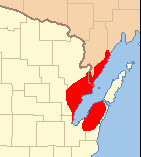
The Peshtigo fire was a large forest fire on October 8, 1871, in northeastern Wisconsin, United States, including much of the southern half of the Door Peninsula and adjacent parts of the Upper Peninsula of Michigan. The largest community in the affected area was Peshtigo, Wisconsin, which had a population of approximately 1,700 residents. The fire burned about 1.2 million acres (490,000 ha) and is the deadliest wildfire in recorded history, with the number of deaths estimated between 1,500 and 2,500. The exact number of deaths is debated. Data from mass graves, both those already exhumed and those still being discovered, show that the death toll of the blaze was most likely greater than the 1889 Johnstown flood death toll of 2,200 people or more.
Occurring on the same day as the more famous Great Chicago Fire, the Peshtigo fire has been largely forgotten, even though it killed at least five times as many people.
Several cities in Michigan, including Holland and Manistee (across Lake Michigan from Peshtigo) and Port Huron (at the southern end of Lake Huron), also had major fires on the same day. These fires, along with many other fires of the 19th century had the same basic causes: small fires coupled with unusually dry weather.
Slash-and-burn land management was a common way to clear forest for farming and railroad construction. On the day of the Peshtigo fire, an eastward-moving cold front increased the wind speed and several slash-and-burn fires merged.
A firestorm ensued. In the words of Gess and Lutz, in a firestorm "superheated flames of at least 2,000 degrees Fahrenheit ... advance on winds of 110 miles per hour or stronger. The diameter of such a fire ranges from one thousand to ten thousand feet ... When a firestorm erupts in a forest, it is a blowup, nature's nuclear explosion ... "
By the time it was over, between 1.2 and 1.5 million acres of land had been burned. In addition to Peshtigo, 16 other communities were destroyed in the fire.
The value of the property and forest that was destroyed in the fire was estimated to be about $5 million US (about $131 million in 2024 dollars). Additionally, 2,000,000 trees, saplings, and animals perished in the fire; this had a devastating economic impact on the area as well.
An accurate death toll has never been determined because all local records were destroyed in the fire. Estimates vary from 1,200 to 2,400 deaths.
Hub AI
Peshtigo fire AI simulator
(@Peshtigo fire_simulator)
Peshtigo fire
The Peshtigo fire was a large forest fire on October 8, 1871, in northeastern Wisconsin, United States, including much of the southern half of the Door Peninsula and adjacent parts of the Upper Peninsula of Michigan. The largest community in the affected area was Peshtigo, Wisconsin, which had a population of approximately 1,700 residents. The fire burned about 1.2 million acres (490,000 ha) and is the deadliest wildfire in recorded history, with the number of deaths estimated between 1,500 and 2,500. The exact number of deaths is debated. Data from mass graves, both those already exhumed and those still being discovered, show that the death toll of the blaze was most likely greater than the 1889 Johnstown flood death toll of 2,200 people or more.
Occurring on the same day as the more famous Great Chicago Fire, the Peshtigo fire has been largely forgotten, even though it killed at least five times as many people.
Several cities in Michigan, including Holland and Manistee (across Lake Michigan from Peshtigo) and Port Huron (at the southern end of Lake Huron), also had major fires on the same day. These fires, along with many other fires of the 19th century had the same basic causes: small fires coupled with unusually dry weather.
Slash-and-burn land management was a common way to clear forest for farming and railroad construction. On the day of the Peshtigo fire, an eastward-moving cold front increased the wind speed and several slash-and-burn fires merged.
A firestorm ensued. In the words of Gess and Lutz, in a firestorm "superheated flames of at least 2,000 degrees Fahrenheit ... advance on winds of 110 miles per hour or stronger. The diameter of such a fire ranges from one thousand to ten thousand feet ... When a firestorm erupts in a forest, it is a blowup, nature's nuclear explosion ... "
By the time it was over, between 1.2 and 1.5 million acres of land had been burned. In addition to Peshtigo, 16 other communities were destroyed in the fire.
The value of the property and forest that was destroyed in the fire was estimated to be about $5 million US (about $131 million in 2024 dollars). Additionally, 2,000,000 trees, saplings, and animals perished in the fire; this had a devastating economic impact on the area as well.
An accurate death toll has never been determined because all local records were destroyed in the fire. Estimates vary from 1,200 to 2,400 deaths.
Recent media