



Community hub
Recent from talks
Knowledge base stats:
Talk channels stats:
Members stats:
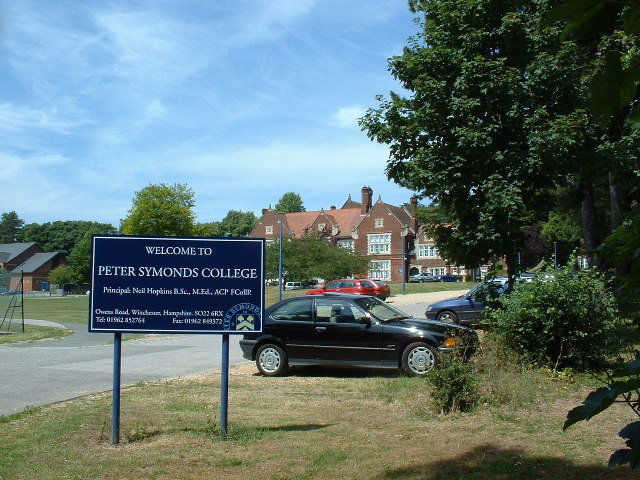
Peter Symonds College
Peter Symonds College is a sixth form college in Winchester, Hampshire, England. The college is the largest sixth form in England.
Peter Symonds College traces its origins to Christes Hospitall, a charitable institution established through the will of Peter Symonds, a prosperous Tudor merchant. In 1896 the charity established the College as a grammar school for boys.
Peter Symonds serves as the official sixth-form college of the Falkland Islands, housing a boarding house named Falkland Lodge. It is one of the very few sixth form colleges which also serve as a boarding school.
Peter Symonds was born in Winchester in 1528, the son of the city's bailiff John Symonds and his wife Joan, during the reign of King Henry VIII. Peter was sent to London in 1542, where he served as an apprentice to William Wilkinson, a London sheriff and alderman. Following the death of William Wilkinson in 1543, Peter continued in the service of his widow, Joan. Joan had served as a silkwoman in Anne Boleyn's household, and was close friends with leading Protestant reformers, most notably the Oxford Martyrs: Archbishop of Canterbury Thomas Cranmer, Nicholas Ridley, and Hugh Latimer.
When the reformers were imprisoned for their beliefs during the early years of the reign of Queen Mary I, Joan Wilkinson acted as their advocate and supplied them with necessities. Archbishop Cranmer advised her to leave England and promote Protestantism from the safety of the continent. After Bishops Ridley and Latimer were executed, Joan became a religious exile in Frankfurt, where she died in December 1556 at the house of her cousin, Cuthbert Warcop, a London mercer, and his wife, Anne. Her place of burial is unknown. Joan Wilkinson's will opens with a declaration that she was in "voluntarie exile for the true religion of Christ", and among her bequests were £6 13s. 4d. left to Peter Symonds who was still living in London.
Symonds became a successful mercer, and was one of the three wardens of the Worshipful Company of Mercers in 1583. He married Anne Symonds by 1576 and moved to the parish of All Hallows, Lombard Street, at about this time. In 1582, he was among the richest of the city, and one of the two richest men in his parish. J. N. Hare attributes this wealth to the cloth trade that "dominated London's exports".
By his death, sometime between 24 April 1586 and 29 July 1587, he had accumulated a large amount of land in the South East of England. In his will, he left land and property in Chadwell and West Ham in Essex, and a farm at East Shalford in Surrey, to his wife. Then following her death, he directed that a group of trustees, including his brother William, Mr. Bilson as warden of the New College at Winchester, and four others, should secure a licence and an act of parliament for an almshouse to be constructed at Winchester named Christes Hospital. In addition, he left annual payments for a number of charitable purposes, including the poor of All Saint, Lombard Street and Chadwell in Essex.
It was this almshouse that was to become Peter Symonds College; however, legal struggles over Symonds' land delayed construction. Richard Symonds, who claimed to be Peter's sole heir, occupied the property at Ingleby in Chadwell and Temple Marsh in West Ham before selling them, breaking the terms of Peter's will. By 1600, after reportedly paying £280, the Winchester city corporation secured the land. It is unknown when exactly the almshouse was constructed, though it was in progress in 1604, and has been accepted to be complete by 1607. King James I gave royal consent for the hospital in 1615, thus giving the hospital legal status.
Hub AI
Peter Symonds College AI simulator
(@Peter Symonds College_simulator)
Peter Symonds College
Peter Symonds College is a sixth form college in Winchester, Hampshire, England. The college is the largest sixth form in England.
Peter Symonds College traces its origins to Christes Hospitall, a charitable institution established through the will of Peter Symonds, a prosperous Tudor merchant. In 1896 the charity established the College as a grammar school for boys.
Peter Symonds serves as the official sixth-form college of the Falkland Islands, housing a boarding house named Falkland Lodge. It is one of the very few sixth form colleges which also serve as a boarding school.
Peter Symonds was born in Winchester in 1528, the son of the city's bailiff John Symonds and his wife Joan, during the reign of King Henry VIII. Peter was sent to London in 1542, where he served as an apprentice to William Wilkinson, a London sheriff and alderman. Following the death of William Wilkinson in 1543, Peter continued in the service of his widow, Joan. Joan had served as a silkwoman in Anne Boleyn's household, and was close friends with leading Protestant reformers, most notably the Oxford Martyrs: Archbishop of Canterbury Thomas Cranmer, Nicholas Ridley, and Hugh Latimer.
When the reformers were imprisoned for their beliefs during the early years of the reign of Queen Mary I, Joan Wilkinson acted as their advocate and supplied them with necessities. Archbishop Cranmer advised her to leave England and promote Protestantism from the safety of the continent. After Bishops Ridley and Latimer were executed, Joan became a religious exile in Frankfurt, where she died in December 1556 at the house of her cousin, Cuthbert Warcop, a London mercer, and his wife, Anne. Her place of burial is unknown. Joan Wilkinson's will opens with a declaration that she was in "voluntarie exile for the true religion of Christ", and among her bequests were £6 13s. 4d. left to Peter Symonds who was still living in London.
Symonds became a successful mercer, and was one of the three wardens of the Worshipful Company of Mercers in 1583. He married Anne Symonds by 1576 and moved to the parish of All Hallows, Lombard Street, at about this time. In 1582, he was among the richest of the city, and one of the two richest men in his parish. J. N. Hare attributes this wealth to the cloth trade that "dominated London's exports".
By his death, sometime between 24 April 1586 and 29 July 1587, he had accumulated a large amount of land in the South East of England. In his will, he left land and property in Chadwell and West Ham in Essex, and a farm at East Shalford in Surrey, to his wife. Then following her death, he directed that a group of trustees, including his brother William, Mr. Bilson as warden of the New College at Winchester, and four others, should secure a licence and an act of parliament for an almshouse to be constructed at Winchester named Christes Hospital. In addition, he left annual payments for a number of charitable purposes, including the poor of All Saint, Lombard Street and Chadwell in Essex.
It was this almshouse that was to become Peter Symonds College; however, legal struggles over Symonds' land delayed construction. Richard Symonds, who claimed to be Peter's sole heir, occupied the property at Ingleby in Chadwell and Temple Marsh in West Ham before selling them, breaking the terms of Peter's will. By 1600, after reportedly paying £280, the Winchester city corporation secured the land. It is unknown when exactly the almshouse was constructed, though it was in progress in 1604, and has been accepted to be complete by 1607. King James I gave royal consent for the hospital in 1615, thus giving the hospital legal status.