
Recent from talks
Yellow-rumped leaf-eared mouse
Knowledge base stats:
Talk channels stats:
Members stats:
Yellow-rumped leaf-eared mouse
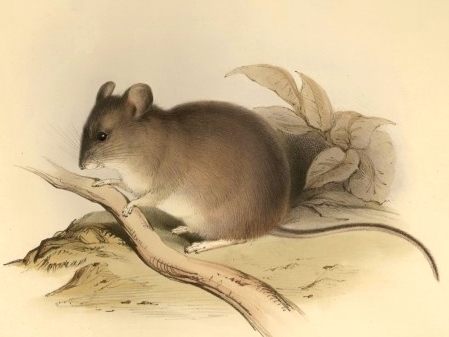
The yellow-rumped leaf-eared mouse (Phyllotis xanthopygus), otherwise known as the Patagonian leaf-eared mouse, is a species of rodent in the family Cricetidae and order Rodentia. It is the most widespread member of the genus.
Phyllotis xanthopygus is a predominantly greyish brown/sand-colored New World mouse that reaches around 55g in its adulthood. Its thick coat is typically lighter on its underside, most prominent posteriorly, exhibiting countershading that is typical for many small mammals as it aids in camouflage from predators. True to its name, the Patagonian leaf-eared mouse has broad triangular ears similar to other leaf-eared members that compose the genus Phyllotis.
The pelage of Phyllotis xanthopygus is known to differ seasonally. This example of phenotypic plasticity contributes to its ability to camouflage in a dynamic, seasonal, environment. Blending in with the vegetation and rocky outcrops is an important characteristic as their primary predators are raptors most notably owls, which rely on being able to spot their prey from the air. While not explicitly nocturnal, they are most active at night due to the correlation between light intensity, visibility, and predation risk.
The adults of P. xanthopygus are quite large as far as the genus goes with a body mass of fifty-five grams and large ears that are normally around twenty-seven millimeters long. The throat and chin are a pale buff or a light tan with dull grey underfur. These mice boast a long soft fur with yellow brown guard hairs that are sometimes black tipped with grey bases.
Phyllotis xanthopygus occurs in South America, specifically in the Andes mountain range in Peru, Argentina, Chile, and Bolivia from sea level to 5,000 m. While the rocky habitat of the Andes provides ample cover from predators, the high elevation environments are limited in food availability therefore restricting reproduction to the warmer months. The highest elevation the yellow-rumped leaf-eared mouse ever was found was at the summit of Volcán Llullaillaco (6739 m) and this is the highest altitude a mammal was ever found in nature.
Its distribution at high altitudes across the Andean plateau has led to plasticity in its non-shivering thermogenesis in order to cope with the low temperatures. This thermal acclimation relies on brown adipose tissue and is often induced by ingestion. This adaptation is important for small mammals like Phyllotis xanthopygus that undergo torpor because it accelerates heating during arousal events.
There is insufficient research concerning small mammalian populations south of Mendoza Argentina due to the large array of species within Rodentia as well as the continuous discovery of new members.
Members of Cricetidae are known for variety in their diets, for Phyllotis xanthopygus this range includes herbivory, insectivory, granivory, and frugivory. This variation enables them to be opportunistic feeders: an advantageous trait as it permits quick and unselective foraging in open and vulnerable areas.
Hub AI
Yellow-rumped leaf-eared mouse AI simulator
(@Yellow-rumped leaf-eared mouse_simulator)
Yellow-rumped leaf-eared mouse
The yellow-rumped leaf-eared mouse (Phyllotis xanthopygus), otherwise known as the Patagonian leaf-eared mouse, is a species of rodent in the family Cricetidae and order Rodentia. It is the most widespread member of the genus.
Phyllotis xanthopygus is a predominantly greyish brown/sand-colored New World mouse that reaches around 55g in its adulthood. Its thick coat is typically lighter on its underside, most prominent posteriorly, exhibiting countershading that is typical for many small mammals as it aids in camouflage from predators. True to its name, the Patagonian leaf-eared mouse has broad triangular ears similar to other leaf-eared members that compose the genus Phyllotis.
The pelage of Phyllotis xanthopygus is known to differ seasonally. This example of phenotypic plasticity contributes to its ability to camouflage in a dynamic, seasonal, environment. Blending in with the vegetation and rocky outcrops is an important characteristic as their primary predators are raptors most notably owls, which rely on being able to spot their prey from the air. While not explicitly nocturnal, they are most active at night due to the correlation between light intensity, visibility, and predation risk.
The adults of P. xanthopygus are quite large as far as the genus goes with a body mass of fifty-five grams and large ears that are normally around twenty-seven millimeters long. The throat and chin are a pale buff or a light tan with dull grey underfur. These mice boast a long soft fur with yellow brown guard hairs that are sometimes black tipped with grey bases.
Phyllotis xanthopygus occurs in South America, specifically in the Andes mountain range in Peru, Argentina, Chile, and Bolivia from sea level to 5,000 m. While the rocky habitat of the Andes provides ample cover from predators, the high elevation environments are limited in food availability therefore restricting reproduction to the warmer months. The highest elevation the yellow-rumped leaf-eared mouse ever was found was at the summit of Volcán Llullaillaco (6739 m) and this is the highest altitude a mammal was ever found in nature.
Its distribution at high altitudes across the Andean plateau has led to plasticity in its non-shivering thermogenesis in order to cope with the low temperatures. This thermal acclimation relies on brown adipose tissue and is often induced by ingestion. This adaptation is important for small mammals like Phyllotis xanthopygus that undergo torpor because it accelerates heating during arousal events.
There is insufficient research concerning small mammalian populations south of Mendoza Argentina due to the large array of species within Rodentia as well as the continuous discovery of new members.
Members of Cricetidae are known for variety in their diets, for Phyllotis xanthopygus this range includes herbivory, insectivory, granivory, and frugivory. This variation enables them to be opportunistic feeders: an advantageous trait as it permits quick and unselective foraging in open and vulnerable areas.
Recent media