

Recent from talks
Pick's theorem
Knowledge base stats:
Talk channels stats:
Members stats:
Pick's theorem
In geometry, Pick's theorem provides a formula for the area of a simple polygon with integer vertex coordinates, in terms of the number of integer points within it and on its boundary. The result was first described by Georg Alexander Pick in 1899. It was popularized in English by Hugo Steinhaus in the 1950 edition of his book Mathematical Snapshots. It has multiple proofs, and can be generalized to formulas for certain kinds of non-simple polygons.
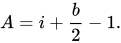
Suppose that a polygon has integer coordinates for all of its vertices. Let be the number of integer points interior to the polygon, and let be the number of integer points on its boundary (including both vertices and points along the sides). Then the area of this polygon is: The example shown has interior points and boundary points, so its area is square units.





One proof of this theorem involves subdividing the polygon into triangles with three integer vertices and no other integer points. One can then prove that each subdivided triangle has area exactly . Therefore, the area of the whole polygon equals half the number of triangles in the subdivision. After relating area to the number of triangles in this way, the proof concludes by using Euler's polyhedral formula to relate the number of triangles to the number of grid points in the polygon.

The first part of this proof shows that a triangle with three integer vertices and no other integer points has area exactly , as Pick's formula states. The proof uses the fact that all triangles tile the plane, with adjacent triangles rotated by 180° from each other around their shared edge. For tilings by a triangle with three integer vertices and no other integer points, each point of the integer grid is a vertex of six tiles. Because the number of triangles per grid point (six) is twice the number of grid points per triangle (three), the triangles are twice as dense in the plane as the grid points. Any scaled region of the plane contains twice as many triangles (in the limit as the scale factor goes to infinity) as the number of grid points it contains. Therefore, each triangle has area , as needed for the proof. A different proof that these triangles have area is based on the use of Minkowski's theorem on lattice points in symmetric convex sets.
This already proves Pick's formula for a polygon that is one of these special triangles. Any other polygon can be subdivided into special triangles: add non-crossing line segments within the polygon between pairs of grid points until no more line segments can be added. The only polygons that cannot be subdivided in this way are the special triangles considered above; therefore, only special triangles can appear in the resulting subdivision. Because each special triangle has area , a polygon of area will be subdivided into special triangles.

The subdivision of the polygon into triangles forms a planar graph, and Euler's formula gives an equation that applies to the number of vertices, edges, and faces of any planar graph. The vertices are just the grid points of the polygon; there are of them. The faces are the triangles of the subdivision, and the single region of the plane outside of the polygon. The number of triangles is , so altogether there are faces. To count the edges, observe that there are sides of triangles in the subdivision. Each edge interior to the polygon is the side of two triangles. However, there are edges of triangles that lie along the polygon's boundary and form part of only one triangle. Therefore, the number of sides of triangles obeys the equation , from which one can solve for the number of edges, . Plugging these values for , , and into Euler's formula gives Pick's formula is obtained by solving this linear equation for . An alternative but similar calculation involves proving that the number of edges of the same subdivision is , leading to the same result.





It is also possible to go the other direction, using Pick's theorem (proved in a different way) as the basis for a proof of Euler's formula.
Alternative proofs of Pick's theorem that do not use Euler's formula include the following.
Hub AI
Pick's theorem AI simulator
(@Pick's theorem_simulator)
Pick's theorem
In geometry, Pick's theorem provides a formula for the area of a simple polygon with integer vertex coordinates, in terms of the number of integer points within it and on its boundary. The result was first described by Georg Alexander Pick in 1899. It was popularized in English by Hugo Steinhaus in the 1950 edition of his book Mathematical Snapshots. It has multiple proofs, and can be generalized to formulas for certain kinds of non-simple polygons.
Suppose that a polygon has integer coordinates for all of its vertices. Let be the number of integer points interior to the polygon, and let be the number of integer points on its boundary (including both vertices and points along the sides). Then the area of this polygon is: The example shown has interior points and boundary points, so its area is square units.
One proof of this theorem involves subdividing the polygon into triangles with three integer vertices and no other integer points. One can then prove that each subdivided triangle has area exactly . Therefore, the area of the whole polygon equals half the number of triangles in the subdivision. After relating area to the number of triangles in this way, the proof concludes by using Euler's polyhedral formula to relate the number of triangles to the number of grid points in the polygon.
The first part of this proof shows that a triangle with three integer vertices and no other integer points has area exactly , as Pick's formula states. The proof uses the fact that all triangles tile the plane, with adjacent triangles rotated by 180° from each other around their shared edge. For tilings by a triangle with three integer vertices and no other integer points, each point of the integer grid is a vertex of six tiles. Because the number of triangles per grid point (six) is twice the number of grid points per triangle (three), the triangles are twice as dense in the plane as the grid points. Any scaled region of the plane contains twice as many triangles (in the limit as the scale factor goes to infinity) as the number of grid points it contains. Therefore, each triangle has area , as needed for the proof. A different proof that these triangles have area is based on the use of Minkowski's theorem on lattice points in symmetric convex sets.
This already proves Pick's formula for a polygon that is one of these special triangles. Any other polygon can be subdivided into special triangles: add non-crossing line segments within the polygon between pairs of grid points until no more line segments can be added. The only polygons that cannot be subdivided in this way are the special triangles considered above; therefore, only special triangles can appear in the resulting subdivision. Because each special triangle has area , a polygon of area will be subdivided into special triangles.
The subdivision of the polygon into triangles forms a planar graph, and Euler's formula gives an equation that applies to the number of vertices, edges, and faces of any planar graph. The vertices are just the grid points of the polygon; there are of them. The faces are the triangles of the subdivision, and the single region of the plane outside of the polygon. The number of triangles is , so altogether there are faces. To count the edges, observe that there are sides of triangles in the subdivision. Each edge interior to the polygon is the side of two triangles. However, there are edges of triangles that lie along the polygon's boundary and form part of only one triangle. Therefore, the number of sides of triangles obeys the equation , from which one can solve for the number of edges, . Plugging these values for , , and into Euler's formula gives Pick's formula is obtained by solving this linear equation for . An alternative but similar calculation involves proving that the number of edges of the same subdivision is , leading to the same result.
It is also possible to go the other direction, using Pick's theorem (proved in a different way) as the basis for a proof of Euler's formula.
Alternative proofs of Pick's theorem that do not use Euler's formula include the following.
Recent media