
Recent from talks
Pistachio
Knowledge base stats:
Talk channels stats:
Members stats:
Pistachio
The pistachio (/pɪˈstɑːʃioʊ, -ˈstæʃ-/, UK also /pɪˈstætʃ(i)oʊ/; Pistacia vera) is a small to medium-sized tree of the cashew family. The tree produces seeds that are widely consumed as food.
In 2022, world production of pistachios was one million tonnes, with the United States, Iran, and Turkey combined accounting for 88% of the total.
The tree grows up to 10 metres (33 feet) tall. It has deciduous, pinnate leaves 10–20 centimetres (4–8 inches) long. The plants are dioecious, with separate male and female trees. The flowers are apetalous and unisexual and borne in panicles.
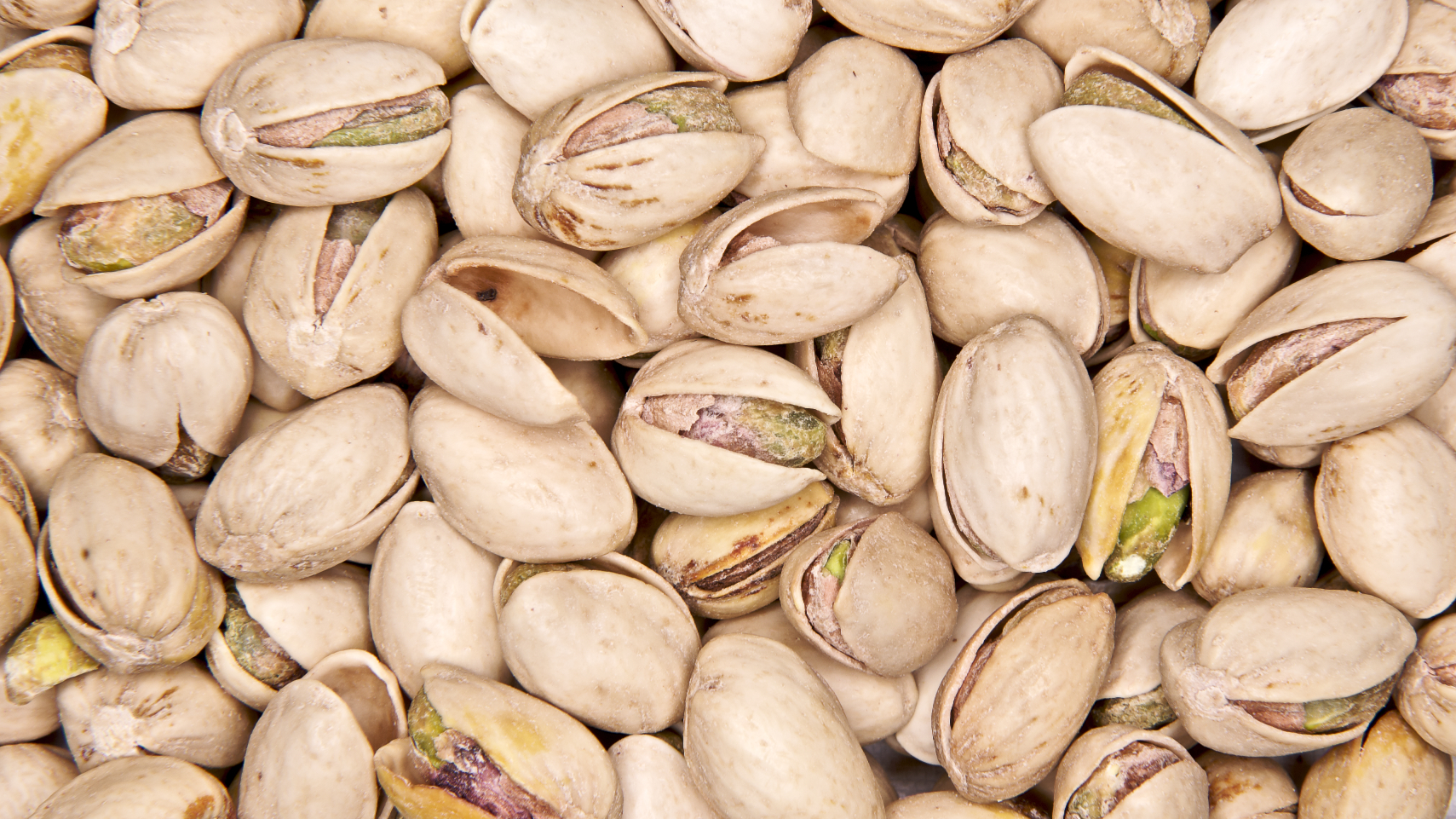
The fruit is a drupe, containing an elongated seed, which is the edible portion. The seed, commonly thought of as a nut, is a culinary nut, not a botanical nut. The fruit has a hard, cream-colored exterior shell. The seed has a mauve-colored skin and light green flesh, with a distinctive flavor. When the fruit ripens, the shell changes from green to an autumnal yellow/red and abruptly splits partly open. This is known as dehiscence and happens with an audible pop. Humans selected the trait of splitting open. Commercial cultivars vary in how consistently they split open.
Each mature pistachio tree averages around 50 kilograms (110 pounds) of seeds, or around 50,000 seeds, every two years.
Pistachio is from late Middle English pistace, from Old French, superseded in the 16th century by forms from Italian pistacchio, via Latin from Greek πιστάκιον pistákion, and from Middle Persian pistakē.
Pistachio is a desert plant and is highly tolerant of saline soil. It has been reported to grow well when irrigated with water having 3,000–4,000 ppm of soluble salts. Pistachio trees are fairly hardy in the right conditions and can survive temperatures ranging between −10 °C (14 °F) in winter and 48 °C (118 °F) in summer. They need a sunny position and well-drained soil. Pistachio trees do poorly in high humidity conditions and are susceptible to root rot in winter if they get too much water and the soil is not sufficiently free-draining. Long, hot summers are required for proper ripening of the fruit.[citation needed]
The pistachio tree may live up to 300 years. The trees are planted in orchards, and take around 7 to 10 years to reach significant production. Production is alternate-bearing or biennial-bearing, meaning the harvest is heavier in alternate years. Peak production is reached around 20 years. Trees are usually pruned to size to make the harvest easier. One male tree produces enough pollen for 8 to 12 drupe-bearing females. Harvesting in the United States and Greece is often accomplished using equipment to shake the drupes off the tree. After hulling and drying, pistachios are sorted according to open-mouth and closed-mouth shells, then roasted or processed by special machines to produce pistachio kernels.[citation needed]
Hub AI
Pistachio AI simulator
(@Pistachio_simulator)
Pistachio
The pistachio (/pɪˈstɑːʃioʊ, -ˈstæʃ-/, UK also /pɪˈstætʃ(i)oʊ/; Pistacia vera) is a small to medium-sized tree of the cashew family. The tree produces seeds that are widely consumed as food.
In 2022, world production of pistachios was one million tonnes, with the United States, Iran, and Turkey combined accounting for 88% of the total.
The tree grows up to 10 metres (33 feet) tall. It has deciduous, pinnate leaves 10–20 centimetres (4–8 inches) long. The plants are dioecious, with separate male and female trees. The flowers are apetalous and unisexual and borne in panicles.
The fruit is a drupe, containing an elongated seed, which is the edible portion. The seed, commonly thought of as a nut, is a culinary nut, not a botanical nut. The fruit has a hard, cream-colored exterior shell. The seed has a mauve-colored skin and light green flesh, with a distinctive flavor. When the fruit ripens, the shell changes from green to an autumnal yellow/red and abruptly splits partly open. This is known as dehiscence and happens with an audible pop. Humans selected the trait of splitting open. Commercial cultivars vary in how consistently they split open.
Each mature pistachio tree averages around 50 kilograms (110 pounds) of seeds, or around 50,000 seeds, every two years.
Pistachio is from late Middle English pistace, from Old French, superseded in the 16th century by forms from Italian pistacchio, via Latin from Greek πιστάκιον pistákion, and from Middle Persian pistakē.
Pistachio is a desert plant and is highly tolerant of saline soil. It has been reported to grow well when irrigated with water having 3,000–4,000 ppm of soluble salts. Pistachio trees are fairly hardy in the right conditions and can survive temperatures ranging between −10 °C (14 °F) in winter and 48 °C (118 °F) in summer. They need a sunny position and well-drained soil. Pistachio trees do poorly in high humidity conditions and are susceptible to root rot in winter if they get too much water and the soil is not sufficiently free-draining. Long, hot summers are required for proper ripening of the fruit.[citation needed]
The pistachio tree may live up to 300 years. The trees are planted in orchards, and take around 7 to 10 years to reach significant production. Production is alternate-bearing or biennial-bearing, meaning the harvest is heavier in alternate years. Peak production is reached around 20 years. Trees are usually pruned to size to make the harvest easier. One male tree produces enough pollen for 8 to 12 drupe-bearing females. Harvesting in the United States and Greece is often accomplished using equipment to shake the drupes off the tree. After hulling and drying, pistachios are sorted according to open-mouth and closed-mouth shells, then roasted or processed by special machines to produce pistachio kernels.[citation needed]
Recent media