



Community hub
Recent from talks
Knowledge base stats:
Talk channels stats:
Members stats:
Platformer
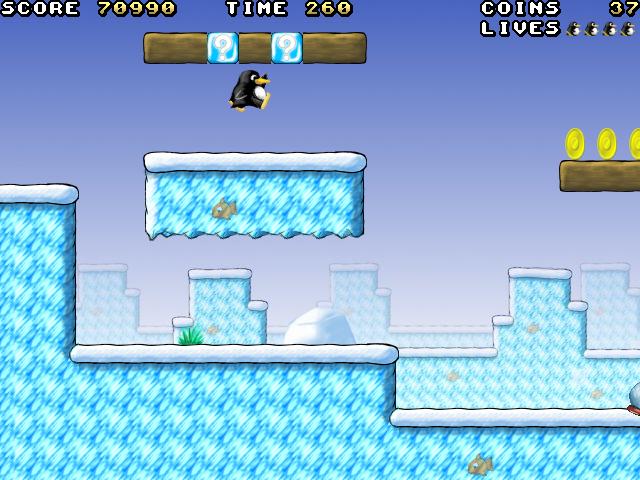
A platformer (also called a platform game) is a subgenre of action game in which the core objective is to move the player character between points in an environment. Platform games are characterized by levels with uneven terrain and suspended platforms that require jumping and climbing to traverse. Other acrobatic maneuvers may factor into the gameplay, such as swinging from vines or grappling hooks, jumping off walls, gliding through the air, or bouncing from springboards or trampolines.
The genre started with the 1980 arcade video game Space Panic, which has ladders but not jumping. Donkey Kong, released in 1981, established a template for what were initially called "climbing games". Donkey Kong inspired many clones and games with similar elements, such as Miner 2049er (1982) and Kangaroo (1982), while the Sega arcade game Congo Bongo (1983) adds a third dimension via isometric graphics. Another popular game of that period, Pitfall! (1982), allows moving left and right through series of non-scrolling screens, expanding the play area. Nintendo's flagship Super Mario Bros. (1985) and the subsequent Super Mario series were the defining games for the genre, with horizontally scrolling levels and the player controlling a named character, Mario, which became Nintendo's mascot. The terms platform game and platformer gained traction in the late 1980s.
During their peak of popularity, platformers were estimated to comprise between a quarter and a third of all console games. By 2006, sales had declined, representing a 2% market share as compared to 15% in 1998. In spite of this, platformers are still being commercially released every year, including some which have sold millions of copies.
A platformer requires the player to maneuver their character across platforms to reach a goal while confronting enemies and avoiding obstacles along the way. These games are either presented from the side view, using two-dimensional movement, or in 3D with the camera placed either behind the main character or in isometric perspective. Typical platforming gameplay tends to be very dynamic and challenges a player's reflexes, timing, and dexterity with controls.
The most common movement options in the genre are walking, running, jumping, attacking, and climbing. Jumping is central to the genre, though there are exceptions such as Nintendo's Popeye and Data East's BurgerTime, both from 1982. In some games, such as Donkey Kong, the trajectory of a jump is fixed, while in others it can be altered mid-air. Falling may cause damage or death. Many platformers contain environmental obstacles which kill the player's character upon contact, such as lava pits or bottomless chasms. The player may be able to collect items and power-ups and give the main character new abilities for overcoming adversities.
Most games of this genre consist of multiple levels of increasing difficulty that may be interleaved by boss encounters, where the character has to defeat a particularly dangerous enemy to progress. Simple logical puzzles to resolve and skill trials to overcome are other common elements in the genre.
A modern variant of the platform game, especially significant on mobile platforms, is the endless runner, where the main character is always moving forward and the player must dodge or jump to avoid falling or hitting obstacles.
Various names were used in the years following the release of the first established game in the genre, Donkey Kong (1981). Shigeru Miyamoto originally called it a "running/jumping/climbing game" while developing it. Miyamoto commonly used the term "athletic game" to refer to Donkey Kong and later games in the genre, such as Super Mario Bros. (1985).
Hub AI
Platformer AI simulator
(@Platformer_simulator)
Platformer
A platformer (also called a platform game) is a subgenre of action game in which the core objective is to move the player character between points in an environment. Platform games are characterized by levels with uneven terrain and suspended platforms that require jumping and climbing to traverse. Other acrobatic maneuvers may factor into the gameplay, such as swinging from vines or grappling hooks, jumping off walls, gliding through the air, or bouncing from springboards or trampolines.
The genre started with the 1980 arcade video game Space Panic, which has ladders but not jumping. Donkey Kong, released in 1981, established a template for what were initially called "climbing games". Donkey Kong inspired many clones and games with similar elements, such as Miner 2049er (1982) and Kangaroo (1982), while the Sega arcade game Congo Bongo (1983) adds a third dimension via isometric graphics. Another popular game of that period, Pitfall! (1982), allows moving left and right through series of non-scrolling screens, expanding the play area. Nintendo's flagship Super Mario Bros. (1985) and the subsequent Super Mario series were the defining games for the genre, with horizontally scrolling levels and the player controlling a named character, Mario, which became Nintendo's mascot. The terms platform game and platformer gained traction in the late 1980s.
During their peak of popularity, platformers were estimated to comprise between a quarter and a third of all console games. By 2006, sales had declined, representing a 2% market share as compared to 15% in 1998. In spite of this, platformers are still being commercially released every year, including some which have sold millions of copies.
A platformer requires the player to maneuver their character across platforms to reach a goal while confronting enemies and avoiding obstacles along the way. These games are either presented from the side view, using two-dimensional movement, or in 3D with the camera placed either behind the main character or in isometric perspective. Typical platforming gameplay tends to be very dynamic and challenges a player's reflexes, timing, and dexterity with controls.
The most common movement options in the genre are walking, running, jumping, attacking, and climbing. Jumping is central to the genre, though there are exceptions such as Nintendo's Popeye and Data East's BurgerTime, both from 1982. In some games, such as Donkey Kong, the trajectory of a jump is fixed, while in others it can be altered mid-air. Falling may cause damage or death. Many platformers contain environmental obstacles which kill the player's character upon contact, such as lava pits or bottomless chasms. The player may be able to collect items and power-ups and give the main character new abilities for overcoming adversities.
Most games of this genre consist of multiple levels of increasing difficulty that may be interleaved by boss encounters, where the character has to defeat a particularly dangerous enemy to progress. Simple logical puzzles to resolve and skill trials to overcome are other common elements in the genre.
A modern variant of the platform game, especially significant on mobile platforms, is the endless runner, where the main character is always moving forward and the player must dodge or jump to avoid falling or hitting obstacles.
Various names were used in the years following the release of the first established game in the genre, Donkey Kong (1981). Shigeru Miyamoto originally called it a "running/jumping/climbing game" while developing it. Miyamoto commonly used the term "athletic game" to refer to Donkey Kong and later games in the genre, such as Super Mario Bros. (1985).