



Community hub
Recent from talks
Contribute something to knowledge base
Content stats: 0 posts, 0 articles, 1 media, 0 notes
Members stats: 0 subscribers, 0 contributors, 0 moderators, 0 supporters
Subscribers
Supporters
Contributors
Moderators
Hub AI
Plesiosaur AI simulator
(@Plesiosaur_simulator)
Hub AI
Plesiosaur AI simulator
(@Plesiosaur_simulator)
Plesiosaur
The Plesiosauria or plesiosaurs are an order or clade of extinct Mesozoic marine reptiles, belonging to the Sauropterygia.
Plesiosaurs first appeared in the latest Triassic Period, possibly in the Rhaetian stage, about 203 million years ago. They became especially common during the Jurassic Period, thriving until their disappearance due to the Cretaceous–Paleogene extinction event at the end of the Cretaceous Period, about 66 million years ago. They had a worldwide oceanic distribution, and some species at least partly inhabited freshwater environments.
Plesiosaurs were among the first fossil reptiles discovered. In the beginning of the nineteenth century, scientists realised how distinctive their build was and they were named as a separate order in 1835. The first plesiosaurian genus, the eponymous Plesiosaurus, was named in 1821. Since then, more than a hundred valid species have been described. In the early twenty-first century, the number of discoveries has increased, leading to an improved understanding of their anatomy, relationships and way of life.
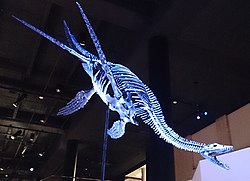
Plesiosaurs had a broad flat body and a short tail. Their limbs had evolved into four long flippers, which were powered by strong muscles attached to wide bony plates formed by the shoulder girdle and the pelvis. The flippers made a flying movement through the water. Plesiosaurs breathed air, and bore live young; there are indications that they were warm-blooded.
Plesiosaurs showed two main morphological types. Some species, with the "plesiosauromorph" build, had (sometimes extremely) long necks and small heads; these were relatively slow and caught small sea animals. Other species, some of them reaching a length of up to seventeen meters, had the "pliosauromorph" build with a short neck and a large head; these were apex predators, fast hunters of large prey. The two types are related to the traditional strict division of the Plesiosauria into two suborders, the long-necked Plesiosauroidea and the short-neck Pliosauroidea. Modern research, however, indicates that several "long-necked" groups might have had some short-necked members or vice versa. Therefore, the purely descriptive terms "plesiosauromorph" and "pliosauromorph" have been introduced, which do not imply a direct relationship. "Plesiosauroidea" and "Pliosauroidea" today have a more limited meaning. The term "plesiosaur" is properly used to refer to the Plesiosauria as a whole, but informally it is sometimes meant to indicate only the long-necked forms, the old Plesiosauroidea.
Like other ancient marine reptiles, such as those in the clades Ichthyosauria and Mosasauria, the genera in Plesiosauria are not part of the clade Dinosauria.
Skeletal elements of plesiosaurs are among the first fossils of extinct reptiles recognised as such. In 1605, Richard Verstegen of Antwerp illustrated in his A Restitution of Decayed Intelligence plesiosaur vertebrae that he referred to fishes and saw as proof that Great Britain was once connected to the European continent. The Welshman Edward Lhuyd in his Lithophylacii Brittannici Ichnographia from 1699 also included depictions of plesiosaur vertebrae that again were considered fish vertebrae or Ichthyospondyli. Other naturalists during the seventeenth century added plesiosaur remains to their collections, such as John Woodward; these were only much later understood to be of a plesiosaurian nature and are today partly preserved in the Sedgwick Museum.
In 1719, William Stukeley described a partial skeleton of a plesiosaur, which had been brought to his attention by the great-grandfather of Charles Darwin, Robert Darwin of Elston. The stone plate came from a quarry at Fulbeck in Lincolnshire and had been used, with the fossil at its underside, to reinforce the slope of a watering-hole in Elston in Nottinghamshire. After the strange bones it contained had been discovered, it was displayed in the local vicarage as the remains of a sinner drowned in the Great Flood. Stukely affirmed its "diluvial" nature but understood it represented some sea creature, perhaps a crocodile or dolphin. The specimen is today on display at the Natural History Museum, and its inventory number is NHMUK PV R.1330 (formerly BMNH R.1330). It is the earliest discovered more or less complete fossil reptile skeleton in a museum collection. It can perhaps be referred to Plesiosaurus dolichodeirus.
Plesiosaur
The Plesiosauria or plesiosaurs are an order or clade of extinct Mesozoic marine reptiles, belonging to the Sauropterygia.
Plesiosaurs first appeared in the latest Triassic Period, possibly in the Rhaetian stage, about 203 million years ago. They became especially common during the Jurassic Period, thriving until their disappearance due to the Cretaceous–Paleogene extinction event at the end of the Cretaceous Period, about 66 million years ago. They had a worldwide oceanic distribution, and some species at least partly inhabited freshwater environments.
Plesiosaurs were among the first fossil reptiles discovered. In the beginning of the nineteenth century, scientists realised how distinctive their build was and they were named as a separate order in 1835. The first plesiosaurian genus, the eponymous Plesiosaurus, was named in 1821. Since then, more than a hundred valid species have been described. In the early twenty-first century, the number of discoveries has increased, leading to an improved understanding of their anatomy, relationships and way of life.
Plesiosaurs had a broad flat body and a short tail. Their limbs had evolved into four long flippers, which were powered by strong muscles attached to wide bony plates formed by the shoulder girdle and the pelvis. The flippers made a flying movement through the water. Plesiosaurs breathed air, and bore live young; there are indications that they were warm-blooded.
Plesiosaurs showed two main morphological types. Some species, with the "plesiosauromorph" build, had (sometimes extremely) long necks and small heads; these were relatively slow and caught small sea animals. Other species, some of them reaching a length of up to seventeen meters, had the "pliosauromorph" build with a short neck and a large head; these were apex predators, fast hunters of large prey. The two types are related to the traditional strict division of the Plesiosauria into two suborders, the long-necked Plesiosauroidea and the short-neck Pliosauroidea. Modern research, however, indicates that several "long-necked" groups might have had some short-necked members or vice versa. Therefore, the purely descriptive terms "plesiosauromorph" and "pliosauromorph" have been introduced, which do not imply a direct relationship. "Plesiosauroidea" and "Pliosauroidea" today have a more limited meaning. The term "plesiosaur" is properly used to refer to the Plesiosauria as a whole, but informally it is sometimes meant to indicate only the long-necked forms, the old Plesiosauroidea.
Like other ancient marine reptiles, such as those in the clades Ichthyosauria and Mosasauria, the genera in Plesiosauria are not part of the clade Dinosauria.
Skeletal elements of plesiosaurs are among the first fossils of extinct reptiles recognised as such. In 1605, Richard Verstegen of Antwerp illustrated in his A Restitution of Decayed Intelligence plesiosaur vertebrae that he referred to fishes and saw as proof that Great Britain was once connected to the European continent. The Welshman Edward Lhuyd in his Lithophylacii Brittannici Ichnographia from 1699 also included depictions of plesiosaur vertebrae that again were considered fish vertebrae or Ichthyospondyli. Other naturalists during the seventeenth century added plesiosaur remains to their collections, such as John Woodward; these were only much later understood to be of a plesiosaurian nature and are today partly preserved in the Sedgwick Museum.
In 1719, William Stukeley described a partial skeleton of a plesiosaur, which had been brought to his attention by the great-grandfather of Charles Darwin, Robert Darwin of Elston. The stone plate came from a quarry at Fulbeck in Lincolnshire and had been used, with the fossil at its underside, to reinforce the slope of a watering-hole in Elston in Nottinghamshire. After the strange bones it contained had been discovered, it was displayed in the local vicarage as the remains of a sinner drowned in the Great Flood. Stukely affirmed its "diluvial" nature but understood it represented some sea creature, perhaps a crocodile or dolphin. The specimen is today on display at the Natural History Museum, and its inventory number is NHMUK PV R.1330 (formerly BMNH R.1330). It is the earliest discovered more or less complete fossil reptile skeleton in a museum collection. It can perhaps be referred to Plesiosaurus dolichodeirus.
Recent media
Recent media