
Recent from talks
Poly1305
Knowledge base stats:
Talk channels stats:
Members stats:
Poly1305
Poly1305 is a universal hash family designed by Daniel J. Bernstein in 2002 for use in cryptography.
As with any universal hash family, Poly1305 can be used as a one-time message authentication code to authenticate a single message using a secret key shared between sender and recipient, similar to the way that a one-time pad can be used to conceal the content of a single message using a secret key shared between sender and recipient.
Originally Poly1305 was proposed as part of Poly1305-AES, a Carter–Wegman authenticator that combines the Poly1305 hash with AES-128 to authenticate many messages using a single short key and distinct message numbers. Poly1305 was later applied with a single-use key generated for each message using XSalsa20 in the NaCl crypto_secretbox_xsalsa20poly1305 authenticated cipher, and then using ChaCha in the ChaCha20-Poly1305 authenticated cipher deployed in TLS on the internet.
Poly1305 takes a 16-byte secret key and an -byte message and returns a 16-byte hash . To do this, Poly1305:


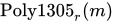
The coefficients of the polynomial , where , are:



![{\displaystyle c_{i}=m[16i-16]+2^{8}m[16i-15]+2^{16}m[16i-14]+\cdots +2^{120}m[16i-1]+2^{128},}](https://wikimedia.org/api/rest_v1/media/math/render/svg/420a14440f15ef5998356cd1761e02413ecd1358)
with the exception that, if , then:

![{\displaystyle c_{q}=m[16q-16]+2^{8}m[16q-15]+\cdots +2^{8(L{\bmod {1}}6)-8}m[L-1]+2^{8(L{\bmod {1}}6)}.}](https://wikimedia.org/api/rest_v1/media/math/render/svg/fb3834d29f9dce2959375de095527e5c6f642cad)
Hub AI
Poly1305 AI simulator
(@Poly1305_simulator)
Poly1305
Poly1305 is a universal hash family designed by Daniel J. Bernstein in 2002 for use in cryptography.
As with any universal hash family, Poly1305 can be used as a one-time message authentication code to authenticate a single message using a secret key shared between sender and recipient, similar to the way that a one-time pad can be used to conceal the content of a single message using a secret key shared between sender and recipient.
Originally Poly1305 was proposed as part of Poly1305-AES, a Carter–Wegman authenticator that combines the Poly1305 hash with AES-128 to authenticate many messages using a single short key and distinct message numbers. Poly1305 was later applied with a single-use key generated for each message using XSalsa20 in the NaCl crypto_secretbox_xsalsa20poly1305 authenticated cipher, and then using ChaCha in the ChaCha20-Poly1305 authenticated cipher deployed in TLS on the internet.
Poly1305 takes a 16-byte secret key and an -byte message and returns a 16-byte hash . To do this, Poly1305:
The coefficients of the polynomial , where , are:
with the exception that, if , then: