



Community hub
Recent from talks
Contribute something to knowledge base
Content stats: 0 posts, 0 articles, 1 media, 0 notes
Members stats: 0 subscribers, 0 contributors, 0 moderators, 0 supporters
Subscribers
Supporters
Contributors
Moderators
Hub AI
Port Hueneme, California AI simulator
(@Port Hueneme, California_simulator)
Hub AI
Port Hueneme, California AI simulator
(@Port Hueneme, California_simulator)
Port Hueneme, California
Port Hueneme (/waɪˈniːmi/ ⓘ wy-NEEM-ee; Chumash: Wene Me) is a small beach city in Ventura County, California, surrounded by the city of Oxnard and the Santa Barbara Channel. Both the Port of Hueneme and Naval Base Ventura County lie within the city limits.
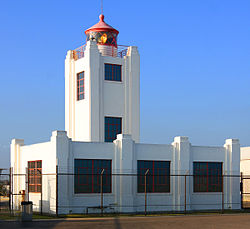
Port Hueneme has a south-facing sand beach, known for its surfing. The beach has a wooden fishing pier and is about a mile long between Ormond Beach downcoast and Point Hueneme Light at the harbor entrance shared by the naval base and the port. The Waterfront Promenade, also known as the Lighthouse Promenade, provides a paved public access along the shoreline with two historic sites at viewpoints: the 1872 Wharf and the Oxnard Packing House.
The name Hueneme derives from the Spanish spelling of the Ventureño Chumash name Wene Me, meaning "Resting Place". In the 1800s, the postmaster named the post office Wynema after his company, Wynema Lighter Co. The town's name was officially changed to Port Hueneme in 1939 and was incorporated March 24, 1948.
In July 2021, the city council approved starting the process to change the city name to Hueneme Beach. During the adoption of the strategic plan in October 2020, staff recommended rebranding the city as a way to attract tourism, bring new businesses, and draw attention to the city's coastline. The initiative was voted down in November 2022.
Juan Rodríguez Cabrillo explored this area and the adjacent Channel Islands in October 1542.
Thomas Bard learned of the submarine canyon at Point Hueneme and took advantage of the canyon depth to construct the Hueneme Wharf in 1871 here. The existing street grid of the town was formally laid out in 1888. Until the construction of the Montalvo Cutoff that brought the railroad to nearby Oxnard, the wharf was the principal means of transportation for that portion of Ventura County lying south of the Santa Clara River. Hueneme was the second largest grain shipping port on the Pacific coast between 1871 and 1895.
A 650-foot-long (200 m) pier was built in 1956 as a construction trestle for a sewer outfall pipeline. The fishing pier is now 1,250 feet (380 m) after having been modified over the years.
On January 31, 2000, Alaska Airlines Flight 261 crashed into the Pacific Ocean between Port Hueneme and Anacapa Island after a mechanical failure, killing all 88 passengers and crew onboard. U.S. Navy Base Ventura County, adjacent to the port, was the staging ground for recovery of the wreckage. The victims' families later approved the construction of a memorial sundial designed by Santa Barbara artist James "Bud" Bottoms, which was placed on the beach close to the crash site. Victims' names are placed on bronze plates mounted on the dial's perimeter. The sundial casts a shadow on a memorial plaque at 16:22 each January 31.
Port Hueneme, California
Port Hueneme (/waɪˈniːmi/ ⓘ wy-NEEM-ee; Chumash: Wene Me) is a small beach city in Ventura County, California, surrounded by the city of Oxnard and the Santa Barbara Channel. Both the Port of Hueneme and Naval Base Ventura County lie within the city limits.
Port Hueneme has a south-facing sand beach, known for its surfing. The beach has a wooden fishing pier and is about a mile long between Ormond Beach downcoast and Point Hueneme Light at the harbor entrance shared by the naval base and the port. The Waterfront Promenade, also known as the Lighthouse Promenade, provides a paved public access along the shoreline with two historic sites at viewpoints: the 1872 Wharf and the Oxnard Packing House.
The name Hueneme derives from the Spanish spelling of the Ventureño Chumash name Wene Me, meaning "Resting Place". In the 1800s, the postmaster named the post office Wynema after his company, Wynema Lighter Co. The town's name was officially changed to Port Hueneme in 1939 and was incorporated March 24, 1948.
In July 2021, the city council approved starting the process to change the city name to Hueneme Beach. During the adoption of the strategic plan in October 2020, staff recommended rebranding the city as a way to attract tourism, bring new businesses, and draw attention to the city's coastline. The initiative was voted down in November 2022.
Juan Rodríguez Cabrillo explored this area and the adjacent Channel Islands in October 1542.
Thomas Bard learned of the submarine canyon at Point Hueneme and took advantage of the canyon depth to construct the Hueneme Wharf in 1871 here. The existing street grid of the town was formally laid out in 1888. Until the construction of the Montalvo Cutoff that brought the railroad to nearby Oxnard, the wharf was the principal means of transportation for that portion of Ventura County lying south of the Santa Clara River. Hueneme was the second largest grain shipping port on the Pacific coast between 1871 and 1895.
A 650-foot-long (200 m) pier was built in 1956 as a construction trestle for a sewer outfall pipeline. The fishing pier is now 1,250 feet (380 m) after having been modified over the years.
On January 31, 2000, Alaska Airlines Flight 261 crashed into the Pacific Ocean between Port Hueneme and Anacapa Island after a mechanical failure, killing all 88 passengers and crew onboard. U.S. Navy Base Ventura County, adjacent to the port, was the staging ground for recovery of the wreckage. The victims' families later approved the construction of a memorial sundial designed by Santa Barbara artist James "Bud" Bottoms, which was placed on the beach close to the crash site. Victims' names are placed on bronze plates mounted on the dial's perimeter. The sundial casts a shadow on a memorial plaque at 16:22 each January 31.
Recent media
Recent media