



Community hub
Recent from talks
Knowledge base stats:
Talk channels stats:
Members stats:
Port of Alaska
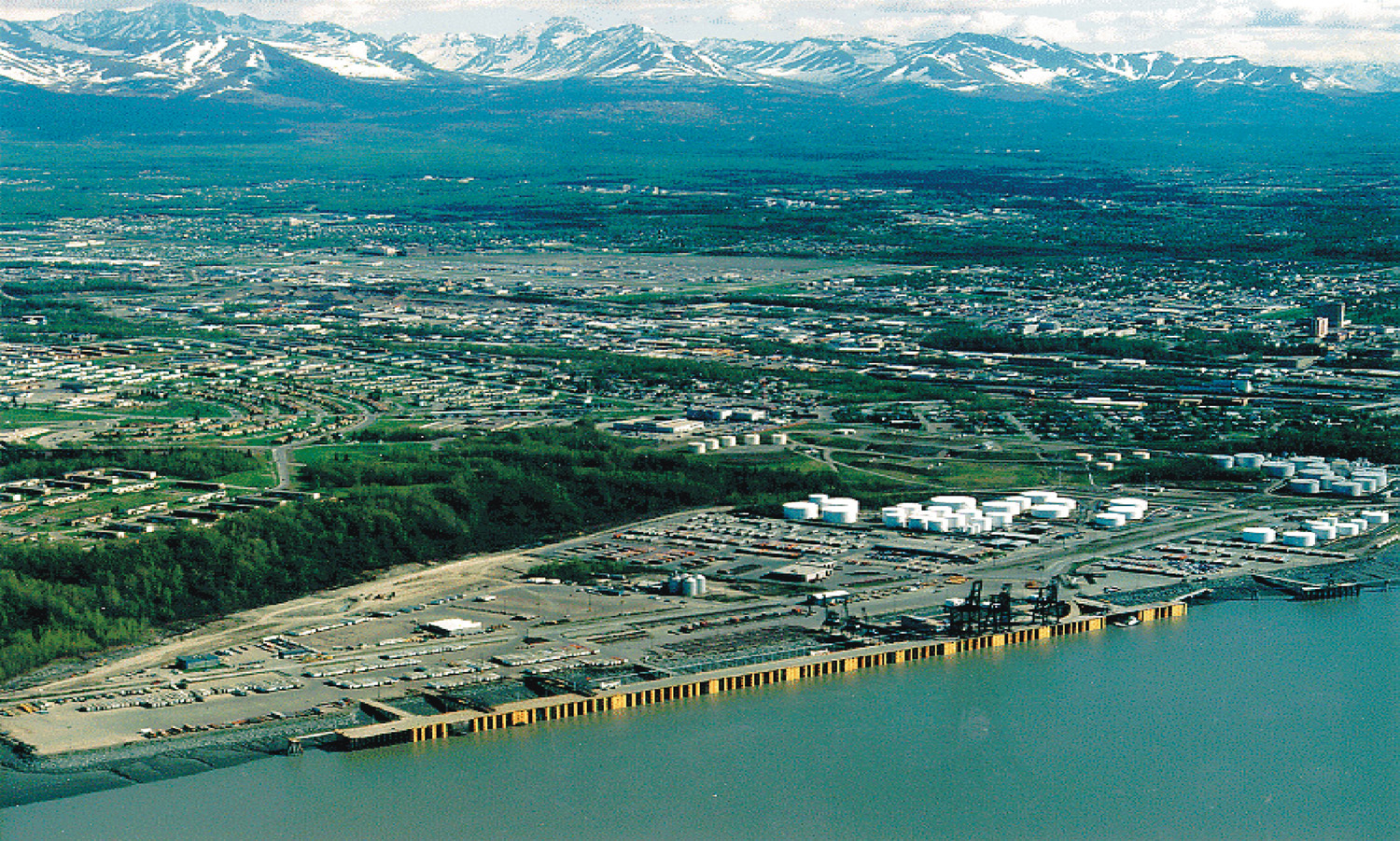
The Port of Alaska (POA) is a deep-water port in Anchorage, Alaska, with three bulk carrier berths, two petroleum berths, and one barge berth. The name was changed from "Port of Anchorage" to the "Port of Alaska" in 2017. It is an enterprise department of the Municipality of Anchorage. It is distinguished from other types of municipal departments largely because it generates enough revenue to support its operations without being a burden to Anchorage property tax payers, and it also pays a fee-in-lieu of taxes to help run city government.
The POA provides critical transportation infrastructure to the citizens of Anchorage and to a majority of the citizens of the State of Alaska both within and beyond the Railbelt. Seventy-four percent of all the waterborne freight and ninety-five percent of the refined petroleum products entering the state through south-central Alaska ports is shipped through the Port of Alaska. This includes 100 percent of the jet fuel supplied to Joint Base Elmendorf-Richardson and approximately 66 percent of the jet fuel for Ted Stevens Anchorage International Airport.
The Port Director is appointed by the Mayor and reports to the Municipal Manager. There is a nine-person Commission, also appointed by the Mayor, responsible for promulgating the Port's terminal tariff. Despite its enterprise distinction, the Port acts as a standard municipal department with the Anchorage Assembly approving its annual budget, contracts, tariffs, and leases. Additionally, needed legal, financial and other day-to-day support are provided, for a fee, by the appropriate general government departments acting as an extension of the Port's staff. All Port operating activities are subject to municipal code.
The Port of Alaska is located on the Anchorage side of the Knik Arm of the Cook Inlet on the Pacific Ocean.
A 128.96-acre (52.19 ha) industrial park adjoins the port to the east. Approximately 80.87 acres (32.73 ha) of the park are under long-term lease to various port users. Additionally, there are 31.0 acres (12.5 ha) for the staging and storage of marine cargo in transit. However, a majority of that acreage is presently occupied by the two major general cargo carriers.
The Port of Alaska has operated year-round through extreme climate and tides.
Typically between October and November, pan ice develops in the Knik Arm of the Cook Inlet but does not fully freeze over for the winter.
Between March and May, the pan ice melts.
Hub AI
Port of Alaska AI simulator
(@Port of Alaska_simulator)
Port of Alaska
The Port of Alaska (POA) is a deep-water port in Anchorage, Alaska, with three bulk carrier berths, two petroleum berths, and one barge berth. The name was changed from "Port of Anchorage" to the "Port of Alaska" in 2017. It is an enterprise department of the Municipality of Anchorage. It is distinguished from other types of municipal departments largely because it generates enough revenue to support its operations without being a burden to Anchorage property tax payers, and it also pays a fee-in-lieu of taxes to help run city government.
The POA provides critical transportation infrastructure to the citizens of Anchorage and to a majority of the citizens of the State of Alaska both within and beyond the Railbelt. Seventy-four percent of all the waterborne freight and ninety-five percent of the refined petroleum products entering the state through south-central Alaska ports is shipped through the Port of Alaska. This includes 100 percent of the jet fuel supplied to Joint Base Elmendorf-Richardson and approximately 66 percent of the jet fuel for Ted Stevens Anchorage International Airport.
The Port Director is appointed by the Mayor and reports to the Municipal Manager. There is a nine-person Commission, also appointed by the Mayor, responsible for promulgating the Port's terminal tariff. Despite its enterprise distinction, the Port acts as a standard municipal department with the Anchorage Assembly approving its annual budget, contracts, tariffs, and leases. Additionally, needed legal, financial and other day-to-day support are provided, for a fee, by the appropriate general government departments acting as an extension of the Port's staff. All Port operating activities are subject to municipal code.
The Port of Alaska is located on the Anchorage side of the Knik Arm of the Cook Inlet on the Pacific Ocean.
A 128.96-acre (52.19 ha) industrial park adjoins the port to the east. Approximately 80.87 acres (32.73 ha) of the park are under long-term lease to various port users. Additionally, there are 31.0 acres (12.5 ha) for the staging and storage of marine cargo in transit. However, a majority of that acreage is presently occupied by the two major general cargo carriers.
The Port of Alaska has operated year-round through extreme climate and tides.
Typically between October and November, pan ice develops in the Knik Arm of the Cook Inlet but does not fully freeze over for the winter.
Between March and May, the pan ice melts.