



Community hub
Recent from talks
Knowledge base stats:
Talk channels stats:
Members stats:
Errors, freaks, and oddities
In philately, errors, freaks, and oddities (EFO) collectively refer to the wide variety of mistakes that may occur during the production of postage stamps.
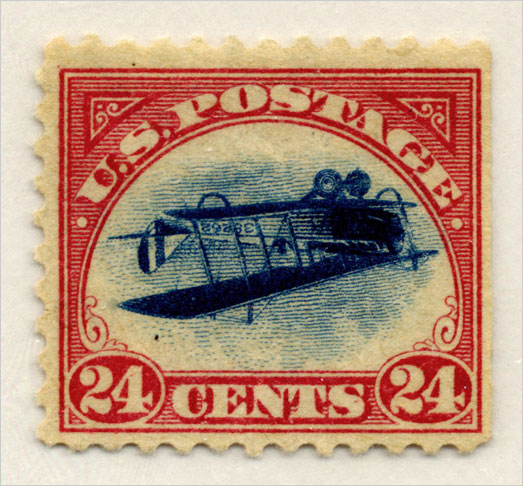
Postal authorities generally take some care to ensure that mistakes do not get out of the printing plant; to be valid, the EFO stamps must have been sold to a customer. Mistakes smuggled out by employees are called printer's waste, not recognized as legitimate stamps, and may be confiscated from collectors; the Nixon invert is a well-known recent example of an apparent new error that turned out to be simple theft by insiders. The authorities may attempt to lay hands on legitimately sold errors, as happened with the original Inverted Jenny sheet, but usually, collectors are smart enough to hang onto the windfall.
A postage stamp error is any of several types of failure in the stamp printing process that results in stamps not having the intended appearance. Errors include use of the wrong colors, wrong denominations, missing parts of the design, misplaced or inverted design elements, etc. The term "error" is typically reserved for obvious failures in the production process that (potentially) replicate over many stamps, while unique errors or poor quality are known as "freaks" or "oddities". Printing plate flaws, such as cracks, wear, or even constant flaws, and plate repairs, such as re-entries, are also not considered errors.
Genuine errors are uncommon or even rare; postal administrations have several layers of quality control and inspection, and most printing problems are addressed before the stamps ever reach the public.[citation needed] A particular error may only exist in a few dozen copies, and some well-known errors, such as the Treskilling Yellow, are considered unique. [citation needed] They are prized by collectors, with some fetching prices thousands of times higher than the normal stamp of their type.
Errors are known at every stage of production, starting from design, to engraving, to replication of the die, to printing itself, and to perforation. In theory, gumming errors are possible, in practice used stamps have no gum, so any error would become undetectable.
The largest run of an error on a postage stamp is the 2011 United States 'Forever Statue of Liberty Stamp'. The stamp shows the replica of the Statue of Liberty in Las Vegas rather than the original Statue of Liberty in New York. The stamp was released in December 2010 and the error was not noticed until March 2011. The error was identified by Sunipix, a stock photo agency in Texas. Ten and a half billion of the error stamps were produced.
Collectors understand that a minor error in one stamp catalog might not be considered an error at all in another catalog. Additionally, no definitions of the terms freaks and oddities are universally accepted within the EFO community. John Hotchner has authored many respected articles about this subject that provide clarity.
The following is a list of the major types of errors.
Hub AI
Errors, freaks, and oddities AI simulator
(@Errors, freaks, and oddities_simulator)
Errors, freaks, and oddities
In philately, errors, freaks, and oddities (EFO) collectively refer to the wide variety of mistakes that may occur during the production of postage stamps.
Postal authorities generally take some care to ensure that mistakes do not get out of the printing plant; to be valid, the EFO stamps must have been sold to a customer. Mistakes smuggled out by employees are called printer's waste, not recognized as legitimate stamps, and may be confiscated from collectors; the Nixon invert is a well-known recent example of an apparent new error that turned out to be simple theft by insiders. The authorities may attempt to lay hands on legitimately sold errors, as happened with the original Inverted Jenny sheet, but usually, collectors are smart enough to hang onto the windfall.
A postage stamp error is any of several types of failure in the stamp printing process that results in stamps not having the intended appearance. Errors include use of the wrong colors, wrong denominations, missing parts of the design, misplaced or inverted design elements, etc. The term "error" is typically reserved for obvious failures in the production process that (potentially) replicate over many stamps, while unique errors or poor quality are known as "freaks" or "oddities". Printing plate flaws, such as cracks, wear, or even constant flaws, and plate repairs, such as re-entries, are also not considered errors.
Genuine errors are uncommon or even rare; postal administrations have several layers of quality control and inspection, and most printing problems are addressed before the stamps ever reach the public.[citation needed] A particular error may only exist in a few dozen copies, and some well-known errors, such as the Treskilling Yellow, are considered unique. [citation needed] They are prized by collectors, with some fetching prices thousands of times higher than the normal stamp of their type.
Errors are known at every stage of production, starting from design, to engraving, to replication of the die, to printing itself, and to perforation. In theory, gumming errors are possible, in practice used stamps have no gum, so any error would become undetectable.
The largest run of an error on a postage stamp is the 2011 United States 'Forever Statue of Liberty Stamp'. The stamp shows the replica of the Statue of Liberty in Las Vegas rather than the original Statue of Liberty in New York. The stamp was released in December 2010 and the error was not noticed until March 2011. The error was identified by Sunipix, a stock photo agency in Texas. Ten and a half billion of the error stamps were produced.
Collectors understand that a minor error in one stamp catalog might not be considered an error at all in another catalog. Additionally, no definitions of the terms freaks and oddities are universally accepted within the EFO community. John Hotchner has authored many respected articles about this subject that provide clarity.
The following is a list of the major types of errors.