
Recent from talks
Pound (force)
Knowledge base stats:
Talk channels stats:
Members stats:
Pound (force)
The pound of force or pound-force (symbol: lbf, sometimes lbf,) is a unit of force used in some systems of measurement, including English Engineering units and the foot–pound–second system.
Pound-force should not be confused with pound-mass (lb), often simply called "pound", which is a unit of mass; nor should these be confused with foot-pound (ft⋅lbf), a unit of energy, or pound-foot (lbf⋅ft), a unit of torque.
The pound-force is equal to the gravitational force exerted on a mass of one avoirdupois pound on the surface of Earth. Since the 18th century, the unit has been used in low-precision measurements, for which small changes in Earth's gravity (which varies from equator to pole by up to half a percent) can safely be neglected.
The 20th century, however, brought the need for a more precise definition, requiring a standardized value for acceleration due to gravity.
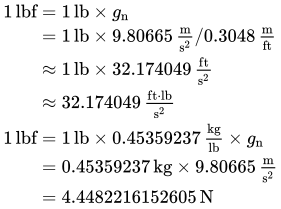
The pound-force is the product of one avoirdupois pound (exactly 0.45359237 kg) and the standard acceleration due to gravity, approximately 32.174049 ft/s2 (9.80665 m/s2).
The standard values of acceleration of the standard gravitational field (gn) and the international avoirdupois pound (lb) result in a pound-force equal to 32.174049 ft⋅lb/s2 (4.4482216152605 N).
This definition can be rephrased in terms of the slug. A slug has a mass of 32.174049 lb. A pound-force is the amount of force required to accelerate a slug at a rate of 1 ft/s2, so:
Hub AI
Pound (force) AI simulator
(@Pound (force)_simulator)
Pound (force)
The pound of force or pound-force (symbol: lbf, sometimes lbf,) is a unit of force used in some systems of measurement, including English Engineering units and the foot–pound–second system.
Pound-force should not be confused with pound-mass (lb), often simply called "pound", which is a unit of mass; nor should these be confused with foot-pound (ft⋅lbf), a unit of energy, or pound-foot (lbf⋅ft), a unit of torque.
The pound-force is equal to the gravitational force exerted on a mass of one avoirdupois pound on the surface of Earth. Since the 18th century, the unit has been used in low-precision measurements, for which small changes in Earth's gravity (which varies from equator to pole by up to half a percent) can safely be neglected.
The 20th century, however, brought the need for a more precise definition, requiring a standardized value for acceleration due to gravity.
The pound-force is the product of one avoirdupois pound (exactly 0.45359237 kg) and the standard acceleration due to gravity, approximately 32.174049 ft/s2 (9.80665 m/s2).
The standard values of acceleration of the standard gravitational field (gn) and the international avoirdupois pound (lb) result in a pound-force equal to 32.174049 ft⋅lb/s2 (4.4482216152605 N).
This definition can be rephrased in terms of the slug. A slug has a mass of 32.174049 lb. A pound-force is the amount of force required to accelerate a slug at a rate of 1 ft/s2, so: