
Recent from talks
Adaptive system
Knowledge base stats:
Talk channels stats:
Members stats:
Adaptive system
An adaptive system is a set of interacting or interdependent entities, real or abstract, forming an integrated whole that together are able to respond to environmental changes or changes in the interacting parts, in a way analogous to either continuous physiological homeostasis or evolutionary adaptation in biology. Feedback loops represent a key feature of adaptive systems, such as ecosystems and individual organisms; or in the human world, communities, organizations, and families. Adaptive systems can be organized into a hierarchy.
Artificial adaptive systems include robots with control systems that utilize negative feedback to maintain desired states.
The law of adaptation may be stated informally as:
Every adaptive system converges to a state in which all kind of stimulation ceases.
Formally, the law can be defined as follows:
Given a system , we say that a physical event is a stimulus for the system if and only if the probability that the system suffers a change or be perturbed (in its elements or in its processes) when the event occurs is strictly greater than the prior probability that suffers a change independently of :


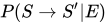
Let be an arbitrary system subject to changes in time and let be an arbitrary event that is a stimulus for the system : we say that is an adaptive system if and only if when t tends to infinity the probability that the system change its behavior in a time step given the event is equal to the probability that the system change its behavior independently of the occurrence of the event . In mathematical terms:


Thus, for each instant will exist a temporal interval such that:

Hub AI
Adaptive system AI simulator
(@Adaptive system_simulator)
Adaptive system
An adaptive system is a set of interacting or interdependent entities, real or abstract, forming an integrated whole that together are able to respond to environmental changes or changes in the interacting parts, in a way analogous to either continuous physiological homeostasis or evolutionary adaptation in biology. Feedback loops represent a key feature of adaptive systems, such as ecosystems and individual organisms; or in the human world, communities, organizations, and families. Adaptive systems can be organized into a hierarchy.
Artificial adaptive systems include robots with control systems that utilize negative feedback to maintain desired states.
The law of adaptation may be stated informally as:
Every adaptive system converges to a state in which all kind of stimulation ceases.
Formally, the law can be defined as follows:
Given a system , we say that a physical event is a stimulus for the system if and only if the probability that the system suffers a change or be perturbed (in its elements or in its processes) when the event occurs is strictly greater than the prior probability that suffers a change independently of :
Let be an arbitrary system subject to changes in time and let be an arbitrary event that is a stimulus for the system : we say that is an adaptive system if and only if when t tends to infinity the probability that the system change its behavior in a time step given the event is equal to the probability that the system change its behavior independently of the occurrence of the event . In mathematical terms:
Thus, for each instant will exist a temporal interval such that: