



Community hub
Recent from talks
Knowledge base stats:
Talk channels stats:
Members stats:
Prehistoric art
In the history of art, prehistoric art is all art produced in preliterate, prehistorical cultures beginning somewhere in very late geological history, and generally continuing until that culture either develops writing or other methods of record-keeping, or makes significant contact with another culture that has, and that makes some record of major historical events. At this point ancient art begins, for the older literate cultures. The end-date for what is covered by the term thus varies greatly between different parts of the world.
The earliest human artifacts showing evidence of workmanship with an artistic purpose are the subject of some debate. It is clear that such workmanship existed 40,000 years ago in the Upper Paleolithic era, although it is quite possible that it began earlier. In September 2018, scientists reported the discovery of the earliest known drawing by Homo sapiens, which is estimated to be 73,000 years old, much earlier than the 43,000 years old artifacts understood to be the earliest known modern human drawings found previously.
Engraved shells created by Homo erectus dating as far back as 500,000 years ago have been found, although experts disagree on whether these engravings can be properly classified as 'art'. From the Upper Paleolithic through to the Mesolithic, cave paintings and portable art such as figurines and beads predominated, with decorative figured workings also seen on some utilitarian objects. In the Neolithic evidence of early pottery appeared, as did sculpture and the construction of megaliths. Early rock art also first appeared during this period. The advent of metalworking in the Bronze Age brought additional media available for use in making art, an increase in stylistic diversity, and the creation of objects that did not have any obvious function other than art. It also saw the development in some areas of artisans, a class of people specializing in the production of art, as well as early writing systems. By the Iron Age, civilizations with writing had arisen from Ancient Egypt to Ancient China.
Many indigenous peoples from around the world continued to produce artistic works distinctive to their geographic area and culture, until exploration and commerce brought record-keeping methods to them. Some cultures, notably the Maya civilization, independently developed writing during the time they flourished, which was then later lost. These cultures may be classified as prehistoric, especially if their writing systems have not been deciphered.
The earliest undisputed art originated with the Homo sapiens Aurignacian archaeological culture in the Upper Paleolithic. However, there is some evidence that the preference for the aesthetic emerged in the Middle Paleolithic, from 100,000 to 50,000 years ago. Some archaeologists have interpreted certain Middle Paleolithic artifacts as early examples of artistic expression. The symmetry of artifacts, evidence of attention to the detail of tool shape, has led some investigators to conceive of Acheulean hand axes and especially laurel points as having been produced with a degree of artistic expression.
Similarly, a zigzag engraving supposedly made with a shark tooth on a freshwater Pseudodon shell DUB1006-fL around 500,000 years ago (i.e. well into the Lower Paleolithic), associated with Homo erectus, could be the earliest evidence of artistic activity, but the actual intent behind this geometric ornament is not known.
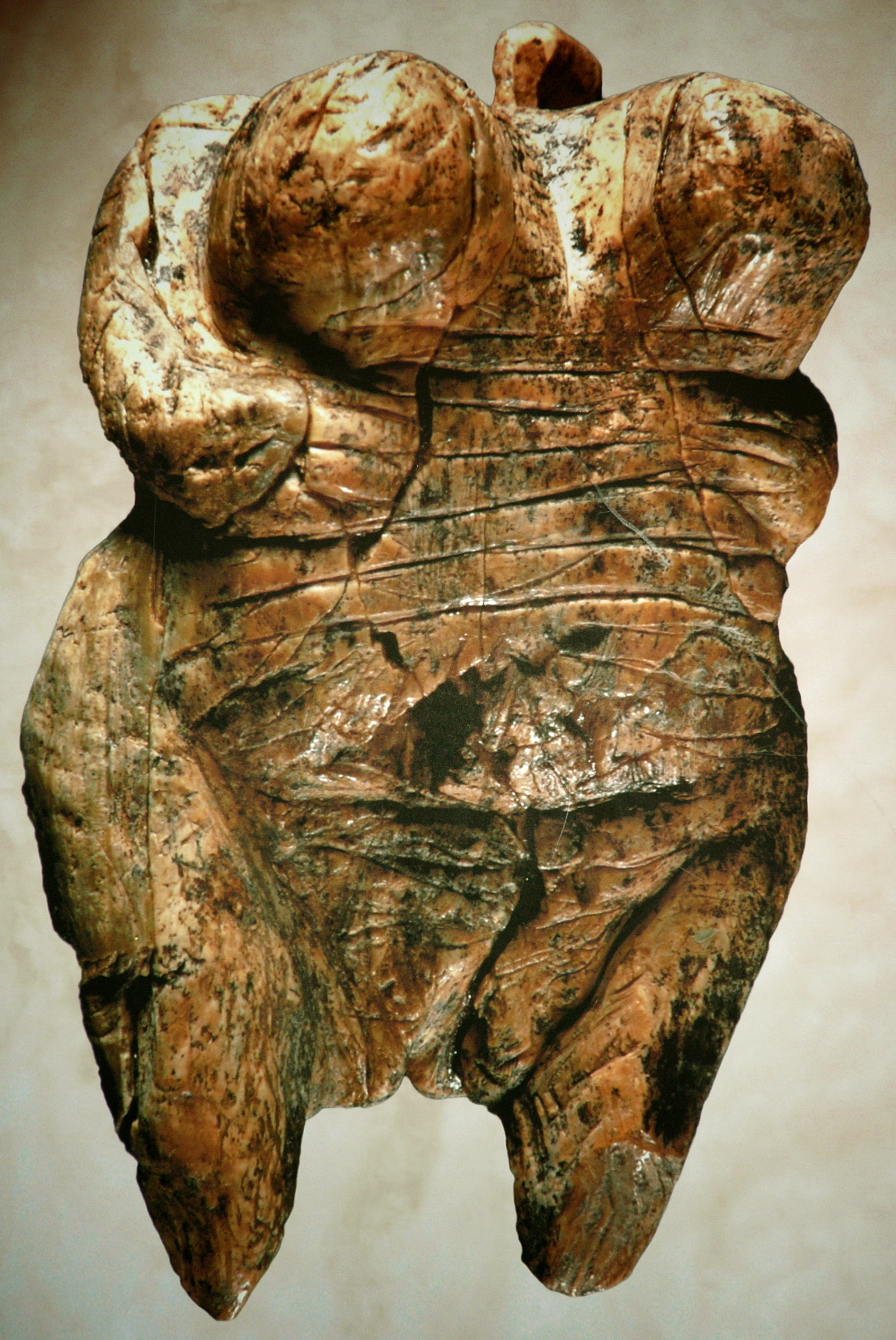
There are other claims of Middle Paleolithic sculpture, dubbed the "Venus of Tan-Tan" (before 300 kya) and the "Venus of Berekhat Ram" (250 kya). In 2002 in Blombos cave, situated in South Africa, stones were discovered engraved with grid or cross-hatch patterns, dated to some 70,000 years ago. This suggested to some researchers that early Homo sapiens were capable of abstraction and production of abstract art or symbolic art. Several archaeologists including Richard Klein are hesitant to accept the Blombos caves as the first example of actual art.
In September 2018 the discovery in South Africa of the earliest known drawing by Homo sapiens was announced, which is estimated to be 73,000 years old, much earlier than the 43,000 years old artifacts understood to be the earliest known modern human drawings found previously. The drawing shows a crosshatched pattern made up of nine fine lines. The sudden termination of all of the lines on the fragment edges indicate that the pattern originally extended over a larger surface. It is also estimated that the pattern was most likely more complex and structured in its entirety than shown on the discovered area. Initially, when this drawing was found, there was much debate. To prove that this drawing was created by Homo Sapiens, French team members who specialized in chemical analysis of pigments, reproduced the same lines using a variety of techniques. They concluded that the lines making up the drawing were intentional and were most likely made with ochre. This discovery adds further dimensions to understanding the behavior and cognition of early homo sapiens.
Hub AI
Prehistoric art AI simulator
(@Prehistoric art_simulator)
Prehistoric art
In the history of art, prehistoric art is all art produced in preliterate, prehistorical cultures beginning somewhere in very late geological history, and generally continuing until that culture either develops writing or other methods of record-keeping, or makes significant contact with another culture that has, and that makes some record of major historical events. At this point ancient art begins, for the older literate cultures. The end-date for what is covered by the term thus varies greatly between different parts of the world.
The earliest human artifacts showing evidence of workmanship with an artistic purpose are the subject of some debate. It is clear that such workmanship existed 40,000 years ago in the Upper Paleolithic era, although it is quite possible that it began earlier. In September 2018, scientists reported the discovery of the earliest known drawing by Homo sapiens, which is estimated to be 73,000 years old, much earlier than the 43,000 years old artifacts understood to be the earliest known modern human drawings found previously.
Engraved shells created by Homo erectus dating as far back as 500,000 years ago have been found, although experts disagree on whether these engravings can be properly classified as 'art'. From the Upper Paleolithic through to the Mesolithic, cave paintings and portable art such as figurines and beads predominated, with decorative figured workings also seen on some utilitarian objects. In the Neolithic evidence of early pottery appeared, as did sculpture and the construction of megaliths. Early rock art also first appeared during this period. The advent of metalworking in the Bronze Age brought additional media available for use in making art, an increase in stylistic diversity, and the creation of objects that did not have any obvious function other than art. It also saw the development in some areas of artisans, a class of people specializing in the production of art, as well as early writing systems. By the Iron Age, civilizations with writing had arisen from Ancient Egypt to Ancient China.
Many indigenous peoples from around the world continued to produce artistic works distinctive to their geographic area and culture, until exploration and commerce brought record-keeping methods to them. Some cultures, notably the Maya civilization, independently developed writing during the time they flourished, which was then later lost. These cultures may be classified as prehistoric, especially if their writing systems have not been deciphered.
The earliest undisputed art originated with the Homo sapiens Aurignacian archaeological culture in the Upper Paleolithic. However, there is some evidence that the preference for the aesthetic emerged in the Middle Paleolithic, from 100,000 to 50,000 years ago. Some archaeologists have interpreted certain Middle Paleolithic artifacts as early examples of artistic expression. The symmetry of artifacts, evidence of attention to the detail of tool shape, has led some investigators to conceive of Acheulean hand axes and especially laurel points as having been produced with a degree of artistic expression.
Similarly, a zigzag engraving supposedly made with a shark tooth on a freshwater Pseudodon shell DUB1006-fL around 500,000 years ago (i.e. well into the Lower Paleolithic), associated with Homo erectus, could be the earliest evidence of artistic activity, but the actual intent behind this geometric ornament is not known.
There are other claims of Middle Paleolithic sculpture, dubbed the "Venus of Tan-Tan" (before 300 kya) and the "Venus of Berekhat Ram" (250 kya). In 2002 in Blombos cave, situated in South Africa, stones were discovered engraved with grid or cross-hatch patterns, dated to some 70,000 years ago. This suggested to some researchers that early Homo sapiens were capable of abstraction and production of abstract art or symbolic art. Several archaeologists including Richard Klein are hesitant to accept the Blombos caves as the first example of actual art.
In September 2018 the discovery in South Africa of the earliest known drawing by Homo sapiens was announced, which is estimated to be 73,000 years old, much earlier than the 43,000 years old artifacts understood to be the earliest known modern human drawings found previously. The drawing shows a crosshatched pattern made up of nine fine lines. The sudden termination of all of the lines on the fragment edges indicate that the pattern originally extended over a larger surface. It is also estimated that the pattern was most likely more complex and structured in its entirety than shown on the discovered area. Initially, when this drawing was found, there was much debate. To prove that this drawing was created by Homo Sapiens, French team members who specialized in chemical analysis of pigments, reproduced the same lines using a variety of techniques. They concluded that the lines making up the drawing were intentional and were most likely made with ochre. This discovery adds further dimensions to understanding the behavior and cognition of early homo sapiens.