


Community hub
Recent from talks
Contribute something to knowledge base
Content stats: 0 posts, 0 articles, 1 media, 0 notes
Members stats: 0 subscribers, 0 contributors, 0 moderators, 0 supporters
Subscribers
Supporters
Contributors
Moderators
Hub AI
Price–earnings ratio AI simulator
(@Price–earnings ratio_simulator)
Hub AI
Price–earnings ratio AI simulator
(@Price–earnings ratio_simulator)
Price–earnings ratio
The price–earnings ratio, also known as P/E ratio, P/E, or PER, is the ratio of a company's share (stock) price to the company's earnings per share. The ratio is used for valuing companies and to find out whether they are overvalued or undervalued.
As an example, if share A is trading at $24 and the earnings per share for the most recent 12-month period is $3, then share A has a P/E ratio of $24/$3/year = 8 years. Put another way, the purchaser of the share is expecting 8 years to recoup the share price. Companies with losses (negative earnings) or no profit have an undefined P/E ratio (usually shown as "not applicable" or "N/A"); sometimes, however, a negative P/E ratio may be shown. There is a general consensus among most investors that a P/E ratio of around 10 to 20 is 'fairly valued' but this is sector-dependent.
There are multiple versions of the P/E ratio, depending on whether earnings are projected or realized, and the type of earnings.
Some people also use the formula market capitalization/ net income to calculate the P/E ratio. This formula often gives the same answer as market price/ earnings per share, (if new capital has been issued it gives the wrong answer), as market capitalization = (market price) × (current number of shares), whereas earnings per share = net income/ average number of shares.
Variations on the standard trailing and forward P/E ratios are common. Generally, alternative P/E measures substitute different measures of earnings, such as rolling averages over longer periods of time (to attempt to "smooth" volatile or cyclical earnings, for example), or "corrected" earnings figures that exclude certain extraordinary events or one-off gains or losses. The definitions may not be standardized. For companies that are loss-making, or whose earnings are expected to change dramatically, a "primary" P/E can be used instead, based on the earnings projections made for the next years to which a discount calculation is applied.
As the ratio of a stock (share price) to a flow (earnings per share), the P/E ratio has the units of time. It can be interpreted as the amount of time over which the company would need to sustain its current earnings in order to make enough money to pay back the current share price. While the P/E ratio can in principle be given in terms of any time unit, in practice it is essentially always implicitly reported in years, with the unit of "years" rarely indicated explicitly. (This is the convention followed in this article.)[dubious – discuss]
The price/earnings ratio (PER) is the most widely used method for determining whether shares are "correctly" valued in relation to one another. But the PER does not in itself indicate whether the share is a bargain. The PER depends on the market's perception of the risk and future growth in earnings. A company with a low PER indicates that the market perceives it as higher risk or lower growth or both as compared to a company with a higher PER. The PER of a listed company's share is the result of the collective perception of the market as to how risky the company is and what its earnings growth prospects are in relation to that of other companies. Investors use the PER to compare their own perception of the risk and growth of a company against the market's collective perception of the risk and growth as reflected in the current PER. If investors believe that their perception is superior to that of the market, they can make the decision to buy or sell accordingly.
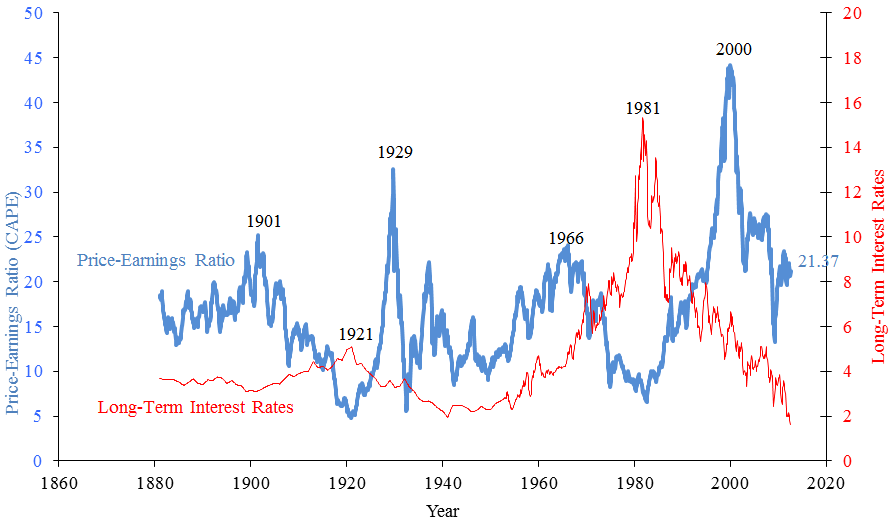
Since 1900, the average P/E ratio for the S&P 500 index has ranged from 4.78 in Dec 1920 to 44.20 in Dec 1999. However, except for some brief periods, during 1920–1990 the market P/E ratio was mostly between 10 and 20.
Price–earnings ratio
The price–earnings ratio, also known as P/E ratio, P/E, or PER, is the ratio of a company's share (stock) price to the company's earnings per share. The ratio is used for valuing companies and to find out whether they are overvalued or undervalued.
As an example, if share A is trading at $24 and the earnings per share for the most recent 12-month period is $3, then share A has a P/E ratio of $24/$3/year = 8 years. Put another way, the purchaser of the share is expecting 8 years to recoup the share price. Companies with losses (negative earnings) or no profit have an undefined P/E ratio (usually shown as "not applicable" or "N/A"); sometimes, however, a negative P/E ratio may be shown. There is a general consensus among most investors that a P/E ratio of around 10 to 20 is 'fairly valued' but this is sector-dependent.
There are multiple versions of the P/E ratio, depending on whether earnings are projected or realized, and the type of earnings.
Some people also use the formula market capitalization/ net income to calculate the P/E ratio. This formula often gives the same answer as market price/ earnings per share, (if new capital has been issued it gives the wrong answer), as market capitalization = (market price) × (current number of shares), whereas earnings per share = net income/ average number of shares.
Variations on the standard trailing and forward P/E ratios are common. Generally, alternative P/E measures substitute different measures of earnings, such as rolling averages over longer periods of time (to attempt to "smooth" volatile or cyclical earnings, for example), or "corrected" earnings figures that exclude certain extraordinary events or one-off gains or losses. The definitions may not be standardized. For companies that are loss-making, or whose earnings are expected to change dramatically, a "primary" P/E can be used instead, based on the earnings projections made for the next years to which a discount calculation is applied.
As the ratio of a stock (share price) to a flow (earnings per share), the P/E ratio has the units of time. It can be interpreted as the amount of time over which the company would need to sustain its current earnings in order to make enough money to pay back the current share price. While the P/E ratio can in principle be given in terms of any time unit, in practice it is essentially always implicitly reported in years, with the unit of "years" rarely indicated explicitly. (This is the convention followed in this article.)[dubious – discuss]
The price/earnings ratio (PER) is the most widely used method for determining whether shares are "correctly" valued in relation to one another. But the PER does not in itself indicate whether the share is a bargain. The PER depends on the market's perception of the risk and future growth in earnings. A company with a low PER indicates that the market perceives it as higher risk or lower growth or both as compared to a company with a higher PER. The PER of a listed company's share is the result of the collective perception of the market as to how risky the company is and what its earnings growth prospects are in relation to that of other companies. Investors use the PER to compare their own perception of the risk and growth of a company against the market's collective perception of the risk and growth as reflected in the current PER. If investors believe that their perception is superior to that of the market, they can make the decision to buy or sell accordingly.
Since 1900, the average P/E ratio for the S&P 500 index has ranged from 4.78 in Dec 1920 to 44.20 in Dec 1999. However, except for some brief periods, during 1920–1990 the market P/E ratio was mostly between 10 and 20.
Recent media
Recent media