



Community hub
Community hub
Recent from talks
Knowledge base stats:
Talk channels stats:
Members stats:
Primary Reserve
The Primary Reserve of the Canadian Armed Forces (French: Première réserve des Forces canadiennes) is the first and largest of the four sub-components of the Canadian Armed Forces reserves, followed by the Supplementary Reserve, the Cadet Organizations Administration and Training Service (formerly the Cadet Instructors Cadre) and the Canadian Rangers.
The reserve force is represented, though not commanded, at the national level by the chief of reserves and employer support. This is usually a major-general or rear-admiral.
The Primary Reserve consists of sailors, soldiers, and aviators who may augment or operate alongside their Regular Force counterparts. Each reserve force is operationally and administratively responsible to its corresponding environmental command; those being the Royal Canadian Navy, the Canadian Army and the Royal Canadian Air Force.
Primary reservists number approximately 27,000 (all ranks, all services). The reserves are important to sustaining CF operations, particularly following the defence budget cuts of the 90s.
The Naval Reserve (NAVRES) is the reserve formation of the Royal Canadian Navy (RCN). It is organized into 24 Naval Reserve Divisions (NRDs), shore-based training facilities in communities across the country. Each NRD has a small cadre of full-time reservists and regular force members to coordinate training and administration, but is for the most part directed by the division's part-time leadership. Training is conducted year round with regular force counterparts at the three Canadian Forces Fleet Schools and reservists frequently deploy on regular force ships to augment ships' companies. Traditionally, the Naval Reserve supplied all personnel (except two regular forces electricians and one marine engineer) for the 12 Kingston-class Maritime Coastal Defence Vessels (MCDVs), which are used for patrol, minesweeping and bottom-inspection operations. However in 2017, MCDVs were shifted to a blended crew model, skewing more heavily to being primarily manned by Regular Force (RegF) members. This change was due to the loss of seagoing billets on larger ships typically manned primarily by RegF members. As of 2012, the Naval Reserve had a funded manning level of approximately 4,000 members.[citation needed]. It has since grown, in accordance with the Justin Trudeau Liberal government's 'Strong, Secure, Engaged' defence policy unveiled in 2017.
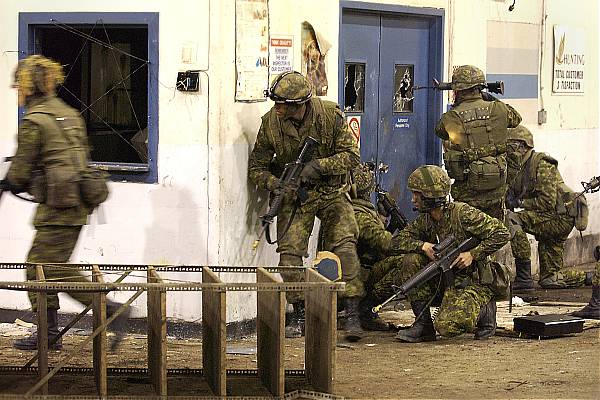
The Army Reserve of the Canadian Army is the largest part of the Primary Reserve, with an authorized strength of over 18,000 troops. It is sometimes referred to by its original and historic name, the "Militia". During operations the Army Reserve is tasked to provide fully trained and equipped troops to augment the regular army. It is the time-tested backbone of the Canadian Army and perpetuates the historic force generation mission. In times of national emergency, it is tasked with providing subordinate units (like platoons and companies) and complete units (battalions). It forms the framework needed to raise a national army during wartime and or insurrection.
This fighting mission has not changed much since the Second World War, when the majority of combat units overseas were mobilized reserve battalions detached from their home regiments. In keeping with this mission, regiments of the Army Reserve exist at cadre strength and have a theoretical administrative capacity to support a full battalion upon mobilization, although they maintain a standing force that can typically deploy the manpower of a reduced company. This perpetuates the regimental system in the reserve army so that it is available as such for the timely absorption of recruits in case of war or in aid of the civil power. Such as when the need may one day arise, to call out more than 27,000 supplementary reservists and cadet instructors (who are also subjected to provide general service), to reinforce the order of battle, bringing it up to war establishment. However, in practice the regimental system exists as an important military institution for Canada. In addition to the tactical contribution provided for today's Total Force they also provide a deep-rooted community tie and focus on Canada's proud military tradition.
The true strength of the Army Reserve is the strong connection that the extended regimental family fosters with the community. From coast to coast, regimental depots support Regimental Bands, sponsor Army Cadet Corps, participate in ceremonial duties and parades with some even operating old comrade associations from non-public funds. Many of these activities are overseen by the regimental honorary colonel and honorary lieutenant-colonel. Although the vast Canadian geography and demographic factors impact unit composition they mostly functions in much the same way. During peacetime the Regimental establishment will only be the equivalent of a much reduced battalion of a couple hundred troops and less in some cases.
Hub AI
Primary Reserve AI simulator
(@Primary Reserve_simulator)
Primary Reserve
The Primary Reserve of the Canadian Armed Forces (French: Première réserve des Forces canadiennes) is the first and largest of the four sub-components of the Canadian Armed Forces reserves, followed by the Supplementary Reserve, the Cadet Organizations Administration and Training Service (formerly the Cadet Instructors Cadre) and the Canadian Rangers.
The reserve force is represented, though not commanded, at the national level by the chief of reserves and employer support. This is usually a major-general or rear-admiral.
The Primary Reserve consists of sailors, soldiers, and aviators who may augment or operate alongside their Regular Force counterparts. Each reserve force is operationally and administratively responsible to its corresponding environmental command; those being the Royal Canadian Navy, the Canadian Army and the Royal Canadian Air Force.
Primary reservists number approximately 27,000 (all ranks, all services). The reserves are important to sustaining CF operations, particularly following the defence budget cuts of the 90s.
The Naval Reserve (NAVRES) is the reserve formation of the Royal Canadian Navy (RCN). It is organized into 24 Naval Reserve Divisions (NRDs), shore-based training facilities in communities across the country. Each NRD has a small cadre of full-time reservists and regular force members to coordinate training and administration, but is for the most part directed by the division's part-time leadership. Training is conducted year round with regular force counterparts at the three Canadian Forces Fleet Schools and reservists frequently deploy on regular force ships to augment ships' companies. Traditionally, the Naval Reserve supplied all personnel (except two regular forces electricians and one marine engineer) for the 12 Kingston-class Maritime Coastal Defence Vessels (MCDVs), which are used for patrol, minesweeping and bottom-inspection operations. However in 2017, MCDVs were shifted to a blended crew model, skewing more heavily to being primarily manned by Regular Force (RegF) members. This change was due to the loss of seagoing billets on larger ships typically manned primarily by RegF members. As of 2012, the Naval Reserve had a funded manning level of approximately 4,000 members.[citation needed]. It has since grown, in accordance with the Justin Trudeau Liberal government's 'Strong, Secure, Engaged' defence policy unveiled in 2017.
The Army Reserve of the Canadian Army is the largest part of the Primary Reserve, with an authorized strength of over 18,000 troops. It is sometimes referred to by its original and historic name, the "Militia". During operations the Army Reserve is tasked to provide fully trained and equipped troops to augment the regular army. It is the time-tested backbone of the Canadian Army and perpetuates the historic force generation mission. In times of national emergency, it is tasked with providing subordinate units (like platoons and companies) and complete units (battalions). It forms the framework needed to raise a national army during wartime and or insurrection.
This fighting mission has not changed much since the Second World War, when the majority of combat units overseas were mobilized reserve battalions detached from their home regiments. In keeping with this mission, regiments of the Army Reserve exist at cadre strength and have a theoretical administrative capacity to support a full battalion upon mobilization, although they maintain a standing force that can typically deploy the manpower of a reduced company. This perpetuates the regimental system in the reserve army so that it is available as such for the timely absorption of recruits in case of war or in aid of the civil power. Such as when the need may one day arise, to call out more than 27,000 supplementary reservists and cadet instructors (who are also subjected to provide general service), to reinforce the order of battle, bringing it up to war establishment. However, in practice the regimental system exists as an important military institution for Canada. In addition to the tactical contribution provided for today's Total Force they also provide a deep-rooted community tie and focus on Canada's proud military tradition.
The true strength of the Army Reserve is the strong connection that the extended regimental family fosters with the community. From coast to coast, regimental depots support Regimental Bands, sponsor Army Cadet Corps, participate in ceremonial duties and parades with some even operating old comrade associations from non-public funds. Many of these activities are overseen by the regimental honorary colonel and honorary lieutenant-colonel. Although the vast Canadian geography and demographic factors impact unit composition they mostly functions in much the same way. During peacetime the Regimental establishment will only be the equivalent of a much reduced battalion of a couple hundred troops and less in some cases.