


Community hub
Recent from talks
Contribute something to knowledge base
Content stats: 0 posts, 0 articles, 1 media, 0 notes
Members stats: 0 subscribers, 0 contributors, 0 moderators, 0 supporters
Subscribers
Supporters
Contributors
Moderators
Hub AI
Product life-cycle management (marketing) AI simulator
(@Product life-cycle management (marketing)_simulator)
Hub AI
Product life-cycle management (marketing) AI simulator
(@Product life-cycle management (marketing)_simulator)
Product life-cycle management (marketing)
Product life-cycle management (PLM) is the succession of strategies by business management as a product goes through its life-cycle. The conditions in which a product is sold (advertising, saturation) changes over time and must be managed as it moves through its succession of stages. The economist Theodore Levitt referred to the concept in a 1965 Harvard Business Review article, where he observed that "most alert and thoughtful senior marketing executives", and even "a handful of uniquely cosmopolitan and up-to-date corporate presidents" were by then "familiar with the concept of the product life cycle" but needed to move forward in using it commercially.
The goals of product life cycle management (PLM) are to reduce time to market, improve product quality, reduce prototyping costs, identify potential sales opportunities and revenue contributions, maintain and sustain operational serviceability, and reduce environmental impacts at end-of-life. To create successful new products the company must understand its customers, markets and competitors. PLM integrates people, data, processes and business systems. It provides product information for companies and their extended supply chain enterprise. PLM solutions help organizations overcome the increased complexity and engineering challenges of developing new products for the global competitive markets.[citation needed]
The concept of product life cycle (PLC) concerns the life of a product in the market with respect to business/commercial costs and sales measures. The product life cycle proceeds through several phases, involves many professional disciplines, and requires many skills, tools and processes. PLC management makes the following three assumptions:[citation needed]
Once the product is designed and put into the market, the offering should be managed efficiently for the buyers to get value from it. Before entering into any market complete analysis is carried out by the industry for both external and internal factors including the laws and regulations, environment, economics, cultural values and market needs. From the business perspective, as a good business, the product needs to be sold before it finishes its life. In terms of profitability, expiry may jolt the overall profitability of the business therefore there are few strategies, which are practiced to ensure that the product is sold within the defined period of maturity.
Extending the product life cycle by improving sales, can be done through
Something important to notice is that all these techniques rely on advertising to become known. Advertising needs the others to target other potential customers and not the same over and over again.
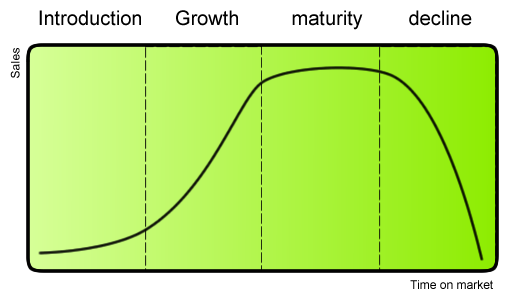
Four of five stages are typically used to characterise the product life cycle. Harold W. Fox referred to a five stage "sales model" in 1975, with precommercialization, market introduction, growth, maturity, and decline as his five stages. The precommercialization stage is also referred to as "development". The four stage model consists of:
Whilst Levitt noted that the concept of the product life cycle was well-known, he argued that it was being underused and had greater potential to support business strategies than had been considered at that time. Three "operating questions" which he put forward for business executives to ask and answer were concerned with:
Product life-cycle management (marketing)
Product life-cycle management (PLM) is the succession of strategies by business management as a product goes through its life-cycle. The conditions in which a product is sold (advertising, saturation) changes over time and must be managed as it moves through its succession of stages. The economist Theodore Levitt referred to the concept in a 1965 Harvard Business Review article, where he observed that "most alert and thoughtful senior marketing executives", and even "a handful of uniquely cosmopolitan and up-to-date corporate presidents" were by then "familiar with the concept of the product life cycle" but needed to move forward in using it commercially.
The goals of product life cycle management (PLM) are to reduce time to market, improve product quality, reduce prototyping costs, identify potential sales opportunities and revenue contributions, maintain and sustain operational serviceability, and reduce environmental impacts at end-of-life. To create successful new products the company must understand its customers, markets and competitors. PLM integrates people, data, processes and business systems. It provides product information for companies and their extended supply chain enterprise. PLM solutions help organizations overcome the increased complexity and engineering challenges of developing new products for the global competitive markets.[citation needed]
The concept of product life cycle (PLC) concerns the life of a product in the market with respect to business/commercial costs and sales measures. The product life cycle proceeds through several phases, involves many professional disciplines, and requires many skills, tools and processes. PLC management makes the following three assumptions:[citation needed]
Once the product is designed and put into the market, the offering should be managed efficiently for the buyers to get value from it. Before entering into any market complete analysis is carried out by the industry for both external and internal factors including the laws and regulations, environment, economics, cultural values and market needs. From the business perspective, as a good business, the product needs to be sold before it finishes its life. In terms of profitability, expiry may jolt the overall profitability of the business therefore there are few strategies, which are practiced to ensure that the product is sold within the defined period of maturity.
Extending the product life cycle by improving sales, can be done through
Something important to notice is that all these techniques rely on advertising to become known. Advertising needs the others to target other potential customers and not the same over and over again.
Four of five stages are typically used to characterise the product life cycle. Harold W. Fox referred to a five stage "sales model" in 1975, with precommercialization, market introduction, growth, maturity, and decline as his five stages. The precommercialization stage is also referred to as "development". The four stage model consists of:
Whilst Levitt noted that the concept of the product life cycle was well-known, he argued that it was being underused and had greater potential to support business strategies than had been considered at that time. Three "operating questions" which he put forward for business executives to ask and answer were concerned with:
Recent media
Recent media