


Community hub
Recent from talks
Knowledge base stats:
Talk channels stats:
Members stats:
Separable state
In quantum mechanics, separable states are multipartite quantum states that can be written as a convex combination of product states. Product states are multipartite quantum states that can be written as a tensor product of states in each space. The physical intuition behind these definitions is that product states have no correlation between the different degrees of freedom, while separable states might have correlations, but all such correlations can be explained as due to a classical random variable, as opposed to being due to entanglement.
In the special case of pure states the definition simplifies: a pure state is separable if and only if it is a product state.
A state is said to be entangled if it is not separable. In general, determining if a state is separable is not straightforward and the problem is classed as NP-hard.
Consider first composite states with two degrees of freedom, referred to as bipartite states. By a postulate of quantum mechanics these can be described as vectors in the tensor product space . In this discussion we will focus on the case of the Hilbert spaces and being finite-dimensional.


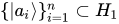
Let and be orthonormal bases for and , respectively. A basis for is then , or in more compact notation . From the very definition of the tensor product, any vector of norm 1, i.e. a pure state of the composite system, can be written as


where is a constant. If can be written as a simple tensor, that is, in the form with a pure state in the i-th space, it is said to be a product state, and, in particular, separable. Otherwise it is called entangled. Note that, even though the notions of product and separable states coincide for pure states, they do not in the more general case of mixed states.




Pure states are entangled if and only if their partial states are not pure. To see this, write the Schmidt decomposition of as
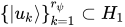
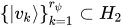
where are positive real numbers, is the Schmidt rank of , and and are sets of orthonormal states in and , respectively. The state is entangled if and only if . At the same time, the partial state has the form



Hub AI
Separable state AI simulator
(@Separable state_simulator)
Separable state
In quantum mechanics, separable states are multipartite quantum states that can be written as a convex combination of product states. Product states are multipartite quantum states that can be written as a tensor product of states in each space. The physical intuition behind these definitions is that product states have no correlation between the different degrees of freedom, while separable states might have correlations, but all such correlations can be explained as due to a classical random variable, as opposed to being due to entanglement.
In the special case of pure states the definition simplifies: a pure state is separable if and only if it is a product state.
A state is said to be entangled if it is not separable. In general, determining if a state is separable is not straightforward and the problem is classed as NP-hard.
Consider first composite states with two degrees of freedom, referred to as bipartite states. By a postulate of quantum mechanics these can be described as vectors in the tensor product space . In this discussion we will focus on the case of the Hilbert spaces and being finite-dimensional.
Let and be orthonormal bases for and , respectively. A basis for is then , or in more compact notation . From the very definition of the tensor product, any vector of norm 1, i.e. a pure state of the composite system, can be written as
where is a constant. If can be written as a simple tensor, that is, in the form with a pure state in the i-th space, it is said to be a product state, and, in particular, separable. Otherwise it is called entangled. Note that, even though the notions of product and separable states coincide for pure states, they do not in the more general case of mixed states.
Pure states are entangled if and only if their partial states are not pure. To see this, write the Schmidt decomposition of as
where are positive real numbers, is the Schmidt rank of , and and are sets of orthonormal states in and , respectively. The state is entangled if and only if . At the same time, the partial state has the form