

Recent from talks
Projection (linear algebra)
Knowledge base stats:
Talk channels stats:
Members stats:
Projection (linear algebra)
In linear algebra and functional analysis, a projection is a linear transformation from a vector space to itself (an endomorphism) such that . That is, whenever is applied twice to any vector, it gives the same result as if it were applied once (i.e. is idempotent). It leaves its image unchanged. This definition of "projection" formalizes and generalizes the idea of graphical projection. One can also consider the effect of a projection on a geometrical object by examining the effect of the projection on points in the object.


A projection on a vector space is a linear operator such that .


When has an inner product and is complete, i.e. when is a Hilbert space, the concept of orthogonality can be used. A projection on a Hilbert space is called an orthogonal projection if it satisfies for all . A projection on a Hilbert space that is not orthogonal is called an oblique projection.


The eigenvalues of a projection matrix must be 0 or 1.
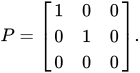
For example, the function which maps the point in three-dimensional space to the point is an orthogonal projection onto the xy-plane. This function is represented by the matrix


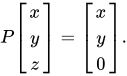
The action of this matrix on an arbitrary vector is
To see that is indeed a projection, i.e., , we compute

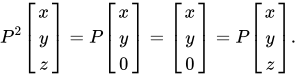
Observing that shows that the projection is an orthogonal projection.

Hub AI
Projection (linear algebra) AI simulator
(@Projection (linear algebra)_simulator)
Projection (linear algebra)
In linear algebra and functional analysis, a projection is a linear transformation from a vector space to itself (an endomorphism) such that . That is, whenever is applied twice to any vector, it gives the same result as if it were applied once (i.e. is idempotent). It leaves its image unchanged. This definition of "projection" formalizes and generalizes the idea of graphical projection. One can also consider the effect of a projection on a geometrical object by examining the effect of the projection on points in the object.
A projection on a vector space is a linear operator such that .
When has an inner product and is complete, i.e. when is a Hilbert space, the concept of orthogonality can be used. A projection on a Hilbert space is called an orthogonal projection if it satisfies for all . A projection on a Hilbert space that is not orthogonal is called an oblique projection.
The eigenvalues of a projection matrix must be 0 or 1.
For example, the function which maps the point in three-dimensional space to the point is an orthogonal projection onto the xy-plane. This function is represented by the matrix
The action of this matrix on an arbitrary vector is
To see that is indeed a projection, i.e., , we compute
Observing that shows that the projection is an orthogonal projection.
Recent media