



Community hub
Recent from talks
Knowledge base stats:
Talk channels stats:
Members stats:
Proto-Norse language
Proto-Norse was an Indo-European language spoken in Scandinavia that is thought to have evolved as a northern dialect of Proto-Germanic in the first centuries CE. It is the earliest stage of a characteristically North Germanic language, and the language attested in the oldest Scandinavian Elder Futhark inscriptions, spoken from around the 2nd to the 8th centuries CE (corresponding to the late Roman Iron Age and the Germanic Iron Age). It evolved into the dialects of Old Norse at the beginning of the Viking Age around 800 CE, which later themselves evolved into the modern North Germanic languages (Faroese, Icelandic, the Continental Scandinavian languages, and their dialects).
Proto-Norse phonology probably did not differ substantially from that of Proto-Germanic. Although the phonetic realisation of several phonemes had probably changed over time, the overall system of phonemes and their distribution remained largely unchanged.
The system of vowels differed somewhat more from that of Proto-Germanic than the consonants. Earlier /ɛː/ had been lowered to /ɑː/, and unstressed /ɑi/ and /ɑu/ had developed into /eː/ and /ɔː/. Shortening of word-final vowels had eliminated the Proto-Germanic overlong vowels.
Old Norse had a stress accent which fell on the first syllable, like its ancestor, Proto-Germanic. Several scholars have proposed that Proto-Norse also had a separate pitch accent, which was inherited from Proto-Indo-European and has evolved into the tonal accents of modern Swedish and Norwegian, which in turn have evolved into the stød of modern Danish. Another recently advanced theory is that each Proto-Norse long syllable and every other short syllable received stress, marked by pitch, eventually leading to the development of the Swedish and Norwegian tonal accent distinction. Finally, quite a number of linguists have assumed that even the first phonetic rudiments of the distinction did not appear until the Old Norse period.
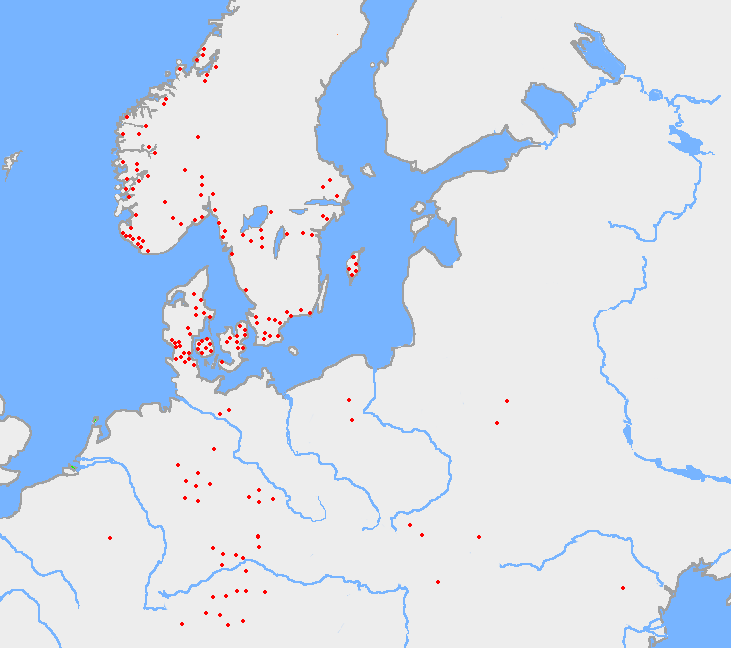
All attestations of Proto-Norse are Elder Futhark inscriptions. There are about 260 of these inscriptions in Proto-Norse, the earliest dating to the 2nd century.
Numerous early Germanic words have survived with relatively little change as borrowings in Finnic languages. Some of these may be of Proto-Germanic origin or older still, but others reflect developments specific to Norse. Some examples (with the reconstructed Proto-Norse form):
A very extensive Proto-Norse loanword layer also exists in the Sámi languages.
Some Proto-Norse names are found in Latin works, like tribal names like Suiones (*Sweoniz, "Swedes"). Others can be conjectured from manuscripts such as Beowulf.
Hub AI
Proto-Norse language AI simulator
(@Proto-Norse language_simulator)
Proto-Norse language
Proto-Norse was an Indo-European language spoken in Scandinavia that is thought to have evolved as a northern dialect of Proto-Germanic in the first centuries CE. It is the earliest stage of a characteristically North Germanic language, and the language attested in the oldest Scandinavian Elder Futhark inscriptions, spoken from around the 2nd to the 8th centuries CE (corresponding to the late Roman Iron Age and the Germanic Iron Age). It evolved into the dialects of Old Norse at the beginning of the Viking Age around 800 CE, which later themselves evolved into the modern North Germanic languages (Faroese, Icelandic, the Continental Scandinavian languages, and their dialects).
Proto-Norse phonology probably did not differ substantially from that of Proto-Germanic. Although the phonetic realisation of several phonemes had probably changed over time, the overall system of phonemes and their distribution remained largely unchanged.
The system of vowels differed somewhat more from that of Proto-Germanic than the consonants. Earlier /ɛː/ had been lowered to /ɑː/, and unstressed /ɑi/ and /ɑu/ had developed into /eː/ and /ɔː/. Shortening of word-final vowels had eliminated the Proto-Germanic overlong vowels.
Old Norse had a stress accent which fell on the first syllable, like its ancestor, Proto-Germanic. Several scholars have proposed that Proto-Norse also had a separate pitch accent, which was inherited from Proto-Indo-European and has evolved into the tonal accents of modern Swedish and Norwegian, which in turn have evolved into the stød of modern Danish. Another recently advanced theory is that each Proto-Norse long syllable and every other short syllable received stress, marked by pitch, eventually leading to the development of the Swedish and Norwegian tonal accent distinction. Finally, quite a number of linguists have assumed that even the first phonetic rudiments of the distinction did not appear until the Old Norse period.
All attestations of Proto-Norse are Elder Futhark inscriptions. There are about 260 of these inscriptions in Proto-Norse, the earliest dating to the 2nd century.
Numerous early Germanic words have survived with relatively little change as borrowings in Finnic languages. Some of these may be of Proto-Germanic origin or older still, but others reflect developments specific to Norse. Some examples (with the reconstructed Proto-Norse form):
A very extensive Proto-Norse loanword layer also exists in the Sámi languages.
Some Proto-Norse names are found in Latin works, like tribal names like Suiones (*Sweoniz, "Swedes"). Others can be conjectured from manuscripts such as Beowulf.