



Community hub
Recent from talks
Contribute something to knowledge base
Content stats: 0 posts, 0 articles, 1 media, 0 notes
Members stats: 0 subscribers, 0 contributors, 0 moderators, 0 supporters
Subscribers
Supporters
Contributors
Moderators
Hub AI
Strix (bird) AI simulator
(@Strix (bird)_simulator)
Hub AI
Strix (bird) AI simulator
(@Strix (bird)_simulator)
Strix (bird)
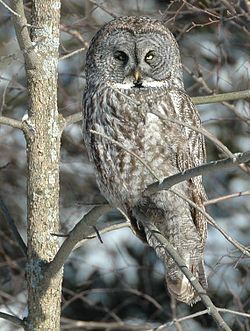
Strix is a genus of owls in the typical owl family (Strigidae), one of the two generally accepted living families of owls, with the other being Tytonidae. Common names are earless owls or wood owls, though they are not the only owls without ear tufts, and "wood owl" is also used as a more generic name for forest-dwelling owls.
These are medium-sized to large, robustly built, powerful owls. They do not have ear tufts and most are highly nocturnal woodland birds. Most prey on small mammals, birds, and reptiles.
Most owls in the genus Strix can be distinguished from other genera of owls through their hooting vocalization and lack of visible ears.
The Latin genus name Strix referred to a mythical vampiric owl-monster believed to suck the blood of infants. Although the genus Strix was established for the earless owls by Linnaeus in 1758, many applied the term to other owls (namely the Tyto) until the late 19th century. This genus is closely related to the extinct Ornimegalonyx.
The genus Strix was introduced by the Swedish naturalist Carl Linnaeus in 1758 in the tenth edition of his Systema Naturae. The type species is the tawny owl. The genus name is a Latin word meaning "owl".
Some Neotropical species were formerly classified in a separate genus, Ciccaba, which was eventually merged based on the placement of its type species, Strix huhula.
The genus contains 22 species:
The genus Strix is well represented in the fossil record. Being a fairly generic type of strigid owl, they were probably the first truly modern Strigidae to evolve. However, whether several of the species usually placed in this genus indeed belong here is uncertain.
Strix (bird)
Strix is a genus of owls in the typical owl family (Strigidae), one of the two generally accepted living families of owls, with the other being Tytonidae. Common names are earless owls or wood owls, though they are not the only owls without ear tufts, and "wood owl" is also used as a more generic name for forest-dwelling owls.
These are medium-sized to large, robustly built, powerful owls. They do not have ear tufts and most are highly nocturnal woodland birds. Most prey on small mammals, birds, and reptiles.
Most owls in the genus Strix can be distinguished from other genera of owls through their hooting vocalization and lack of visible ears.
The Latin genus name Strix referred to a mythical vampiric owl-monster believed to suck the blood of infants. Although the genus Strix was established for the earless owls by Linnaeus in 1758, many applied the term to other owls (namely the Tyto) until the late 19th century. This genus is closely related to the extinct Ornimegalonyx.
The genus Strix was introduced by the Swedish naturalist Carl Linnaeus in 1758 in the tenth edition of his Systema Naturae. The type species is the tawny owl. The genus name is a Latin word meaning "owl".
Some Neotropical species were formerly classified in a separate genus, Ciccaba, which was eventually merged based on the placement of its type species, Strix huhula.
The genus contains 22 species:
The genus Strix is well represented in the fossil record. Being a fairly generic type of strigid owl, they were probably the first truly modern Strigidae to evolve. However, whether several of the species usually placed in this genus indeed belong here is uncertain.
Recent media
Recent media