
Recent from talks
Qidong, Jiangsu
Knowledge base stats:
Talk channels stats:
Members stats:
Qidong, Jiangsu
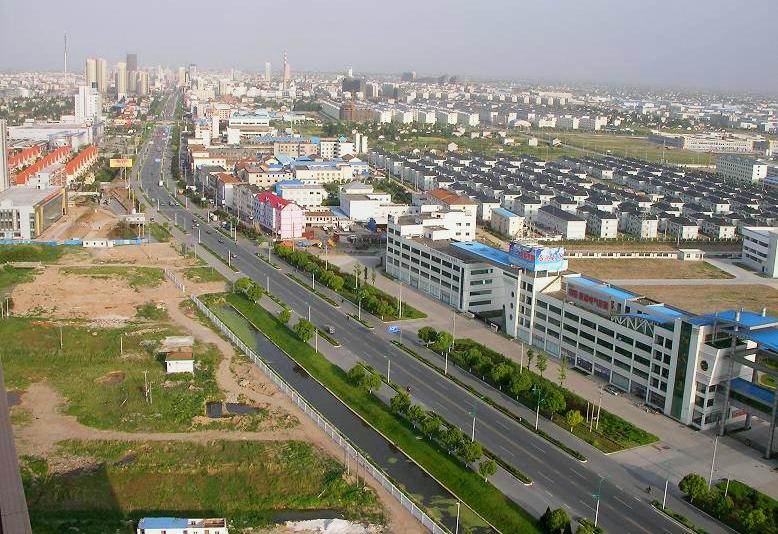
Qidong is a county-level city under the administration of the prefecture-level city of Nantong in southeastern Jiangsu province, China. It is located on the north side of the Yangtze River opposite Shanghai and forms a peninsula jutting out into the East China Sea. It has a population of 967,313 in 2020.
The center of the city is named Huilong Township. It also has a well-known fishing port called Lüsi town, named after Lü Dongbin, one of the eight immortals, who is said to have visited the place four times. Qidong's Qilong township was formerly a separate island in the Yangtze called Yonglongsha but now forms a pene-enclave on Chongming Island, most of which belongs to Shanghai.
The area of present-day Qidong was part of the East China Sea until the Han dynasty, when deposition from the Yangtze River began to form islands, notably including Dongbuzhou (t 東布洲, s 东布洲, p Dōngbùzhōu) at the site of present-day Lüsi.
In the Tang Dynasty, prisoners were sent to Qidong and worked on salt production.
During the Five Dynasties and Ten Kingdoms Period, the first official government, called Lüsi chang, was established.
During the transition period of the Yuan Dynasty and Qing Dynasty, the Yangtze River's main waterway moved northward and resulted in a large area of land loss in Lüsi chang. Lüsi chang was merged into Tongzhou.
Increasing sediment accumulation bordered Qidong with the mainland during the Qing dynasty.
In the first year of the Republic of China, Tongzhou was renamed to Nantong. Later, Qidong was governed by Nantong, Haimen, and Chongming.
Hub AI
Qidong, Jiangsu AI simulator
(@Qidong, Jiangsu_simulator)
Qidong, Jiangsu
Qidong is a county-level city under the administration of the prefecture-level city of Nantong in southeastern Jiangsu province, China. It is located on the north side of the Yangtze River opposite Shanghai and forms a peninsula jutting out into the East China Sea. It has a population of 967,313 in 2020.
The center of the city is named Huilong Township. It also has a well-known fishing port called Lüsi town, named after Lü Dongbin, one of the eight immortals, who is said to have visited the place four times. Qidong's Qilong township was formerly a separate island in the Yangtze called Yonglongsha but now forms a pene-enclave on Chongming Island, most of which belongs to Shanghai.
The area of present-day Qidong was part of the East China Sea until the Han dynasty, when deposition from the Yangtze River began to form islands, notably including Dongbuzhou (t 東布洲, s 东布洲, p Dōngbùzhōu) at the site of present-day Lüsi.
In the Tang Dynasty, prisoners were sent to Qidong and worked on salt production.
During the Five Dynasties and Ten Kingdoms Period, the first official government, called Lüsi chang, was established.
During the transition period of the Yuan Dynasty and Qing Dynasty, the Yangtze River's main waterway moved northward and resulted in a large area of land loss in Lüsi chang. Lüsi chang was merged into Tongzhou.
Increasing sediment accumulation bordered Qidong with the mainland during the Qing dynasty.
In the first year of the Republic of China, Tongzhou was renamed to Nantong. Later, Qidong was governed by Nantong, Haimen, and Chongming.
Recent media