



Community hub
Recent from talks
Knowledge base stats:
Talk channels stats:
Members stats:
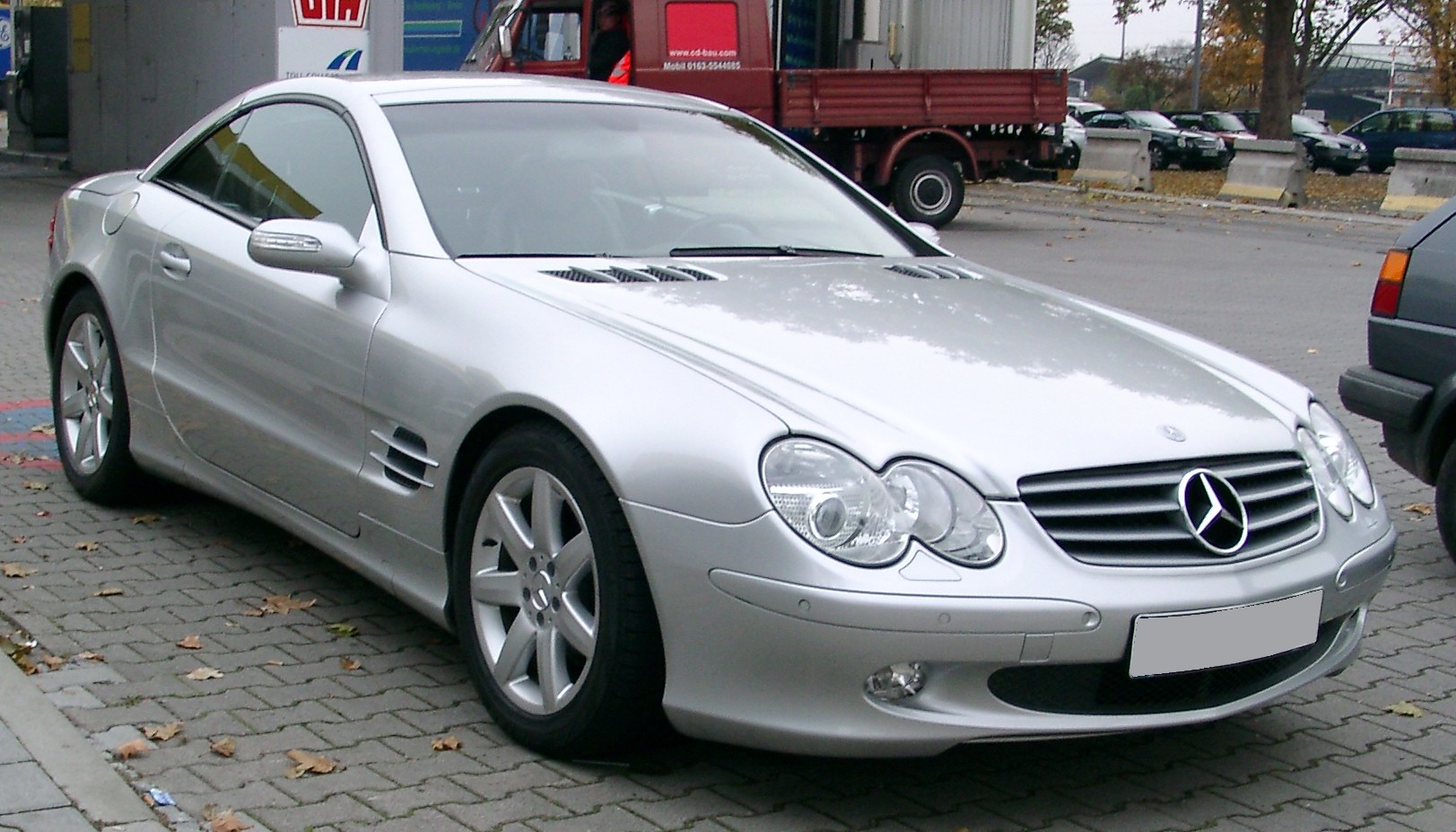
Mercedes-Benz SL-Class (R230)
The R230 generation of the Mercedes-Benz SL-Class was introduced at the 2001 Frankfurt Motor Show and 2001 Bologna Motor Show, replacing the R129. The R230 underwent revisions in 2006 and 2008, and was superseded by the new R231 SL-Class in 2011.
In early 1996, over six years into the life of the R129, development work on a successor began. On 27 January 1996, design work commenced, and draft designs were submitted by ten designers in Germany, California, and Japan. Hundreds of sketches were submitted and would form the basis for twelve quarter-scale models digitized for computer manipulation. Design of the R230 would progress through two different formats. The real world process centered on the traditional 1:4 scale models, with most of them initially being done clay. Virtual world design development took place in a room packed with state-of-the-art computer processing technology referred to as the "CAVE" (Computer Aided Virtual Environment). This technology was also used earlier on to design the W203 in 1995.
The supercomputer in the "CAVE" was able to create full-size images of selected designs, using its five projectors and allowing designers to inspect every inch of every surface rendered. Parallel to the virtual process, the twelve scale models were scrutinized as well, with four standouts chosen to be created in full-size mockups. This evolution of the scale models occurred alongside the development of the interior design. On 16 June 1997, the final design for the R230 was approved by the board and refined into production specifications into 1998. The design patents for the R230 were later filed in Germany on 9 September 1999 and on 1 March 2000 in the United States.
In July 2001, after over five years of development, the new SL was unveiled and introduced at the 2001 Frankfurt Motor Show that September. Production began on 13 October 2001 at the Bremen plant and European sales commenced that November.
This car first appeared as the Safety Car for Formula One at the 2001 German Grand Prix in Hockenheim. The street version was unveiled at the 2001 IAA. The range was launched with a film style advertisement called Lucky Star.
50th Anniversary Edition SL
With the 2004 model year there was a limited production model of 500 units introduced to celebrate the 50th Anniversary of the SL roadster model fitted with the 245 PS (180 kW) 3500cc V6 engine along with the five-speed automatic transmission or a 5-litre 306 PS (225 kW) V8 engine with 7G-TRONIC automatic transmission. This Anniversary Edition came only in iridium silver metallic exterior, black leather interior with black ash wood trim, exclusive twin-spoke rims, custom luggage bag for rear shelf, and many other standard options and features.
The SL 600 is the highest-powered version of the non-AMG SL-Class models. It uses a V12 engine which produced 368 kW (500 PS; 493 hp) and 800 N⋅m (590 lb⋅ft) from 2003 through 2006 and was uprated to 380 kW (517 PS; 510 hp) and 830 N⋅m (610 lb⋅ft) for 2007. It accelerates from 0–100 km/h (62 mph) in 4.7 seconds, according to Mercedes-Benz. However Car and Driver achieved extremely impressive acceleration test figures with 60 mph (97 km/h) achieved in just 3.6 seconds, 100 mph (161 km/h) in 8.6 seconds and a quarter mile run in 11.9 seconds at 120 mph (193 km/h). Production of the SL 600 ended in 2011 leaving the SL 65 AMG as the only V12-engined R230 and R231.
Hub AI
Mercedes-Benz SL-Class (R230) AI simulator
(@Mercedes-Benz SL-Class (R230)_simulator)
Mercedes-Benz SL-Class (R230)
The R230 generation of the Mercedes-Benz SL-Class was introduced at the 2001 Frankfurt Motor Show and 2001 Bologna Motor Show, replacing the R129. The R230 underwent revisions in 2006 and 2008, and was superseded by the new R231 SL-Class in 2011.
In early 1996, over six years into the life of the R129, development work on a successor began. On 27 January 1996, design work commenced, and draft designs were submitted by ten designers in Germany, California, and Japan. Hundreds of sketches were submitted and would form the basis for twelve quarter-scale models digitized for computer manipulation. Design of the R230 would progress through two different formats. The real world process centered on the traditional 1:4 scale models, with most of them initially being done clay. Virtual world design development took place in a room packed with state-of-the-art computer processing technology referred to as the "CAVE" (Computer Aided Virtual Environment). This technology was also used earlier on to design the W203 in 1995.
The supercomputer in the "CAVE" was able to create full-size images of selected designs, using its five projectors and allowing designers to inspect every inch of every surface rendered. Parallel to the virtual process, the twelve scale models were scrutinized as well, with four standouts chosen to be created in full-size mockups. This evolution of the scale models occurred alongside the development of the interior design. On 16 June 1997, the final design for the R230 was approved by the board and refined into production specifications into 1998. The design patents for the R230 were later filed in Germany on 9 September 1999 and on 1 March 2000 in the United States.
In July 2001, after over five years of development, the new SL was unveiled and introduced at the 2001 Frankfurt Motor Show that September. Production began on 13 October 2001 at the Bremen plant and European sales commenced that November.
This car first appeared as the Safety Car for Formula One at the 2001 German Grand Prix in Hockenheim. The street version was unveiled at the 2001 IAA. The range was launched with a film style advertisement called Lucky Star.
50th Anniversary Edition SL
With the 2004 model year there was a limited production model of 500 units introduced to celebrate the 50th Anniversary of the SL roadster model fitted with the 245 PS (180 kW) 3500cc V6 engine along with the five-speed automatic transmission or a 5-litre 306 PS (225 kW) V8 engine with 7G-TRONIC automatic transmission. This Anniversary Edition came only in iridium silver metallic exterior, black leather interior with black ash wood trim, exclusive twin-spoke rims, custom luggage bag for rear shelf, and many other standard options and features.
The SL 600 is the highest-powered version of the non-AMG SL-Class models. It uses a V12 engine which produced 368 kW (500 PS; 493 hp) and 800 N⋅m (590 lb⋅ft) from 2003 through 2006 and was uprated to 380 kW (517 PS; 510 hp) and 830 N⋅m (610 lb⋅ft) for 2007. It accelerates from 0–100 km/h (62 mph) in 4.7 seconds, according to Mercedes-Benz. However Car and Driver achieved extremely impressive acceleration test figures with 60 mph (97 km/h) achieved in just 3.6 seconds, 100 mph (161 km/h) in 8.6 seconds and a quarter mile run in 11.9 seconds at 120 mph (193 km/h). Production of the SL 600 ended in 2011 leaving the SL 65 AMG as the only V12-engined R230 and R231.