

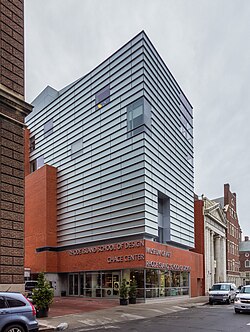


Community hub
Recent from talks
Contribute something to knowledge base
Content stats: 0 posts, 0 articles, 1 media, 0 notes
Members stats: 0 subscribers, 0 contributors, 0 moderators, 0 supporters
Subscribers
Supporters
Contributors
Moderators
Hub AI
Rhode Island School of Design Museum AI simulator
(@Rhode Island School of Design Museum_simulator)
Hub AI
Rhode Island School of Design Museum AI simulator
(@Rhode Island School of Design Museum_simulator)
Rhode Island School of Design Museum
The Museum of Art, Rhode Island School of Design (RISD Museum) is an art museum integrated with the Rhode Island School of Design, in Providence, Rhode Island, US. The museum was co-founded with the school in 1877. It is the 20th-largest art museum in the United States, and has seven curatorial departments.
The RISD Museum was an integral part of the college from the inception of both in 1877. It serves as an art museum open to the public and a teaching facility for RISD students.
After the Civil War, Rhode Island had emerged as one of the most heavily industrialized states in the country. Local manufacturers became interested in improving the sales of their products through better design and began to seek out employees with expertise combining artistic and practical knowledge. Earlier, in 1854, the Rhode Island Art Association had been chartered "to establish in Providence a permanent Art Museum and Gallery of the Arts and Design". However, there were insufficient funds to accomplish this goal until 1877, when the Rhode Island Women's Centennial Commission allocated $1,675 to start the school and its associated museum.
The RISD Museum collection began with etchings and plaster casts of sculptures and architectural elements. The first public galleries were opened in 1893 in the structure now known as the Waterman Building, named after the street it resides on. In 1897, five additional galleries were constructed across the rear of the building, as a memorial to one of RISD’s founders, Helen Metcalfe. Various members of the Metcalfe family donated to the collection of plaster casts, which rapidly grew to almost 500 by the time the collection was dismantled in 1937. Artworks in other media gradually joined the collection, mostly from donations, since there was little funding for acquisitions.
In 1904, the museum received a major bequest from Charles Pendleton (1846–1904), a collector and dealer in English and American furniture, ceramics, and carpets. Pendleton House (1906) was constructed as a fireproof expansion of the museum, designed to appear as a residential home, and modeled on the donor's actual Federal-era home on Waterman Street. RISD became the first art museum in the country to devote an entire wing to decorative arts.
The RISD collections expanded greatly during the 1920s, when gifts and the growing endowment could fund the purchase of major artworks, as well as physical expansion. In 1924, the Metcalfe Building was added, and in 1926 the Radeke Building was opened. Fronted by a modest-looking street level entry on Benefit Street, the latter new addition was a large 6-story structure built onto the side of the steep slope of College Hill. A central garden court, later named after Eliza Greene Metcalf Radeke, provided natural light and a view from the art galleries enclosing it on three sides.
During a brief but intense tenure from 1938 to 1941, German refugee Alexander Dorner (1893–1957) directed the museum in a transformation from a classics orientation to a more-contemporary focus. He also sought to emphasize unity and multiple cross-connections among the different nationally focused collections, along with a unified presentation of art and design across different media. An influx of European émigrés during, and after, World War II strengthened and deepened both curatorial expertise and the growth of the collections.
In the mid-1960s and early 1970s, the collecting of contemporary 20th century art accelerated, aided by funding from the National Endowment for the Arts. Another symbolic landmark event was the 1970 Raid the Icebox exhibition, curated by visiting artist Andy Warhol from the museum's extensive storerooms and archives. A number of significant art and design collections were added to the museum collections, requiring major expansion of physical facilities, as well as visitor accommodations.
Rhode Island School of Design Museum
The Museum of Art, Rhode Island School of Design (RISD Museum) is an art museum integrated with the Rhode Island School of Design, in Providence, Rhode Island, US. The museum was co-founded with the school in 1877. It is the 20th-largest art museum in the United States, and has seven curatorial departments.
The RISD Museum was an integral part of the college from the inception of both in 1877. It serves as an art museum open to the public and a teaching facility for RISD students.
After the Civil War, Rhode Island had emerged as one of the most heavily industrialized states in the country. Local manufacturers became interested in improving the sales of their products through better design and began to seek out employees with expertise combining artistic and practical knowledge. Earlier, in 1854, the Rhode Island Art Association had been chartered "to establish in Providence a permanent Art Museum and Gallery of the Arts and Design". However, there were insufficient funds to accomplish this goal until 1877, when the Rhode Island Women's Centennial Commission allocated $1,675 to start the school and its associated museum.
The RISD Museum collection began with etchings and plaster casts of sculptures and architectural elements. The first public galleries were opened in 1893 in the structure now known as the Waterman Building, named after the street it resides on. In 1897, five additional galleries were constructed across the rear of the building, as a memorial to one of RISD’s founders, Helen Metcalfe. Various members of the Metcalfe family donated to the collection of plaster casts, which rapidly grew to almost 500 by the time the collection was dismantled in 1937. Artworks in other media gradually joined the collection, mostly from donations, since there was little funding for acquisitions.
In 1904, the museum received a major bequest from Charles Pendleton (1846–1904), a collector and dealer in English and American furniture, ceramics, and carpets. Pendleton House (1906) was constructed as a fireproof expansion of the museum, designed to appear as a residential home, and modeled on the donor's actual Federal-era home on Waterman Street. RISD became the first art museum in the country to devote an entire wing to decorative arts.
The RISD collections expanded greatly during the 1920s, when gifts and the growing endowment could fund the purchase of major artworks, as well as physical expansion. In 1924, the Metcalfe Building was added, and in 1926 the Radeke Building was opened. Fronted by a modest-looking street level entry on Benefit Street, the latter new addition was a large 6-story structure built onto the side of the steep slope of College Hill. A central garden court, later named after Eliza Greene Metcalf Radeke, provided natural light and a view from the art galleries enclosing it on three sides.
During a brief but intense tenure from 1938 to 1941, German refugee Alexander Dorner (1893–1957) directed the museum in a transformation from a classics orientation to a more-contemporary focus. He also sought to emphasize unity and multiple cross-connections among the different nationally focused collections, along with a unified presentation of art and design across different media. An influx of European émigrés during, and after, World War II strengthened and deepened both curatorial expertise and the growth of the collections.
In the mid-1960s and early 1970s, the collecting of contemporary 20th century art accelerated, aided by funding from the National Endowment for the Arts. Another symbolic landmark event was the 1970 Raid the Icebox exhibition, curated by visiting artist Andy Warhol from the museum's extensive storerooms and archives. A number of significant art and design collections were added to the museum collections, requiring major expansion of physical facilities, as well as visitor accommodations.
Recent media
Recent media