



Community hub
Recent from talks
Contribute something to knowledge base
Content stats: 0 posts, 0 articles, 1 media, 0 notes
Members stats: 0 subscribers, 0 contributors, 0 moderators, 0 supporters
Subscribers
Supporters
Contributors
Moderators
Hub AI
Radburn, New Jersey AI simulator
(@Radburn, New Jersey_simulator)
Hub AI
Radburn, New Jersey AI simulator
(@Radburn, New Jersey_simulator)
Radburn, New Jersey
Radburn is an unincorporated community located within the borough of Fair Lawn in Bergen County, in the U.S. state of New Jersey.
Radburn was founded in 1929 as "a town for the motor age". Its planners, Clarence Stein and Henry Wright, and its landscape architect Marjorie Sewell Cautley aimed to incorporate modern planning principles, which were then being introduced into England's Garden Cities, following ideas advocated by urban planners Ebenezer Howard, Sir Patrick Geddes and Clarence Perry. Perry's neighborhood unit concept was well-formulated by the time Radburn was planned, being informed by Forest Hills Gardens, Queens, New York City (1909–1914), a garden-city development of the Russell Sage Foundation.
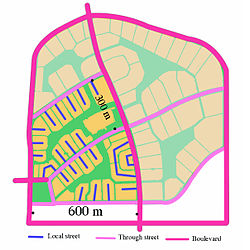
Radburn was explicitly designed to separate traffic by mode, with a pedestrian path system that does not cross any major roads at grade level. Radburn introduced the largely residential "superblock" and is credited with incorporating some of the earliest culs-de-sac in the United States. It was designated a National Historic Landmark District in 2005, in recognition of its history in the development of the garden city movement in the 20th century.
There are approximately 3,100 people in 670 families residing in Radburn. They live in 469 single-family homes, 48 townhouses, 30 two-family houses, and a 93-unit apartment complex. An additional 165-unit townhouse development is under construction.
Radburn's 149 acres (0.60 km2) include 23 acres (93,000 m2) of interior parks, four tennis courts, three baseball fields, two softball fields, two swimming pools, and an archery plaza. Young children and their parents can make use of two toddler playgroup areas, two playgrounds, and a toddler bathing pool.
There is also a community center which houses administrative offices, library, gymnasium, clubroom, pre-school, and maintenance shops.
For census purposes, Radburn is mostly a subset of Census Tract 171 in Bergen County, New Jersey.
The Radburn Community, governed by a distinct board of directors, enjoys much autonomy within the Borough of Fair Lawn. Pursuant to enabling laws passed in the 1920s and covenants included in the original deeds for the development, the Radburn Association is a private association which is empowered to administer Radburn's common properties and to collect from the owners of properties quarterly association fees to cover the Association's maintenance and operation of communal facilities. The Association is also empowered to restrict development and decoration of Radburn properties in order to maintain a consistent "look" to the community. Use of Radburn Association facilities is limited to residents (though the parks themselves are ungated and the walkways are public property of the Borough.) Radburn's border with the rest of Fair Lawn is the Bergen County Line to the West; southeast of Fernwood Drive, Fulton Place, and Franciscan Way but northwest of Owen Avenue to the northwest; Radburn Road to the northeast; one block of Howard Avenue to the southeast; Alden Terrace to the northeast and east; one block of High Street to the South; Craig Road and its extension through Scribner Road to the East; and Berdan Avenue to the South. Radburn's other full-length east-west cross street is Fair Lawn Avenue, and its sole north-south cross street is Plaza Road.
Radburn, New Jersey
Radburn is an unincorporated community located within the borough of Fair Lawn in Bergen County, in the U.S. state of New Jersey.
Radburn was founded in 1929 as "a town for the motor age". Its planners, Clarence Stein and Henry Wright, and its landscape architect Marjorie Sewell Cautley aimed to incorporate modern planning principles, which were then being introduced into England's Garden Cities, following ideas advocated by urban planners Ebenezer Howard, Sir Patrick Geddes and Clarence Perry. Perry's neighborhood unit concept was well-formulated by the time Radburn was planned, being informed by Forest Hills Gardens, Queens, New York City (1909–1914), a garden-city development of the Russell Sage Foundation.
Radburn was explicitly designed to separate traffic by mode, with a pedestrian path system that does not cross any major roads at grade level. Radburn introduced the largely residential "superblock" and is credited with incorporating some of the earliest culs-de-sac in the United States. It was designated a National Historic Landmark District in 2005, in recognition of its history in the development of the garden city movement in the 20th century.
There are approximately 3,100 people in 670 families residing in Radburn. They live in 469 single-family homes, 48 townhouses, 30 two-family houses, and a 93-unit apartment complex. An additional 165-unit townhouse development is under construction.
Radburn's 149 acres (0.60 km2) include 23 acres (93,000 m2) of interior parks, four tennis courts, three baseball fields, two softball fields, two swimming pools, and an archery plaza. Young children and their parents can make use of two toddler playgroup areas, two playgrounds, and a toddler bathing pool.
There is also a community center which houses administrative offices, library, gymnasium, clubroom, pre-school, and maintenance shops.
For census purposes, Radburn is mostly a subset of Census Tract 171 in Bergen County, New Jersey.
The Radburn Community, governed by a distinct board of directors, enjoys much autonomy within the Borough of Fair Lawn. Pursuant to enabling laws passed in the 1920s and covenants included in the original deeds for the development, the Radburn Association is a private association which is empowered to administer Radburn's common properties and to collect from the owners of properties quarterly association fees to cover the Association's maintenance and operation of communal facilities. The Association is also empowered to restrict development and decoration of Radburn properties in order to maintain a consistent "look" to the community. Use of Radburn Association facilities is limited to residents (though the parks themselves are ungated and the walkways are public property of the Borough.) Radburn's border with the rest of Fair Lawn is the Bergen County Line to the West; southeast of Fernwood Drive, Fulton Place, and Franciscan Way but northwest of Owen Avenue to the northwest; Radburn Road to the northeast; one block of Howard Avenue to the southeast; Alden Terrace to the northeast and east; one block of High Street to the South; Craig Road and its extension through Scribner Road to the East; and Berdan Avenue to the South. Radburn's other full-length east-west cross street is Fair Lawn Avenue, and its sole north-south cross street is Plaza Road.
Recent media
Recent media