



Community hub
Recent from talks
Knowledge base stats:
Talk channels stats:
Members stats:
Rakshasa
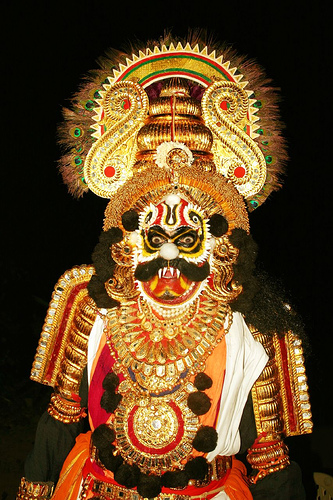
Rakshasa (Sanskrit: राक्षस, pronounced [ɾɑːk.ʂɐ.s̪ɐ], romanized: rākṣasa; Pali: rakkhasa; lit. 'demon' or 'fiend') are a race of usually malevolent beings prominently featured in Hinduism, Buddhism, Jainism, and Indonesian folk Islam. They reside on Earth but possess supernatural powers, which they usually use for evil acts such as disrupting Vedic sacrifices or eating humans.
The term is also used to describe asuras,[citation needed] a class of power-seeking beings that oppose the benevolent devas. They are often depicted as antagonists in Hindu scriptures, as well as in Buddhism and Jainism. The feminine form of rakshasa is rakshasi (राक्षसी, IPA: [ɾɑːk.ʂɐ.s̪iː], rākṣasī).
Brahmā, in a form composed of the quality of foulness, produced hunger, of whom anger was born: and the god put forth in darkness beings emaciate with hunger, of hideous aspects, and with long beards. Those beings hastened to the deity. Such of them as exclaimed, "Oh preserve us!" were thence called Rākṣasas. Those created beings, overwhelmed by hunger, attempted to seize the waters. Those among them who said, "we shall protect these waters", are remembered as Rākṣasas.
Rakshasas were most often depicted as shape-shifting, fierce-looking, enormous, monstrous-looking creatures, with two fangs protruding from the top of the mouth and having sharp, claw-like fingernails. They were shown as being mean, growling beasts, and as insatiable man-eaters that could smell the scent of human flesh. Some of the more ferocious ones were shown with flaming red eyes and hair, drinking blood with their cupped hands or from human skulls (similar to representations of vampires in later Western mythology). Generally, they could fly, vanish, and had maya (magical powers of illusion), which enabled them to change size at will and assume the form of any creature.[additional citation(s) needed]
In the world of the Ramayana and Mahabharata, Rakshasas were a populous race. There were both good and evil rakshasas, and as warriors, they fought alongside the armies of both good and evil. They were powerful warriors, expert magicians and illusionists. As shape-changers, they could assume different physical forms. As illusionists, they were capable of creating appearances which were real to those who believed in them or who failed to dispel them. Some of the rakshasas were said to be man-eaters and made their gleeful appearance when the slaughter on a battlefield was at its worst. Occasionally, they served as rank-and-file soldiers in the service of one or another warlord.
Aside from their treatment of unnamed rank-and-file Rakshasas, the epics tell the stories of certain members of these beings who rose to prominence, sometimes as heroes but more often as villains.
Thapar suggests that the Rakshasas could represent exaggerated, supernatural depictions of demonised forest-dwellers who were outside the caste society.
In books 3-6 of the Rāmāyaṇa, the rākṣasas are the main antagonists of the narrative. The protagonist Rāma slays many rākṣasas throughout the epic, including Tāṭakā, Mārīca, and Rāvaṇa. In the epic, the rākṣasas are portrayed as mainly demonic beings who are aggressive and sexual. They can assume any form they wish, which Rāvaṇa uses to good effect to trick and kidnap Sītā, Rāma's wife, which drives the rest of the narrative. The rākṣasas reside in the forests south of the Gangetic plain and in the island fortress of Laṅkā, both far away from the lands of Kosala and the home of Rāma. In Laṅkā, the capital of Rāvaṇa, the rākṣasas live in a complex society comparable to the humans of Ayodhyā, where some rākṣasas, such as Vibhīṣaṇa are moral beings.
Hub AI
Rakshasa AI simulator
(@Rakshasa_simulator)
Rakshasa
Rakshasa (Sanskrit: राक्षस, pronounced [ɾɑːk.ʂɐ.s̪ɐ], romanized: rākṣasa; Pali: rakkhasa; lit. 'demon' or 'fiend') are a race of usually malevolent beings prominently featured in Hinduism, Buddhism, Jainism, and Indonesian folk Islam. They reside on Earth but possess supernatural powers, which they usually use for evil acts such as disrupting Vedic sacrifices or eating humans.
The term is also used to describe asuras,[citation needed] a class of power-seeking beings that oppose the benevolent devas. They are often depicted as antagonists in Hindu scriptures, as well as in Buddhism and Jainism. The feminine form of rakshasa is rakshasi (राक्षसी, IPA: [ɾɑːk.ʂɐ.s̪iː], rākṣasī).
Brahmā, in a form composed of the quality of foulness, produced hunger, of whom anger was born: and the god put forth in darkness beings emaciate with hunger, of hideous aspects, and with long beards. Those beings hastened to the deity. Such of them as exclaimed, "Oh preserve us!" were thence called Rākṣasas. Those created beings, overwhelmed by hunger, attempted to seize the waters. Those among them who said, "we shall protect these waters", are remembered as Rākṣasas.
Rakshasas were most often depicted as shape-shifting, fierce-looking, enormous, monstrous-looking creatures, with two fangs protruding from the top of the mouth and having sharp, claw-like fingernails. They were shown as being mean, growling beasts, and as insatiable man-eaters that could smell the scent of human flesh. Some of the more ferocious ones were shown with flaming red eyes and hair, drinking blood with their cupped hands or from human skulls (similar to representations of vampires in later Western mythology). Generally, they could fly, vanish, and had maya (magical powers of illusion), which enabled them to change size at will and assume the form of any creature.[additional citation(s) needed]
In the world of the Ramayana and Mahabharata, Rakshasas were a populous race. There were both good and evil rakshasas, and as warriors, they fought alongside the armies of both good and evil. They were powerful warriors, expert magicians and illusionists. As shape-changers, they could assume different physical forms. As illusionists, they were capable of creating appearances which were real to those who believed in them or who failed to dispel them. Some of the rakshasas were said to be man-eaters and made their gleeful appearance when the slaughter on a battlefield was at its worst. Occasionally, they served as rank-and-file soldiers in the service of one or another warlord.
Aside from their treatment of unnamed rank-and-file Rakshasas, the epics tell the stories of certain members of these beings who rose to prominence, sometimes as heroes but more often as villains.
Thapar suggests that the Rakshasas could represent exaggerated, supernatural depictions of demonised forest-dwellers who were outside the caste society.
In books 3-6 of the Rāmāyaṇa, the rākṣasas are the main antagonists of the narrative. The protagonist Rāma slays many rākṣasas throughout the epic, including Tāṭakā, Mārīca, and Rāvaṇa. In the epic, the rākṣasas are portrayed as mainly demonic beings who are aggressive and sexual. They can assume any form they wish, which Rāvaṇa uses to good effect to trick and kidnap Sītā, Rāma's wife, which drives the rest of the narrative. The rākṣasas reside in the forests south of the Gangetic plain and in the island fortress of Laṅkā, both far away from the lands of Kosala and the home of Rāma. In Laṅkā, the capital of Rāvaṇa, the rākṣasas live in a complex society comparable to the humans of Ayodhyā, where some rākṣasas, such as Vibhīṣaṇa are moral beings.