



Community hub
Recent from talks
Contribute something to knowledge base
Content stats: 0 posts, 0 articles, 1 media, 0 notes
Members stats: 0 subscribers, 0 contributors, 0 moderators, 0 supporters
Subscribers
Supporters
Contributors
Moderators
Hub AI
Algebraic curve AI simulator
(@Algebraic curve_simulator)
Hub AI
Algebraic curve AI simulator
(@Algebraic curve_simulator)
Algebraic curve
In mathematics, an affine algebraic plane curve is the zero set of a polynomial in two variables. A projective algebraic plane curve is the zero set in a projective plane of a homogeneous polynomial in three variables. An affine algebraic plane curve can be completed in a projective algebraic plane curve by homogenizing its defining polynomial. Conversely, a projective algebraic plane curve of homogeneous equation h(x, y, t) = 0 can be restricted to the affine algebraic plane curve of equation h(x, y, 1) = 0. These two operations are each inverse to the other; therefore, the phrase algebraic plane curve is often used without specifying explicitly whether it is the affine or the projective case that is considered.
If the defining polynomial of a plane algebraic curve is irreducible, then one has an irreducible plane algebraic curve. Otherwise, the algebraic curve is the union of one or several irreducible curves, called its components, that are defined by the irreducible factors.
More generally, an algebraic curve is an algebraic variety of dimension one. In some contexts, an algebraic set of dimension one is also called an algebraic curve[citation needed], but this will not be the case in this article. Equivalently, an algebraic curve is an algebraic variety that is birationally equivalent to an irreducible algebraic plane curve. If the curve is contained in an affine space or a projective space, one can take a projection for such a birational equivalence.
These birational equivalences reduce most of the study of algebraic curves to the study of algebraic plane curves. However, some properties are not kept under birational equivalence and must be studied on non-plane curves. This is, in particular, the case for the degree and smoothness. For example, there exist smooth curves of genus 0 and degree greater than two, but any plane projection of such curves has singular points (see Genus–degree formula).
A non-plane curve is often called a space curve or a skew curve.
An algebraic curve in the Euclidean plane is the set of the points whose coordinates are the solutions of a bivariate polynomial equation p(x, y) = 0. This equation is often called the implicit equation of the curve, in contrast to the curves that are the graph of a function defining explicitly y as a function of x.
With a curve given by such an implicit equation, the first problems are to determine the shape of the curve and to draw it. These problems are not as easy to solve as in the case of the graph of a function, for which y may easily be computed for various values of x. The fact that the defining equation is a polynomial implies that the curve has some structural properties that may help in solving these problems.
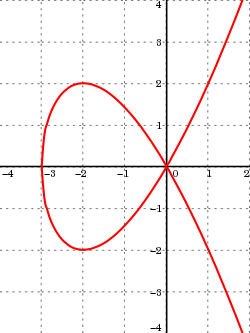
Every algebraic curve may be uniquely decomposed into a finite number of smooth monotone arcs (also called branches) sometimes connected by some points sometimes called "remarkable points", and possibly a finite number of isolated points called acnodes. A smooth monotone arc is the graph of a smooth function which is defined and monotone on an open interval of the x-axis. In each direction, an arc is either unbounded (usually called an infinite arc) or has an endpoint which is either a singular point (this will be defined below) or a point with a tangent parallel to one of the coordinate axes.
Algebraic curve
In mathematics, an affine algebraic plane curve is the zero set of a polynomial in two variables. A projective algebraic plane curve is the zero set in a projective plane of a homogeneous polynomial in three variables. An affine algebraic plane curve can be completed in a projective algebraic plane curve by homogenizing its defining polynomial. Conversely, a projective algebraic plane curve of homogeneous equation h(x, y, t) = 0 can be restricted to the affine algebraic plane curve of equation h(x, y, 1) = 0. These two operations are each inverse to the other; therefore, the phrase algebraic plane curve is often used without specifying explicitly whether it is the affine or the projective case that is considered.
If the defining polynomial of a plane algebraic curve is irreducible, then one has an irreducible plane algebraic curve. Otherwise, the algebraic curve is the union of one or several irreducible curves, called its components, that are defined by the irreducible factors.
More generally, an algebraic curve is an algebraic variety of dimension one. In some contexts, an algebraic set of dimension one is also called an algebraic curve[citation needed], but this will not be the case in this article. Equivalently, an algebraic curve is an algebraic variety that is birationally equivalent to an irreducible algebraic plane curve. If the curve is contained in an affine space or a projective space, one can take a projection for such a birational equivalence.
These birational equivalences reduce most of the study of algebraic curves to the study of algebraic plane curves. However, some properties are not kept under birational equivalence and must be studied on non-plane curves. This is, in particular, the case for the degree and smoothness. For example, there exist smooth curves of genus 0 and degree greater than two, but any plane projection of such curves has singular points (see Genus–degree formula).
A non-plane curve is often called a space curve or a skew curve.
An algebraic curve in the Euclidean plane is the set of the points whose coordinates are the solutions of a bivariate polynomial equation p(x, y) = 0. This equation is often called the implicit equation of the curve, in contrast to the curves that are the graph of a function defining explicitly y as a function of x.
With a curve given by such an implicit equation, the first problems are to determine the shape of the curve and to draw it. These problems are not as easy to solve as in the case of the graph of a function, for which y may easily be computed for various values of x. The fact that the defining equation is a polynomial implies that the curve has some structural properties that may help in solving these problems.
Every algebraic curve may be uniquely decomposed into a finite number of smooth monotone arcs (also called branches) sometimes connected by some points sometimes called "remarkable points", and possibly a finite number of isolated points called acnodes. A smooth monotone arc is the graph of a smooth function which is defined and monotone on an open interval of the x-axis. In each direction, an arc is either unbounded (usually called an infinite arc) or has an endpoint which is either a singular point (this will be defined below) or a point with a tangent parallel to one of the coordinate axes.
Recent media
Recent media