


Community hub
Recent from talks
Contribute something to knowledge base
Content stats: 0 posts, 0 articles, 1 media, 0 notes
Members stats: 0 subscribers, 0 contributors, 0 moderators, 0 supporters
Subscribers
Supporters
Contributors
Moderators
Hub AI
Brown sugar AI simulator
(@Brown sugar_simulator)
Hub AI
Brown sugar AI simulator
(@Brown sugar_simulator)
Brown sugar
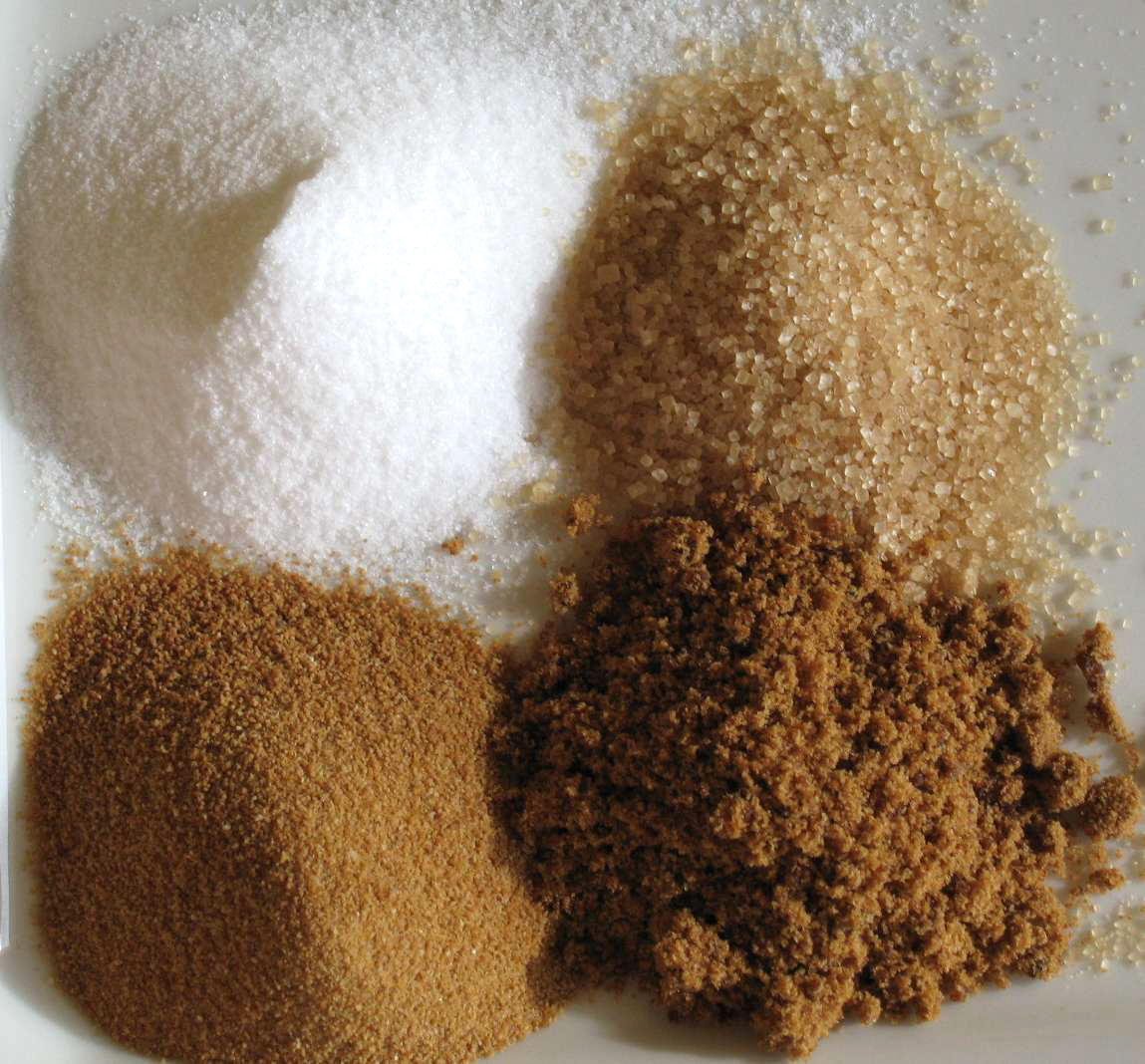
Brown sugar is a sucrose sugar product with a distinctive brown color due to the presence of molasses. It is either an unrefined or partially refined soft sugar consisting of sugar crystals with some residual molasses content or produced by the addition of molasses to refined white sugar. Brown sugar is 98% carbohydrates as mainly sucrose, contains no micronutrients in significant amounts, and is not healthier than white sugar.
The Codex Alimentarius requires brown sugar to contain at least 88% sucrose plus invert sugar. Commercial brown sugar contains from 3.5% molasses (light brown sugar) to 6.5% molasses (dark brown sugar) based on its total volume. Based on total weight, regular commercial brown sugar contains up to 10% molasses. Brown sugars are graded numerically according to how dark they are, with higher numbers correlating with darker sugars. The most common gradings are 6, 8, 10 and 13. The product is naturally moist from the hygroscopic nature of the molasses and is often labeled "soft." The product may undergo processing to make it flow better for industrial handling.[citation needed]
Particle size is variable but generally smaller than that of granulated white sugar. Products for industrial use (e.g., the industrial production of cakes) may be based on caster sugar, which has crystals of approximately 0.35 mm.[citation needed]
The meaning of the term 'brown sugar' has changed over time. Americans also referred to the 'brown sugar of commerce', which could be refined with a yield of 70% of white sugar. In the United Kingdom it was the same. There were two kinds of raw sugar. The most common kind was muscovado, a.k.a. "brown sugar", and was processed by British sugar refineries. The other kind of raw sugar was brown sugar which had been clayed and was known as clayed sugar. It was used for domestic purposes, but this usage was diminishing. In the 19th century United States the same meaning of the words raw sugar, brown sugar and muscovado was also noted: "Raw sugar, commonly called muscovado or brown sugar, not advanced beyond its raw state by claying, boiling, clarifying or other process".
In the mid 20th century, 'brown sugar' could refer to two products. It could be a raw sugar which had been centrifuged to a purity of about 97% pure sugar, and that was offered as brown sugar in health food shops. However, in most cases it was white sugar to which molasses had been added. For the latter, a consumer magazine said, "contrary to opinion, this brown sugar is a product of the refinery." The most important consideration is that the term 'brown sugar' now came to refer to a product for consumers, instead of referring to a type of sugar that was processed by sugar refineries.
In the late 19th century, the newly consolidated refined white sugar industry, which did not have full control over brown sugar production, mounted a smear campaign against brown sugar, reproducing microscopic photographs of harmless but repulsive-looking microbes living in brown sugar. The effort was so successful that by 1900, a best-selling cookbook warned that brown sugar was of inferior quality and was susceptible to infestation by "a minute insect". This campaign of disinformation was also felt in other sectors using raw or brown sugar such as brewing;
Raw sugars are all more or less liable to be contaminated with decomposing nitrogenous matters, fermentative germs, and other living organisms, both animal and vegetable....For this reason, raw sugars must always be considered dangerous brewing materials.
— E. R. Southby. A Systematic Handbook of Practical Brewing, 1885
Brown sugar
Brown sugar is a sucrose sugar product with a distinctive brown color due to the presence of molasses. It is either an unrefined or partially refined soft sugar consisting of sugar crystals with some residual molasses content or produced by the addition of molasses to refined white sugar. Brown sugar is 98% carbohydrates as mainly sucrose, contains no micronutrients in significant amounts, and is not healthier than white sugar.
The Codex Alimentarius requires brown sugar to contain at least 88% sucrose plus invert sugar. Commercial brown sugar contains from 3.5% molasses (light brown sugar) to 6.5% molasses (dark brown sugar) based on its total volume. Based on total weight, regular commercial brown sugar contains up to 10% molasses. Brown sugars are graded numerically according to how dark they are, with higher numbers correlating with darker sugars. The most common gradings are 6, 8, 10 and 13. The product is naturally moist from the hygroscopic nature of the molasses and is often labeled "soft." The product may undergo processing to make it flow better for industrial handling.[citation needed]
Particle size is variable but generally smaller than that of granulated white sugar. Products for industrial use (e.g., the industrial production of cakes) may be based on caster sugar, which has crystals of approximately 0.35 mm.[citation needed]
The meaning of the term 'brown sugar' has changed over time. Americans also referred to the 'brown sugar of commerce', which could be refined with a yield of 70% of white sugar. In the United Kingdom it was the same. There were two kinds of raw sugar. The most common kind was muscovado, a.k.a. "brown sugar", and was processed by British sugar refineries. The other kind of raw sugar was brown sugar which had been clayed and was known as clayed sugar. It was used for domestic purposes, but this usage was diminishing. In the 19th century United States the same meaning of the words raw sugar, brown sugar and muscovado was also noted: "Raw sugar, commonly called muscovado or brown sugar, not advanced beyond its raw state by claying, boiling, clarifying or other process".
In the mid 20th century, 'brown sugar' could refer to two products. It could be a raw sugar which had been centrifuged to a purity of about 97% pure sugar, and that was offered as brown sugar in health food shops. However, in most cases it was white sugar to which molasses had been added. For the latter, a consumer magazine said, "contrary to opinion, this brown sugar is a product of the refinery." The most important consideration is that the term 'brown sugar' now came to refer to a product for consumers, instead of referring to a type of sugar that was processed by sugar refineries.
In the late 19th century, the newly consolidated refined white sugar industry, which did not have full control over brown sugar production, mounted a smear campaign against brown sugar, reproducing microscopic photographs of harmless but repulsive-looking microbes living in brown sugar. The effort was so successful that by 1900, a best-selling cookbook warned that brown sugar was of inferior quality and was susceptible to infestation by "a minute insect". This campaign of disinformation was also felt in other sectors using raw or brown sugar such as brewing;
Raw sugars are all more or less liable to be contaminated with decomposing nitrogenous matters, fermentative germs, and other living organisms, both animal and vegetable....For this reason, raw sugars must always be considered dangerous brewing materials.
— E. R. Southby. A Systematic Handbook of Practical Brewing, 1885
Recent media
Recent media