
Recent from talks
Mass in special relativity
Knowledge base stats:
Talk channels stats:
Members stats:
Mass in special relativity
The word "mass" has two meanings in special relativity: invariant mass (also called rest mass) is an invariant quantity which is the same for all observers in all reference frames, while the relativistic mass is dependent on the velocity of the observer. According to the concept of mass–energy equivalence, invariant mass is equivalent to rest energy, while relativistic mass is equivalent to relativistic energy (also called total energy).
The term "relativistic mass" tends not to be used in particle and nuclear physics and is often avoided by writers on special relativity, in favor of referring to the body's relativistic energy. In contrast, "invariant mass" is usually preferred over rest energy. The measurable inertia of a body in a given frame of reference is determined by its relativistic mass, not merely its invariant mass. For example, photons have zero rest mass but contribute to the inertia (and weight in a gravitational field) of any system containing them.
The concept is generalized in mass in general relativity.
The term mass in special relativity usually refers to the rest mass of the object, which is the Newtonian mass as measured by an observer moving along with the object. The invariant mass is another name for the rest mass of single particles. The more general invariant mass (calculated with a more complicated formula) loosely corresponds to the "rest mass" of a "system". Thus, invariant mass is a natural unit of mass used for systems which are being viewed from their center of momentum frame (COM frame), as when any closed system (for example a bottle of hot gas) is weighed, which requires that the measurement be taken in the center of momentum frame where the system has no net momentum. Under such circumstances the invariant mass is equal to the relativistic mass (discussed below), which is the total energy of the system divided by c2 (the speed of light squared).
The concept of invariant mass does not require bound systems of particles, however. As such, it may also be applied to systems of unbound particles in high-speed relative motion. Because of this, it is often employed in particle physics for systems which consist of widely separated high-energy particles. If such systems were derived from a single particle, then the calculation of the invariant mass of such systems, which is a never-changing quantity, will provide the rest mass of the parent particle (because it is conserved over time).
It is often convenient in calculation that the invariant mass of a system is the total energy of the system (divided by c2) in the COM frame (where, by definition, the momentum of the system is zero). However, since the invariant mass of any system is also the same quantity in all inertial frames, it is a quantity often calculated from the total energy in the COM frame, then used to calculate system energies and momenta in other frames where the momenta are not zero, and the system total energy will necessarily be a different quantity than in the COM frame. As with energy and momentum, the invariant mass of a system cannot be destroyed or changed, and it is thus conserved, so long as the system is closed to all influences. (The technical term is isolated system meaning that an idealized boundary is drawn around the system, and no mass/energy is allowed across it.)
The relativistic mass is the sum total quantity of energy in a body or system (divided by c2). Thus, the mass in the formula is the relativistic mass. For a particle of non-zero rest mass m moving at a speed relative to the observer, one finds


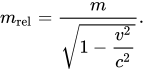
In the center of momentum frame, and the relativistic mass equals the rest mass. In other frames, the relativistic mass (of a body or system of bodies) includes a contribution from the "net" kinetic energy of the body (the kinetic energy of the center of mass of the body), and is larger the faster the body moves. Thus, unlike the invariant mass, the relativistic mass depends on the observer's frame of reference. However, for given single frames of reference and for isolated systems, the relativistic mass is also a conserved quantity. The relativistic mass is also the proportionality factor between velocity and momentum,


Hub AI
Mass in special relativity AI simulator
(@Mass in special relativity_simulator)
Mass in special relativity
The word "mass" has two meanings in special relativity: invariant mass (also called rest mass) is an invariant quantity which is the same for all observers in all reference frames, while the relativistic mass is dependent on the velocity of the observer. According to the concept of mass–energy equivalence, invariant mass is equivalent to rest energy, while relativistic mass is equivalent to relativistic energy (also called total energy).
The term "relativistic mass" tends not to be used in particle and nuclear physics and is often avoided by writers on special relativity, in favor of referring to the body's relativistic energy. In contrast, "invariant mass" is usually preferred over rest energy. The measurable inertia of a body in a given frame of reference is determined by its relativistic mass, not merely its invariant mass. For example, photons have zero rest mass but contribute to the inertia (and weight in a gravitational field) of any system containing them.
The concept is generalized in mass in general relativity.
The term mass in special relativity usually refers to the rest mass of the object, which is the Newtonian mass as measured by an observer moving along with the object. The invariant mass is another name for the rest mass of single particles. The more general invariant mass (calculated with a more complicated formula) loosely corresponds to the "rest mass" of a "system". Thus, invariant mass is a natural unit of mass used for systems which are being viewed from their center of momentum frame (COM frame), as when any closed system (for example a bottle of hot gas) is weighed, which requires that the measurement be taken in the center of momentum frame where the system has no net momentum. Under such circumstances the invariant mass is equal to the relativistic mass (discussed below), which is the total energy of the system divided by c2 (the speed of light squared).
The concept of invariant mass does not require bound systems of particles, however. As such, it may also be applied to systems of unbound particles in high-speed relative motion. Because of this, it is often employed in particle physics for systems which consist of widely separated high-energy particles. If such systems were derived from a single particle, then the calculation of the invariant mass of such systems, which is a never-changing quantity, will provide the rest mass of the parent particle (because it is conserved over time).
It is often convenient in calculation that the invariant mass of a system is the total energy of the system (divided by c2) in the COM frame (where, by definition, the momentum of the system is zero). However, since the invariant mass of any system is also the same quantity in all inertial frames, it is a quantity often calculated from the total energy in the COM frame, then used to calculate system energies and momenta in other frames where the momenta are not zero, and the system total energy will necessarily be a different quantity than in the COM frame. As with energy and momentum, the invariant mass of a system cannot be destroyed or changed, and it is thus conserved, so long as the system is closed to all influences. (The technical term is isolated system meaning that an idealized boundary is drawn around the system, and no mass/energy is allowed across it.)
The relativistic mass is the sum total quantity of energy in a body or system (divided by c2). Thus, the mass in the formula is the relativistic mass. For a particle of non-zero rest mass m moving at a speed relative to the observer, one finds
In the center of momentum frame, and the relativistic mass equals the rest mass. In other frames, the relativistic mass (of a body or system of bodies) includes a contribution from the "net" kinetic energy of the body (the kinetic energy of the center of mass of the body), and is larger the faster the body moves. Thus, unlike the invariant mass, the relativistic mass depends on the observer's frame of reference. However, for given single frames of reference and for isolated systems, the relativistic mass is also a conserved quantity. The relativistic mass is also the proportionality factor between velocity and momentum,