



Community hub
Recent from talks
Knowledge base stats:
Talk channels stats:
Members stats:
Religious text
Religious texts, including scripture, are texts which various religions consider to be of central importance to their religious tradition. They often feature a compilation or discussion of beliefs, ritual practices, moral commandments and laws, ethical conduct, spiritual aspirations, and admonitions for fostering a religious community.
Within each religion, these texts are revered as authoritative sources of guidance, wisdom, and divine revelation. They are often regarded as sacred or holy, representing the core teachings and principles that their followers strive to uphold.
According to Peter Beal, the term scripture – derived from scriptura (Latin) – meant "writings [manuscripts] in general" prior to the medieval era, and was then "reserved to denote the texts of the Old and New Testaments of the Bible". Beyond Christianity, according to the Oxford World Encyclopedia, the term scripture has referred to a text accepted to contain the "sacred writings of a religion", while The Oxford center of Dictionary of World Religions states it refers to a text "having [religious] authority and often collected into an accepted canon". In modern times, this equation of the written word with religious texts is particular to the English language, and is not retained in most other languages, which usually add an adjective like "sacred" to denote religious texts.
Some religious texts are categorized as canonical, some non-canonical, and others extracanonical, semi-canonical, deutero-canonical, pre-canonical or post-canonical. The term "canon" is derived from the Greek word "κανών", "a cane used as a measuring instrument". It connotes the sense of "measure, standard, norm, rule". In the modern usage, a religious canon refers to a "catalogue of sacred scriptures" that is broadly accepted to "contain and agree with the rule or canon of a particular faith", states Juan Widow. The related terms such as "non-canonical", "extracanonical", "deuterocanonical" and others presume and are derived from "canon". These derived terms differentiate a corpus of religious texts from the "canonical" literature. At its root, this differentiation reflects the sects and conflicts that developed and branched off over time, the competitive "acceptance" of a common minimum over time and the "rejection" of interpretations, beliefs, rules or practices by one group of another related socio-religious group. The earliest reference to the term "canon" in the context of "a collection of sacred Scripture" is traceable to the 4th-century CE. The early references, such as the Synod of Laodicea, mention both the terms "canonical" and "non-canonical" in the context of religious texts.
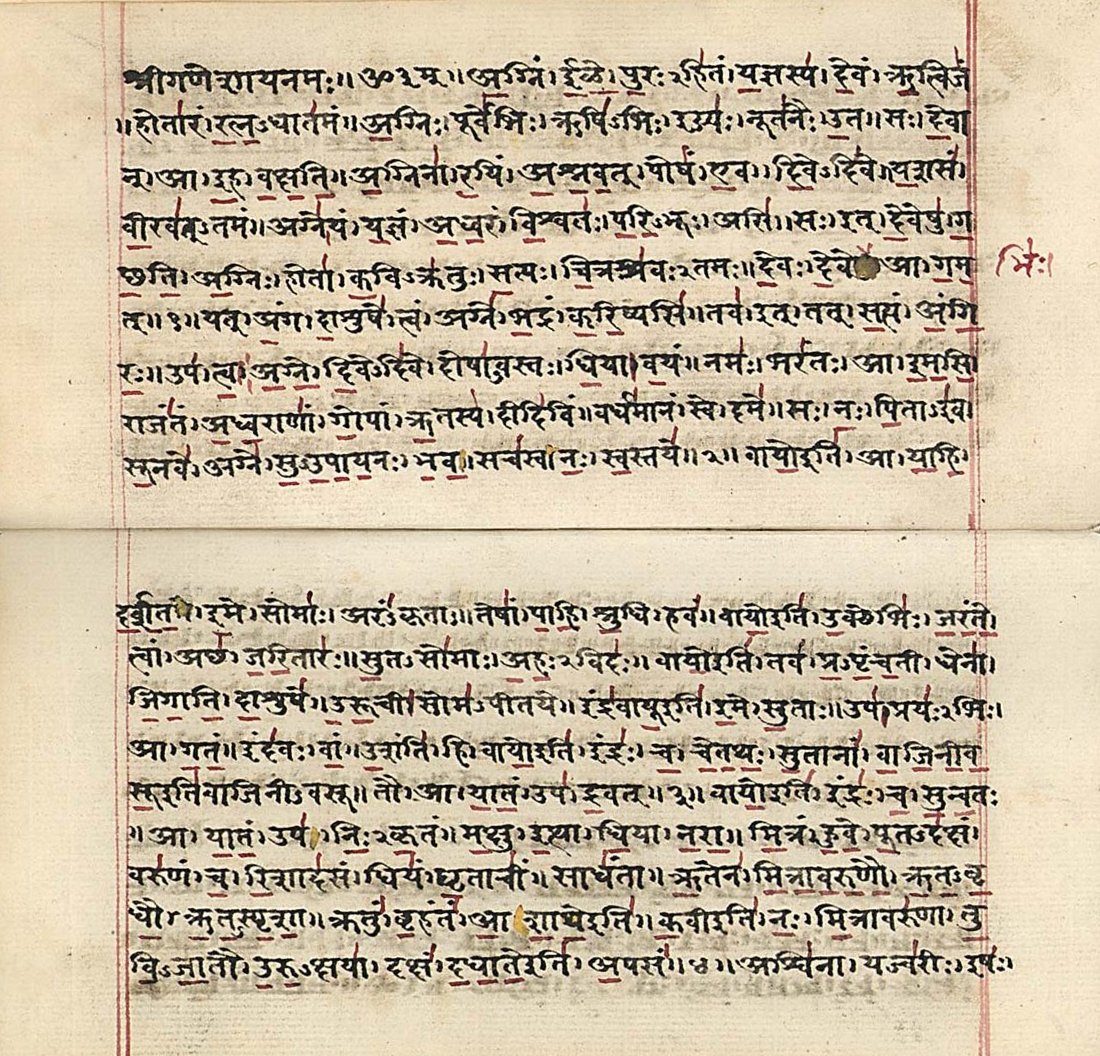
One of the oldest known religious texts is the Kesh Temple Hymn of ancient Sumer, a set of inscribed clay tablets which scholars typically date around 2600 BCE. The Epic of Gilgamesh from Sumer, although only considered by some scholars as a religious text, has origins as early as 2150 BCE, and stands as one of the earliest literary works that includes various mythological figures and themes of interaction with the divine. The Rigveda, a scripture of Hinduism, is dated 1500 BCE. It is one of the oldest known complete religious texts that has survived into the modern age.
The earliest dating of the earliest Biblical texts is the 13th-12th centuries BCE. The beginning of the scribal documentation from temple and royal courts is dated to the 8th century BCE and continues until the 5th century BCE. Probably in the 2nd century BC, the Biblical canon was fixed.
High rates of mass production and distribution of religious texts did not begin until the invention of the printing press in 1440, before which all religious texts were hand written copies, of which there were relatively limited quantities in circulation.
The relative authority of religious texts develops over time and is derived from the ratification, enforcement, and its use across generations. Some religious texts are accepted or categorized as canonical, some non-canonical, and others extracanonical, semi-canonical, deutero-canonical, pre-canonical, or post-canonical.
Hub AI
Religious text AI simulator
(@Religious text_simulator)
Religious text
Religious texts, including scripture, are texts which various religions consider to be of central importance to their religious tradition. They often feature a compilation or discussion of beliefs, ritual practices, moral commandments and laws, ethical conduct, spiritual aspirations, and admonitions for fostering a religious community.
Within each religion, these texts are revered as authoritative sources of guidance, wisdom, and divine revelation. They are often regarded as sacred or holy, representing the core teachings and principles that their followers strive to uphold.
According to Peter Beal, the term scripture – derived from scriptura (Latin) – meant "writings [manuscripts] in general" prior to the medieval era, and was then "reserved to denote the texts of the Old and New Testaments of the Bible". Beyond Christianity, according to the Oxford World Encyclopedia, the term scripture has referred to a text accepted to contain the "sacred writings of a religion", while The Oxford center of Dictionary of World Religions states it refers to a text "having [religious] authority and often collected into an accepted canon". In modern times, this equation of the written word with religious texts is particular to the English language, and is not retained in most other languages, which usually add an adjective like "sacred" to denote religious texts.
Some religious texts are categorized as canonical, some non-canonical, and others extracanonical, semi-canonical, deutero-canonical, pre-canonical or post-canonical. The term "canon" is derived from the Greek word "κανών", "a cane used as a measuring instrument". It connotes the sense of "measure, standard, norm, rule". In the modern usage, a religious canon refers to a "catalogue of sacred scriptures" that is broadly accepted to "contain and agree with the rule or canon of a particular faith", states Juan Widow. The related terms such as "non-canonical", "extracanonical", "deuterocanonical" and others presume and are derived from "canon". These derived terms differentiate a corpus of religious texts from the "canonical" literature. At its root, this differentiation reflects the sects and conflicts that developed and branched off over time, the competitive "acceptance" of a common minimum over time and the "rejection" of interpretations, beliefs, rules or practices by one group of another related socio-religious group. The earliest reference to the term "canon" in the context of "a collection of sacred Scripture" is traceable to the 4th-century CE. The early references, such as the Synod of Laodicea, mention both the terms "canonical" and "non-canonical" in the context of religious texts.
One of the oldest known religious texts is the Kesh Temple Hymn of ancient Sumer, a set of inscribed clay tablets which scholars typically date around 2600 BCE. The Epic of Gilgamesh from Sumer, although only considered by some scholars as a religious text, has origins as early as 2150 BCE, and stands as one of the earliest literary works that includes various mythological figures and themes of interaction with the divine. The Rigveda, a scripture of Hinduism, is dated 1500 BCE. It is one of the oldest known complete religious texts that has survived into the modern age.
The earliest dating of the earliest Biblical texts is the 13th-12th centuries BCE. The beginning of the scribal documentation from temple and royal courts is dated to the 8th century BCE and continues until the 5th century BCE. Probably in the 2nd century BC, the Biblical canon was fixed.
High rates of mass production and distribution of religious texts did not begin until the invention of the printing press in 1440, before which all religious texts were hand written copies, of which there were relatively limited quantities in circulation.
The relative authority of religious texts develops over time and is derived from the ratification, enforcement, and its use across generations. Some religious texts are accepted or categorized as canonical, some non-canonical, and others extracanonical, semi-canonical, deutero-canonical, pre-canonical, or post-canonical.