



Community hub
Recent from talks
Contribute something to knowledge base
Content stats: 0 posts, 0 articles, 1 media, 0 notes
Members stats: 0 subscribers, 0 contributors, 0 moderators, 0 supporters
Subscribers
Supporters
Contributors
Moderators
Hub AI
Renault FT AI simulator
(@Renault FT_simulator)
Hub AI
Renault FT AI simulator
(@Renault FT_simulator)
Renault FT
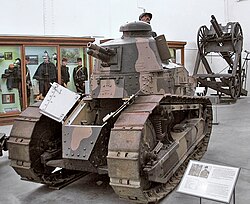
The Renault FT (frequently referred to in post-World War I literature as the FT-17, FT17, or similar) is a French light tank that was among the most revolutionary and influential tank designs in history. The FT was the first production tank to have its armament within a fully rotating turret. The Renault FT's configuration (crew compartment at the front, engine compartment at the back, and main armament in a revolving turret) became and remains the standard tank layout. Consequently, some armoured warfare historians have called the Renault FT the world's first modern tank.
Over 3,000 Renault FT tanks were manufactured by France, most of them in 1918. After World War I, FT tanks were exported in large numbers. Copies and derivative designs were manufactured in the United States (M1917 light tank), in Italy (Fiat 3000), and in the Soviet Union (T-18 tank). The Renault FT saw combat during the interwar conflicts around the world but was considered obsolete at the outbreak of World War II.
The FT was designed and produced by the Société des Automobiles Renault (Renault Automobile Company).
It is thought possible that Louis Renault began working on the idea as early as 21 December 1915, after a visit from Colonel J. B. E. Estienne. Estienne had drawn up plans for a tracked armoured vehicle based on the Holt caterpillar tractor, and with permission from General Joffre, approached Renault as a possible manufacturer. Renault declined, saying that his company was operating at full capacity producing war materiel and that he had no experience of tracked vehicles. Estienne later discovered that the Schneider company was working on a tracked armoured vehicle, which became France's first operational tank, the Schneider CA.
At a later, chance meeting with Renault on 16 July 1916, Estienne asked him to reconsider, which he did, favourably.
Louis Renault himself conceived the new tank's overall design and set its basic specifications. He imposed a 7-ton limit to the FT's projected weight. Renault was unconvinced that a sufficient power-to-weight ratio could be achieved with the production engines available at the time to give sufficient mobility to the heavy tank types requested by the military. Renault's industrial designer Rodolphe Ernst-Metzmaier generated the FT's execution plans. Charles-Edmond Serre, a long-time associate of Louis Renault, organized and supervised the new tank's mass production. The FT's tracks were kept automatically under tension to prevent derailments, while a rounded tailpiece facilitated the crossing of trenches. Because the engine had been designed to function normally under any slant, very steep slopes could be negotiated by the Renault FT without loss of power. Effective internal ventilation was provided by the engine's radiator fan, which drew its air through the front crew compartment of the tank and forced it out through the rear engine's compartment.
Renault encountered some early difficulties in getting his proposal fully supported by Estienne. After the first British use of heavy tanks on 15 September 1916 during the Battle of the Somme, the French military still pondered whether a large number of light tanks would be preferable to a smaller number of super-heavy tanks (the later Char 2C). On 27 November 1916, Estienne sent to the French Commander in Chief a personal memorandum proposing the immediate adoption and mass manufacture of a light tank based on the specifications of the Renault prototype. After receiving two large government orders for the FT tank, one in April 1917 and the other in June 1917, Renault was able to proceed. His design remained in competition with the super-heavy Char 2C until the end of the war.
The prototype was refined during the second half of 1917, but the Renault FT remained plagued by radiator fan belt problems throughout the war. Only 84 were produced in 1917, but 2,697 were delivered to the French army before the Armistice.
Renault FT
The Renault FT (frequently referred to in post-World War I literature as the FT-17, FT17, or similar) is a French light tank that was among the most revolutionary and influential tank designs in history. The FT was the first production tank to have its armament within a fully rotating turret. The Renault FT's configuration (crew compartment at the front, engine compartment at the back, and main armament in a revolving turret) became and remains the standard tank layout. Consequently, some armoured warfare historians have called the Renault FT the world's first modern tank.
Over 3,000 Renault FT tanks were manufactured by France, most of them in 1918. After World War I, FT tanks were exported in large numbers. Copies and derivative designs were manufactured in the United States (M1917 light tank), in Italy (Fiat 3000), and in the Soviet Union (T-18 tank). The Renault FT saw combat during the interwar conflicts around the world but was considered obsolete at the outbreak of World War II.
The FT was designed and produced by the Société des Automobiles Renault (Renault Automobile Company).
It is thought possible that Louis Renault began working on the idea as early as 21 December 1915, after a visit from Colonel J. B. E. Estienne. Estienne had drawn up plans for a tracked armoured vehicle based on the Holt caterpillar tractor, and with permission from General Joffre, approached Renault as a possible manufacturer. Renault declined, saying that his company was operating at full capacity producing war materiel and that he had no experience of tracked vehicles. Estienne later discovered that the Schneider company was working on a tracked armoured vehicle, which became France's first operational tank, the Schneider CA.
At a later, chance meeting with Renault on 16 July 1916, Estienne asked him to reconsider, which he did, favourably.
Louis Renault himself conceived the new tank's overall design and set its basic specifications. He imposed a 7-ton limit to the FT's projected weight. Renault was unconvinced that a sufficient power-to-weight ratio could be achieved with the production engines available at the time to give sufficient mobility to the heavy tank types requested by the military. Renault's industrial designer Rodolphe Ernst-Metzmaier generated the FT's execution plans. Charles-Edmond Serre, a long-time associate of Louis Renault, organized and supervised the new tank's mass production. The FT's tracks were kept automatically under tension to prevent derailments, while a rounded tailpiece facilitated the crossing of trenches. Because the engine had been designed to function normally under any slant, very steep slopes could be negotiated by the Renault FT without loss of power. Effective internal ventilation was provided by the engine's radiator fan, which drew its air through the front crew compartment of the tank and forced it out through the rear engine's compartment.
Renault encountered some early difficulties in getting his proposal fully supported by Estienne. After the first British use of heavy tanks on 15 September 1916 during the Battle of the Somme, the French military still pondered whether a large number of light tanks would be preferable to a smaller number of super-heavy tanks (the later Char 2C). On 27 November 1916, Estienne sent to the French Commander in Chief a personal memorandum proposing the immediate adoption and mass manufacture of a light tank based on the specifications of the Renault prototype. After receiving two large government orders for the FT tank, one in April 1917 and the other in June 1917, Renault was able to proceed. His design remained in competition with the super-heavy Char 2C until the end of the war.
The prototype was refined during the second half of 1917, but the Renault FT remained plagued by radiator fan belt problems throughout the war. Only 84 were produced in 1917, but 2,697 were delivered to the French army before the Armistice.
Recent media
Recent media