



Community hub
Recent from talks
Knowledge base stats:
Talk channels stats:
Members stats:
Cutter (boat)
A cutter is any of various types of watercraft. The term can refer to the rig (sail plan) of a sailing vessel (but with regional differences in definition), to a governmental enforcement agency vessel (such as a coast guard or border force cutter), to a type of ship's boat which can be used under sail or oars, or, historically, to a type of fast-sailing vessel introduced in the 18th century, some of which were used as small warships.
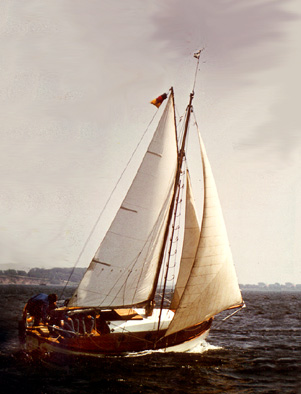
As a sailing rig, a cutter is a single-masted boat, with two or more headsails. On the eastern side of the Atlantic, the two headsails on a single mast is the fullest extent of the modern definition. In U.S. waters, a greater level of complexity applies, with the placement of the mast and the rigging details of the bowsprit taken into account – so a boat with two headsails may be classed as a sloop.
Government agencies use the term "cutter" for vessels employed in patrolling their territorial waters and other enforcement activities. This terminology is derived from the sailing cutters which had this sort of role from the 18th century to the end of the 19th century. (See below.) Whilst the details vary from country to country, generally these are small ships that can remain at sea for extended periods and in all usual weather conditions. Many, but not all, are armed. Uses include control of a country's borders and preventing smuggling.
Cutters as ship's boats came into use in the early 18th century (dating which roughly coincides with the decked sailing vessels described below). These were clinker-built open boats which were fitted for propulsion by both oar and sail. They were more optimised for sailing than the barges and pinnaces that were types of ship's boat used in the Royal Navy – one distinctive resulting feature of this was the washstrake added to increase the freeboard. It was pierced with rowlock cut-outs for the oars, so that the thwarts did not need to be set unusually high to achieve the right geometry for efficient use.
Cutters, as decked sailing vessels designed for speed, came into use in the early part of the 18th century. When first introduced, the term applied largely to the hull form, in the same way that clipper was used almost a hundred years later. Some of these 18th and 19th century examples were rigged as ketches or brigs. However, the typical rig, especially in Naval or revenue protection use, was a single-masted rig setting a huge amount of sail. Square sails were set, as well as a full complement of fore and aft sails. In civilian use, cutters were mostly involved in smuggling. The navy and coastguard therefore also used cutters in an attempt to catch those operating illegally.
The term cutter appeared in the early 18th century as a description of a hull type. These vessels were designed for speed and the name was used in a similar way to clipper in the next century. The concept of hull type was perpetuated by the term "cutter brig" which was used over the period circa 1781–1807 for those rigged as brigs. "Cutter built" was a description applied to a hull of this type and designed for speed. More generally, the unmodified word "cutter" soon became associated with a single-masted rig.
Fast vessels were often used for illegal purposes, such as smuggling, or by the authorities trying to prevent this illegality. Therefore, cutters were used for both. The Royal Navy bought and had built a large number for use in controlling smuggling, as "advice boats" (carrying dispatches), or against privateers.
The characteristic cutter hull shape was wide; many had a length to breadth ratio of 3 to 1. It had a lot of deadrise and fine lines. A huge amount of sail could be set on these beamy hulls. The rig became standardised as having one mast, a gaff-rigged mainsail, square sails and several headsails – together with a full range of extra light weather sails. The mainsail had a boom that extended beyond the stern. Square sails consisted of a course, topsail and topgallant. In earlier examples (before 1800) the topsail's foot had a large amount of roach and was sheeted to a separate yard that was set below the main yard (which carried the course). The headsails were a staysail, set on the forestay (which fastened to the stemhead), a jib, set flying to a traveller on the bowsprit and, in most cases, a flying jib (alternatively termed a jib-topsail) also set flying, but to a higher point on the mast. A cutter has a running bowsprit, which can be brought inboard when not needed, such as in rough weather or in harbour. The bowsprit was usually of great length, sometimes longer than the hull. The standard fair weather sails consisted of a ringtail to the mainsail and studding sails to the square sails. It was not unknown for cutters to use a removable mizzen mast for use when reaching, setting a lugsail. Since the boom of the mainsail overhung the stern, the mast would have to be removed to tack or gybe.
Hub AI
Cutter (boat) AI simulator
(@Cutter (boat)_simulator)
Cutter (boat)
A cutter is any of various types of watercraft. The term can refer to the rig (sail plan) of a sailing vessel (but with regional differences in definition), to a governmental enforcement agency vessel (such as a coast guard or border force cutter), to a type of ship's boat which can be used under sail or oars, or, historically, to a type of fast-sailing vessel introduced in the 18th century, some of which were used as small warships.
As a sailing rig, a cutter is a single-masted boat, with two or more headsails. On the eastern side of the Atlantic, the two headsails on a single mast is the fullest extent of the modern definition. In U.S. waters, a greater level of complexity applies, with the placement of the mast and the rigging details of the bowsprit taken into account – so a boat with two headsails may be classed as a sloop.
Government agencies use the term "cutter" for vessels employed in patrolling their territorial waters and other enforcement activities. This terminology is derived from the sailing cutters which had this sort of role from the 18th century to the end of the 19th century. (See below.) Whilst the details vary from country to country, generally these are small ships that can remain at sea for extended periods and in all usual weather conditions. Many, but not all, are armed. Uses include control of a country's borders and preventing smuggling.
Cutters as ship's boats came into use in the early 18th century (dating which roughly coincides with the decked sailing vessels described below). These were clinker-built open boats which were fitted for propulsion by both oar and sail. They were more optimised for sailing than the barges and pinnaces that were types of ship's boat used in the Royal Navy – one distinctive resulting feature of this was the washstrake added to increase the freeboard. It was pierced with rowlock cut-outs for the oars, so that the thwarts did not need to be set unusually high to achieve the right geometry for efficient use.
Cutters, as decked sailing vessels designed for speed, came into use in the early part of the 18th century. When first introduced, the term applied largely to the hull form, in the same way that clipper was used almost a hundred years later. Some of these 18th and 19th century examples were rigged as ketches or brigs. However, the typical rig, especially in Naval or revenue protection use, was a single-masted rig setting a huge amount of sail. Square sails were set, as well as a full complement of fore and aft sails. In civilian use, cutters were mostly involved in smuggling. The navy and coastguard therefore also used cutters in an attempt to catch those operating illegally.
The term cutter appeared in the early 18th century as a description of a hull type. These vessels were designed for speed and the name was used in a similar way to clipper in the next century. The concept of hull type was perpetuated by the term "cutter brig" which was used over the period circa 1781–1807 for those rigged as brigs. "Cutter built" was a description applied to a hull of this type and designed for speed. More generally, the unmodified word "cutter" soon became associated with a single-masted rig.
Fast vessels were often used for illegal purposes, such as smuggling, or by the authorities trying to prevent this illegality. Therefore, cutters were used for both. The Royal Navy bought and had built a large number for use in controlling smuggling, as "advice boats" (carrying dispatches), or against privateers.
The characteristic cutter hull shape was wide; many had a length to breadth ratio of 3 to 1. It had a lot of deadrise and fine lines. A huge amount of sail could be set on these beamy hulls. The rig became standardised as having one mast, a gaff-rigged mainsail, square sails and several headsails – together with a full range of extra light weather sails. The mainsail had a boom that extended beyond the stern. Square sails consisted of a course, topsail and topgallant. In earlier examples (before 1800) the topsail's foot had a large amount of roach and was sheeted to a separate yard that was set below the main yard (which carried the course). The headsails were a staysail, set on the forestay (which fastened to the stemhead), a jib, set flying to a traveller on the bowsprit and, in most cases, a flying jib (alternatively termed a jib-topsail) also set flying, but to a higher point on the mast. A cutter has a running bowsprit, which can be brought inboard when not needed, such as in rough weather or in harbour. The bowsprit was usually of great length, sometimes longer than the hull. The standard fair weather sails consisted of a ringtail to the mainsail and studding sails to the square sails. It was not unknown for cutters to use a removable mizzen mast for use when reaching, setting a lugsail. Since the boom of the mainsail overhung the stern, the mast would have to be removed to tack or gybe.