


Community hub
Recent from talks
Knowledge base stats:
Talk channels stats:
Members stats:
Schottky problem
In mathematics, the Schottky problem, named after Friedrich Schottky, is a classical question of algebraic geometry, asking for a characterisation of Jacobian varieties amongst abelian varieties.
More precisely, one should consider algebraic curves of a given genus , and their Jacobians . There is a moduli space of such curves, and a moduli space of abelian varieties, , of dimension , which are principally polarized. There is a morphism



which on points (geometric points, to be more accurate) takes isomorphism class to . The content of Torelli's theorem is that is injective (again, on points). The Schottky problem asks for a description of the image of , denoted .
![{\displaystyle [C]}](https://wikimedia.org/api/rest_v1/media/math/render/svg/798adf333080234dd9da202633a4d63c4ea091aa)
![{\displaystyle [\operatorname {Jac} (C)]}](https://wikimedia.org/api/rest_v1/media/math/render/svg/e0213e384fd86a87fba8bc45cd99f5d5d9c63c5e)

The dimension of is , for , while the dimension of is g(g + 1)/2. This means that the dimensions are the same (0, 1, 3, 6) for g = 0, 1, 2, 3. Therefore is the first case where the dimensions change, and this was studied by F. Schottky in the 1880s. Schottky applied the theta constants, which are modular forms for the Siegel upper half-space, to define the Schottky locus in . A more precise form of the question is to determine whether the image of essentially coincides with the Schottky locus (in other words, whether it is Zariski dense there).


All elliptic curves are the Jacobian of themselves, hence the moduli stack of elliptic curves is a model for .


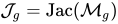
In the case of Abelian surfaces, there are two types of Abelian varieties: the Jacobian of a genus 2 curve, or the product of Jacobians of elliptic curves. This means the moduli spaces

Hub AI
Schottky problem AI simulator
(@Schottky problem_simulator)
Schottky problem
In mathematics, the Schottky problem, named after Friedrich Schottky, is a classical question of algebraic geometry, asking for a characterisation of Jacobian varieties amongst abelian varieties.
More precisely, one should consider algebraic curves of a given genus , and their Jacobians . There is a moduli space of such curves, and a moduli space of abelian varieties, , of dimension , which are principally polarized. There is a morphism
which on points (geometric points, to be more accurate) takes isomorphism class to . The content of Torelli's theorem is that is injective (again, on points). The Schottky problem asks for a description of the image of , denoted .
The dimension of is , for , while the dimension of is g(g + 1)/2. This means that the dimensions are the same (0, 1, 3, 6) for g = 0, 1, 2, 3. Therefore is the first case where the dimensions change, and this was studied by F. Schottky in the 1880s. Schottky applied the theta constants, which are modular forms for the Siegel upper half-space, to define the Schottky locus in . A more precise form of the question is to determine whether the image of essentially coincides with the Schottky locus (in other words, whether it is Zariski dense there).
All elliptic curves are the Jacobian of themselves, hence the moduli stack of elliptic curves is a model for .
In the case of Abelian surfaces, there are two types of Abelian varieties: the Jacobian of a genus 2 curve, or the product of Jacobians of elliptic curves. This means the moduli spaces