



Community hub
Recent from talks
Knowledge base stats:
Talk channels stats:
Members stats:
Ring expansion and contraction
Ring expansion and ring contraction reactions expand or contract rings, usually in organic chemistry. The term usually refers to reactions involve making and breaking C-C bonds, Diverse pathways lead to these kinds of reactions. Many of these reactions are primarily of theoretical or pedagoogical interest, but some are very useful.
Rings can be expanded by attack of the ring onto an outside group already appended to the ring (a migration/insertion), opening of a bicycle to a single larger ring, or coupling a ring closing with an expansion. These expansions can be further broken down by what type of atom they incorporate (a carbon or a heteroatom) into the expanded ring.
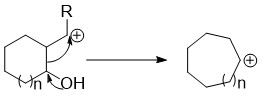
These reactions have the general features of having an exocyclic leaving group on a carbon adjacent to the ring and an electron donating group on the ring capable of initiating a migration of an endocyclic bond.
A common migration introduction of carbon is a pinacol rearrangement. While this reaction refers specifically to a vicinal dihydroxide rearrangement, there are other pinacol type rearrangements that proceed through the same general mechanism such as the Tiffeneau–Demjanov rearrangement. These "semipinacol rearrangements" occur under milder conditions and are thus preferable in complex syntheses. These reactions are useful beyond simply expanding a ring because the exocyclic group attacked may also have other functionality appended to it besides the leaving group. The group to which the endocyclic bond migrates can also be selectively added to the ring based on the functionality already present, for example 1,2 addition into a cyclic ketone.
A common method for expanding a ring involves opening cyclopropane-containing bicyclic intermediate. The strategy can start with a Simmons-Smith-like cyclopropanation of a cyclic alkene.
A related cyclopropane-based ring expansion is the Buchner ring expansion. The Buchner ring expansion is used to convert arenes to cycloheptatrienes. The Buchner ring expansion is encouraged to open to the desired product by placing electron withdrawing groups on the carbon added. In order to perform the ring opening on saturated bicyclic molecules the cyclopropane must be introduced such that a neighboring group can facilitate the expansion or the ring must be opened by attackate the expansion or the ring must be opened by attack from an outside group.
Ring opening as a means of ring expansion can also be applied to larger systems to give access to even larger ring syscyclization. The Grob fragmentation can be applied as an example of such an expansion. Like the pinacol type migration the Grob fragmentation relies on an electron donating group to promote the bond migration and encourage the leaving group to be expelled. In this case the electron donating group can be a pseudo electron donating group which is capable of eliminating and donating an electron pair into the carbon with the breaking bond. Working with two smaller rings can allow for elaboration of two parts of the molecule separately before working with the expanded ring. The Dowd-Beckwith ring expansion reaction is also capable of adding several carbons to a ring at a time, and is a useful tool for making large rings. While it proceeds through an intermediate bicycle the final cyclization and ring opening take place within the same radical reaction. This expansion is useful because it allows the expansion of a beta-ketoester to a large cyclic ketone which can easily be elaborated using either the cyclic ketone or the exocyclic ester.
Some heterocycles can be made through ring expansions.
Hub AI
Ring expansion and contraction AI simulator
(@Ring expansion and contraction_simulator)
Ring expansion and contraction
Ring expansion and ring contraction reactions expand or contract rings, usually in organic chemistry. The term usually refers to reactions involve making and breaking C-C bonds, Diverse pathways lead to these kinds of reactions. Many of these reactions are primarily of theoretical or pedagoogical interest, but some are very useful.
Rings can be expanded by attack of the ring onto an outside group already appended to the ring (a migration/insertion), opening of a bicycle to a single larger ring, or coupling a ring closing with an expansion. These expansions can be further broken down by what type of atom they incorporate (a carbon or a heteroatom) into the expanded ring.
These reactions have the general features of having an exocyclic leaving group on a carbon adjacent to the ring and an electron donating group on the ring capable of initiating a migration of an endocyclic bond.
A common migration introduction of carbon is a pinacol rearrangement. While this reaction refers specifically to a vicinal dihydroxide rearrangement, there are other pinacol type rearrangements that proceed through the same general mechanism such as the Tiffeneau–Demjanov rearrangement. These "semipinacol rearrangements" occur under milder conditions and are thus preferable in complex syntheses. These reactions are useful beyond simply expanding a ring because the exocyclic group attacked may also have other functionality appended to it besides the leaving group. The group to which the endocyclic bond migrates can also be selectively added to the ring based on the functionality already present, for example 1,2 addition into a cyclic ketone.
A common method for expanding a ring involves opening cyclopropane-containing bicyclic intermediate. The strategy can start with a Simmons-Smith-like cyclopropanation of a cyclic alkene.
A related cyclopropane-based ring expansion is the Buchner ring expansion. The Buchner ring expansion is used to convert arenes to cycloheptatrienes. The Buchner ring expansion is encouraged to open to the desired product by placing electron withdrawing groups on the carbon added. In order to perform the ring opening on saturated bicyclic molecules the cyclopropane must be introduced such that a neighboring group can facilitate the expansion or the ring must be opened by attackate the expansion or the ring must be opened by attack from an outside group.
Ring opening as a means of ring expansion can also be applied to larger systems to give access to even larger ring syscyclization. The Grob fragmentation can be applied as an example of such an expansion. Like the pinacol type migration the Grob fragmentation relies on an electron donating group to promote the bond migration and encourage the leaving group to be expelled. In this case the electron donating group can be a pseudo electron donating group which is capable of eliminating and donating an electron pair into the carbon with the breaking bond. Working with two smaller rings can allow for elaboration of two parts of the molecule separately before working with the expanded ring. The Dowd-Beckwith ring expansion reaction is also capable of adding several carbons to a ring at a time, and is a useful tool for making large rings. While it proceeds through an intermediate bicycle the final cyclization and ring opening take place within the same radical reaction. This expansion is useful because it allows the expansion of a beta-ketoester to a large cyclic ketone which can easily be elaborated using either the cyclic ketone or the exocyclic ester.
Some heterocycles can be made through ring expansions.