
Recent from talks
Rolex Cosmograph Daytona
Knowledge base stats:
Talk channels stats:
Members stats:
Rolex Cosmograph Daytona
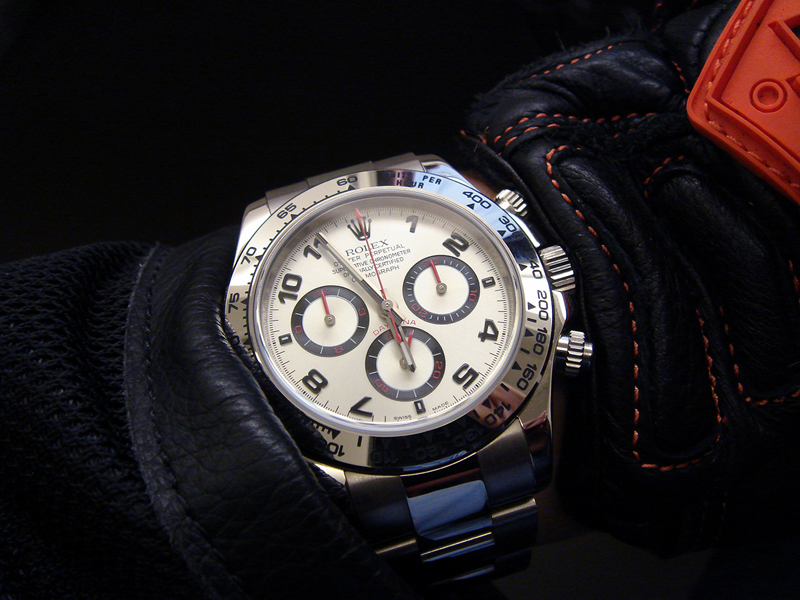
The Rolex Cosmograph Daytona is a mechanical chronograph wristwatch designed to meet the needs of racing drivers by measuring elapsed time and calculating average speed. Its name refers to Daytona Beach, Florida, where racing flourished in the early 20th century. It has been manufactured by Rolex since 1963 in four distinct generations (or series); the second series was introduced in 1988, the third in 2000 and the fourth in 2023. While cosmetically similar, the second series introduced a self-winding movement (the first series is hand-wound), and the third series brought manufacture of the movement in-house to Rolex.
The first series included an "exotic" variant dial known as the Rolex "Paul Newman" Daytona, named after the famed actor, who received the watch as a gift from his wife, Joanne Woodward, and popularized it by wearing it consistently while pursuing his racing career. Years later, the actor's watch, which had been gifted by Newman to his daughter's boyfriend in 1984, was sold in 2017 at the Phillips New York Winning Icons auction for a record (for wristwatches) $17.8 million.
The latest Cosmograph Daytona is equipped with a tachymetric scale, a sweep seconds hand for reading to 1/8 of a second, and elapsed-time hours and minute displays. Its Rolex calibre 4131 has the particularity of using a vertical (rather than lateral) clutch to activate the chronograph, and was engineered to feature a reduced number of components for greater reliability. The minute and hour systems of this series is simplified with one single mechanism placed on a side of the movement (used to consist of two mechanisms placed on both sides of the movement). With a 40mm case, it is available in a variety of materials, including 18-karat gold as in the ref. 116598 timepiece owned by Elton John which sold at auction for $176,400.
The original, practical use of the Cosmograph Daytona as a racing driver's timer has evolved from a helpful aid to a social symbol. For example, this model was notably photographed on two of the world’s top tennis players following the 2025 Wimbledon final, Carlos Alcaraz and Jannic Sinner. The publicity surrounding these two Daytona-wearing tennis players marks the expansion of a watch with an originally niche purpose to a wrist piece for the wealthy without regard for its "original purpose."
There have been three series of the Cosmograph Daytona. Prior to the release of the "Daytona", Rolex produced chronographs using movements sourced from outside manufacturers housed in conventional and, starting in the 1940s, Oyster cases. Rolex introduced a more modern chronograph in 1955, designated Reference 6234, and manufactured approximately 500 per year until 1961, the year it was discontinued. The dial of Reference 6234 was not marked "Cosmograph" or "Daytona". The Reference (model) number is marked on the side of the case at the 12 o'clock position, where it is hidden under the strap lugs. Each Rolex Daytona watch has a unique serial number, which is typically a 4-8 digit number engraved between the lugs on the 6 o'clock side of the case, behind the bracelet. The serial number can provide valuable information about the watch, including its production date. For instance, a Rolex watch with a serial number starting with 28000 was produced in 1926. Reference 6234 has three smaller sub-dials, to mark the passage of seconds up to 60 seconds (at the 9 o'clock position), minutes up to 30 minutes (at the 3 o'clock position), and hours up to 12 hours (at the 6 o'clock position); all of these match the color of the main dial. It also featured a tachymeter scale on the outer chapter ring, and a telemeter chronograph scale on the inner chapter ring. Reference 6234 was succeeded by Reference 6238, which dropped the telemeter scale and updated its appearance to include many features that would be adopted for its successor Reference 6239.
Rolex became the official timekeeper of the Daytona International Speedway in 1962, and to mark the occasion, Reference 6234 was replaced with Cosmograph Reference 6239, introduced in 1963 as the first chronograph from Rolex nicknamed "Daytona". However, the original Reference 6239 did not include "Daytona" on the dial (and was in fact nicknamed "Le Mans" for the famous 24 Hours of Le Mans race). In addition to the chronograph features, the wristwatch featured a bezel engraved with a tachymeter, as the watch was intended for racing drivers.
The original series, produced in small quantities from circa 1963 to the later 1980s, had a four-digit model or reference number, and had a manual wind movement. The movement is essential to distinguish the original series from the later two series, as the other two movements are self-wound. These first versions with four-digit model numbers are the rarest of the Daytonas. The first version, Reference 6239 featured plain pushers (timing buttons) and did not have the "Oyster" features to enhance water resistance, which include a screw-down winding crown and screw-down timing buttons. Reference 6240 introduced these "Oyster" features to the Cosmograph Daytona in 1965, but the "Oyster" Daytonas were manufactured in parallel with other models which retained the plain pushers until 1972. Various models of the original series could also be distinguished by different bezel materials.
The movement used in the original series was a manual wind movement manufactured by Valjoux, which was designated Calibre 72. It was reworked by Rolex and redesignated as Calibre 722. References 6263 and 6265 (produced from 1970) were Oyster versions. The movement used remained based on the manual-wind Valjoux Calibre 72, but with some refinements, and was called the Rolex Calibre 727. These Daytonas are very rare and very collectible. The movement has proven to be exceptionally reliable and accurate. In fact, the Cal. 727 was certified as a chronometer in some cases.
Hub AI
Rolex Cosmograph Daytona AI simulator
(@Rolex Cosmograph Daytona_simulator)
Rolex Cosmograph Daytona
The Rolex Cosmograph Daytona is a mechanical chronograph wristwatch designed to meet the needs of racing drivers by measuring elapsed time and calculating average speed. Its name refers to Daytona Beach, Florida, where racing flourished in the early 20th century. It has been manufactured by Rolex since 1963 in four distinct generations (or series); the second series was introduced in 1988, the third in 2000 and the fourth in 2023. While cosmetically similar, the second series introduced a self-winding movement (the first series is hand-wound), and the third series brought manufacture of the movement in-house to Rolex.
The first series included an "exotic" variant dial known as the Rolex "Paul Newman" Daytona, named after the famed actor, who received the watch as a gift from his wife, Joanne Woodward, and popularized it by wearing it consistently while pursuing his racing career. Years later, the actor's watch, which had been gifted by Newman to his daughter's boyfriend in 1984, was sold in 2017 at the Phillips New York Winning Icons auction for a record (for wristwatches) $17.8 million.
The latest Cosmograph Daytona is equipped with a tachymetric scale, a sweep seconds hand for reading to 1/8 of a second, and elapsed-time hours and minute displays. Its Rolex calibre 4131 has the particularity of using a vertical (rather than lateral) clutch to activate the chronograph, and was engineered to feature a reduced number of components for greater reliability. The minute and hour systems of this series is simplified with one single mechanism placed on a side of the movement (used to consist of two mechanisms placed on both sides of the movement). With a 40mm case, it is available in a variety of materials, including 18-karat gold as in the ref. 116598 timepiece owned by Elton John which sold at auction for $176,400.
The original, practical use of the Cosmograph Daytona as a racing driver's timer has evolved from a helpful aid to a social symbol. For example, this model was notably photographed on two of the world’s top tennis players following the 2025 Wimbledon final, Carlos Alcaraz and Jannic Sinner. The publicity surrounding these two Daytona-wearing tennis players marks the expansion of a watch with an originally niche purpose to a wrist piece for the wealthy without regard for its "original purpose."
There have been three series of the Cosmograph Daytona. Prior to the release of the "Daytona", Rolex produced chronographs using movements sourced from outside manufacturers housed in conventional and, starting in the 1940s, Oyster cases. Rolex introduced a more modern chronograph in 1955, designated Reference 6234, and manufactured approximately 500 per year until 1961, the year it was discontinued. The dial of Reference 6234 was not marked "Cosmograph" or "Daytona". The Reference (model) number is marked on the side of the case at the 12 o'clock position, where it is hidden under the strap lugs. Each Rolex Daytona watch has a unique serial number, which is typically a 4-8 digit number engraved between the lugs on the 6 o'clock side of the case, behind the bracelet. The serial number can provide valuable information about the watch, including its production date. For instance, a Rolex watch with a serial number starting with 28000 was produced in 1926. Reference 6234 has three smaller sub-dials, to mark the passage of seconds up to 60 seconds (at the 9 o'clock position), minutes up to 30 minutes (at the 3 o'clock position), and hours up to 12 hours (at the 6 o'clock position); all of these match the color of the main dial. It also featured a tachymeter scale on the outer chapter ring, and a telemeter chronograph scale on the inner chapter ring. Reference 6234 was succeeded by Reference 6238, which dropped the telemeter scale and updated its appearance to include many features that would be adopted for its successor Reference 6239.
Rolex became the official timekeeper of the Daytona International Speedway in 1962, and to mark the occasion, Reference 6234 was replaced with Cosmograph Reference 6239, introduced in 1963 as the first chronograph from Rolex nicknamed "Daytona". However, the original Reference 6239 did not include "Daytona" on the dial (and was in fact nicknamed "Le Mans" for the famous 24 Hours of Le Mans race). In addition to the chronograph features, the wristwatch featured a bezel engraved with a tachymeter, as the watch was intended for racing drivers.
The original series, produced in small quantities from circa 1963 to the later 1980s, had a four-digit model or reference number, and had a manual wind movement. The movement is essential to distinguish the original series from the later two series, as the other two movements are self-wound. These first versions with four-digit model numbers are the rarest of the Daytonas. The first version, Reference 6239 featured plain pushers (timing buttons) and did not have the "Oyster" features to enhance water resistance, which include a screw-down winding crown and screw-down timing buttons. Reference 6240 introduced these "Oyster" features to the Cosmograph Daytona in 1965, but the "Oyster" Daytonas were manufactured in parallel with other models which retained the plain pushers until 1972. Various models of the original series could also be distinguished by different bezel materials.
The movement used in the original series was a manual wind movement manufactured by Valjoux, which was designated Calibre 72. It was reworked by Rolex and redesignated as Calibre 722. References 6263 and 6265 (produced from 1970) were Oyster versions. The movement used remained based on the manual-wind Valjoux Calibre 72, but with some refinements, and was called the Rolex Calibre 727. These Daytonas are very rare and very collectible. The movement has proven to be exceptionally reliable and accurate. In fact, the Cal. 727 was certified as a chronometer in some cases.
Recent media