


Community hub
Recent from talks
Contribute something
Nothing was collected or created yet.
Romanum decet pontificem
View on Wikipedia

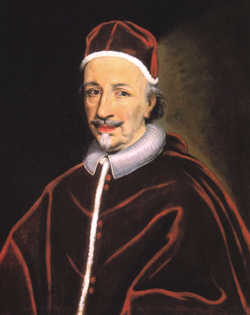
Romanum decet Pontificem (named for its Latin incipit: "it befits the Roman pontiff") is a papal bull issued by Pope Innocent XII (1691–1700) on June 22, 1692, banning the office of cardinal-nephew, limiting his successors to elevating only one cardinal relative,[1] eliminating various sinecures traditionally reserved for cardinal-nephews and capping the stipend or endowment the nephew of a pope could receive to 12,000 scudi.[2][3][4]
Romanum decet Pontificem was later incorporated into the Code of Canon Law of 1917 in canons 240, 2; 1414, 4; and 1432, 1.[5] In 1694, Innocent XII's series of reforms was capped off with an expensive campaign to eliminate the venality of offices while reimbursing their current holders.[6]
However, following Romanum decet Pontificem, only three of the eight popes of the 18th century did not make a nephew or brother cardinal, and two of the three were members of monastic orders, that is without a family in the proper sense.[4]
References
[edit]- ^ "The Cardinals of the Holy Roman Church - Biographical Dictionary - Consistory of September 1, 1681". cardinals.fiu.edu. Retrieved 2025-11-05.
- ^ Standen, Edith A. 1981. "Tapestries for a Cardinal-Nephew: A Roman Set Illustrating Tasso's "Gerusalemme Liberata." Metropolitan Museum Journal. 16: 147-164.
- ^ Ed. Philippe Levillain. 2002. "Nepotism." The Papacy: An Encyclopedia. Routledge. ISBN 0-415-92228-3. p. 1032.
- ^ a b Chadwick, Owen (1981). The Popes and European revolution. Oxford history of the Christian Church. Oxford and New York: Clarendon Press; Oxford University Press. pp. 304–305. ISBN 978-0-19-826919-9.
- ^ "The Cardinals of the Holy Roman Church - Guide to documents and events". cardinals.fiu.edu. Retrieved 2025-11-05.
- ^ Levillain, 2002, p. 468.