Hubbry Logo
Rote IslandRote IslandMain
Open search
Rote Island
Community hub
Rote Island
logo
8 pages, 0 posts
0 subscribers
Be the first to start a discussion here.
Rote Island
Rote Island
from Wikipedia

Rote Island (Indonesian: Pulau Rote, also called Roti) is an island of Indonesia, part of the East Nusa Tenggara province of the Lesser Sunda Islands. According to legend, this island got its name accidentally when a lost Portuguese sailor arrived and asked a farmer where he was. The surprised farmer, who could not speak Portuguese, introduced himself, "Rote".[citation needed] About 80% of the people of Rote Island in Indonesia are Christian. Christianity is an important part of the community.

Key Information

Geography

[edit]

Rote lies 500 km (310.686 miles) northwest of the Australian coast and 150 km (105.633 miles) north of the Ashmore and Cartier Islands. The island is situated to the southwest of the larger island of Timor. To the north is the Savu Sea, and to the south is the Timor Sea. To the west lie Savu and Sumba. The uninhabited Pamana (or Ndana) island, just south of Rote, with an area of 14 km2 (5 sq mi), is the southernmost island of Indonesia. Along with some other nearby small islands, such as Nuse Island and Ndao island to the west of Rote, it forms the kabupaten (regency) of Rote Ndao Regency, which in the 2020 decennial census recorded a population of 143,764;[1] the official estimate as at mid 2022 was 148,811.[2] Rote island has an area of 1,280.10 km2 (494 sq mi) (including offshore islands).

The main town, Ba'a, is located on the northern side of the island. Rote has a good surf area in the south, around the village of Nembrala.

For the most part, the island is covered by grassland and palms. This island experiences tropical savanna climate (Aw) with dry months for much of the year because of the dry winds that blow from mainland Australia. The main rainfall usually occurs between November and March. Between 80% and 95% of all rain falls during the wet west monsoon period and with little or no rain falling between July and October. The mean rainfall for Rote Island is around 1,200 to 1,300 mm annually. During the dry season, many streams and rivers run dry and local inhabitants must rely only on wells for their water supplies.

Geology

[edit]

Rote is the youngest island of the Banda Fore Arc. The Banda Fore Arc is an accretionary wedge forming in response to an arc continent collision between oceanic crust of the Eurasian Plate and the Australian Plate. As the Australian continental shelf subducts under the Banda Arc, marine sediment is transferred to the upper plate, forming and accretionary wedge. Most of the wedge is submarine, but some parts are exposed above sea level forming the islands of Sumba, Savu, Rote and Timor.[3]

Rote and Savu are the youngest of these islands. Researchers have investigated the biostratigraphy of microfossils to time the uplift of these islands and the rate at which they rose from below sea level. Planktonic microorganisms called Foraminifera build shells of calcite. When they die, their shells accumulate on the seafloor as thick sequences of chalk. Chalk forms in deep marine, low energy environments. The Neogene Batu Putih Formation is a deposit of chalk, 100s of meters thick, that accumulated on top of the Banda Fore Arc accretionary wedge. This chalk is exposed at the surface on Rote and Savu.[3]

By studying the faunal succession and thickness of chalk deposits, researchers have determined that the accretionary wedge began forming at least 5.6 million years ago. Rote rose to the surface around 200,000 years ago, half a million years after nearby Savu, from a depth of at least 2.5 km below sea level, at an average rate of 0.6 mm/year over the past 5.2 million years. Over the last 125,000 years that rate has increased to almost 1.4 mm/year. Changes in the rates in uplift is hypothesized to be a consequence of the subduction of the Scott Plateau of the Australian passive margin. More work is needed to understand the crustal and tectonic mechanisms that are at play in the development of the Rote and Savu islands.[3]

Transportation

[edit]

There is a daily ferry to the island from Kupang, the provincial capital on West Timor, which provides transport for local passengers and goods as well as tourists. The trip between Kupang and Ba'a takes around two hours. The ferry leaves at 8.30 AM and costs 80,000 Indonesian rupiah. The fare in 2023 had risen to 202,000 IDR.[4]

Wings Air operates daily flights between Rote's David Constantijn Saudale Airport and Kupang's El Tari International Airport. Flight time is about 30 minutes.

Economy

[edit]
Town Market in Ba'a, Rote

Rote consists of rolling hills, terraced plantations, acacia palm, savanna and some forests. The Rotinese depend, like the Sabunese, on the lontar palm not only for basic survival but also as a supplement to their income from fishing and jewelry making.

Agriculture is the main form of employment. Fishing is also important, especially in the eastern village of Papela (east of Londalusi in the map), which has led to disputes with Australia over the water between them.[5]

Tourist attractions

[edit]

Rote has many historical relics including fine antique Chinese porcelain, as well as ancient arts and traditions. Several prominent Indonesian figures were born in Rote. A popular music instrument, Sasando, is made of palm leaves.

In the eastern part of the island is a pond in Landu Village that has non-poisonous jellyfish. The pond also has a white sandy beach.[6]

Rote Island, also known as Rote Ndao, is an island consisting of 96 small islands and 6 of them are inhabited. Many islands have natural beaches and other natural and frequent tourism, but so far only local tourists often come to Rote. 10 of the most famous tourist attractions in Rote that are Bo'a beach, Nemberala beach,[7] Lutu Babatu beach, Falii water located in West Rote, Oesosole beach in East Rote, Termanu stone in central Rote, Laguna Nirwana in Southwest Rote, Oekode Waterfall, Zero Point Rote and Inaoe beach in South Rote.[8]

Culture

[edit]

The ti'i langga is a traditional hat with a horn-like protrusion at the top that is a symbol of Rote cultural identity.[9]

There are many languages spoken on the island, all related to the languages on nearby Timor island. These languages are: Bilba, Dengka, Lole, Ringgou, Dela-Oenale, Termanu, and Tii.

Trivia

[edit]

The critically endangered Rote Island snake-necked turtle is endemic to Rote Island.

The US-born Australian scholar, James J. Fox, has written extensively about Rotinese culture.

[edit]

See also

[edit]

References

[edit]

Further reading

[edit]
Revisions and contributorsEdit on WikipediaRead on Wikipedia
from Grokipedia
Rote Island is the southernmost island of Indonesia, situated in the East Nusa Tenggara province within the Lesser Sunda archipelago, approximately 16 kilometers southwest of Timor across the Roti Strait. Covering an area of roughly 1,200 square kilometers, it features a dry savanna landscape dominated by lontar palms and experiences a prolonged dry season. The island's population, estimated at around 100,000, primarily consists of the indigenous Rotinese people who maintain traditional subsistence practices centered on lontar palm exploitation for food, building materials, and crafts. Historically inhabited by the Rotinese since ancient times and organized into small kingdoms, Rote Island resisted widespread Islamization, resulting in a predominantly Christian and animist population that preserves distinct cultural elements such as the sasando—a unique bamboo and lontar leaf stringed instrument—and intricate ikat weaving traditions. The local economy relies heavily on agriculture, including crops like corn, cassava, and peanuts, alongside fishing, seaweed farming, and emerging tourism driven by pristine beaches, world-class surfing at spots like Nemberala, and vibrant coral reefs supporting marine biodiversity. Notable for its ecological significance, including endemic species like the Rote turtle facing extinction threats addressed through community-led conservation, the island exemplifies sustainable traditional practices amid challenges like water scarcity and environmental pressures from climate variability. These characteristics define Rote as a bastion of cultural authenticity and natural allure in Indonesia's maritime frontier.

Physical Environment

Geography

Rote Island constitutes Indonesia's southernmost inhabited landmass, situated approximately 16 kilometers southwest of Timor across the Roti Strait within East Nusa Tenggara province. The island spans roughly 1,200 square kilometers, encompassing a regency that includes surrounding marine areas but primarily features the main landmass oriented southwest to northeast. The climate is tropical savanna type, marked by extended dry periods from April to November—often spanning 8 months with minimal precipitation—and a brief wet season from December to March. Annual rainfall averages 1,200 to 1,300 millimeters, predominantly falling during the wet months, rendering the island prone to droughts and arid conditions more severe than those on adjacent Timor. Physically, Rote exhibits low-relief coastal plains fringed by coral reefs, inland dry savannas interspersed with rugged hills, and limited freshwater streams that frequently desiccate in the dry season. The landscape supports sparse vegetation adapted to aridity, with the principal harbor at Ba'a facilitating maritime access on the northern shore.

Geology

Rote Island forms part of the southeastern Banda Arc system, where the northward-advancing Australian continental margin of the Sahul Shelf collides with the overriding volcanic arc, initiating uplift and deformation as early as the Pliocene epoch. This arc-continent interaction, characterized by subduction rollback and oblique collision, has resulted in the island's emergence from a forearc position, with mixed vertical and horizontal deformations lifting continental fragments partially from the Australian shelf. Volcanic activity in the inner arc dates to approximately 4 million years ago, though Rote itself exhibits limited direct volcanism, instead reflecting collisional tectonics that deform sedimentary sequences. The island's subsurface is predominantly composed of Quaternary coral limestones and Tertiary sedimentary rocks, including the highly strained Wai Luli Formation exposed in the island's core, which records flexural flow-type deformation from collisional stresses. Coastal areas feature Holocene alluvium overlying Quaternary coral limestone, interspersed with Tertiary Bobonaro Complex mélange containing blocks of Permian crinoid-rich limestone, Gondwana sandstones, and minor metamorphic or igneous fragments. Karst landscapes dominate over 60% of the island due to extensive carbonate dissolution, with raised coral terraces—evidenced by thicknesses up to 237 meters in formations like Batu Putih—indicating episodic tectonic uplift superimposed on Quaternary sea-level changes. Mineral resources remain limited, with no significant economic deposits identified beyond the low-value limestones serving as the primary aquifer. Seismic hazards arise from the island's position amid active tectonics, including faults in the nearby Timor Trough and Banda Arc subduction zone extending to depths of about 650 kilometers, fostering frequent earthquakes through slab rupture and collisional stresses. The region records high moment release rates, particularly in intermediate-depth events beneath the arc, underscoring Rote's vulnerability to tectonic unrest without notable volcanic mitigation.

History

Early Settlement and Pre-Colonial Era

Archaeological investigations at rock-shelter sites, including Pia Hudale, reveal evidence of human occupation on Rote Island during the terminal Pleistocene period, around 12,000 years before present, characterized by stone artifacts indicative of early foraging and tool-making activities. These findings suggest that prehistoric populations possessed sufficient maritime skills to navigate to the island, part of the Wallacean archipelago, potentially as part of broader migrations from mainland Asia via island-hopping routes. Subsequent layers in these shelters show continuity in stone technology, with shifts in raw material use reflecting adaptations to local environments on Rote and nearby Sawu Island. The arrival of Austronesian-speaking groups, estimated between 2,000 and 3,000 years ago, marked a transformative phase, introducing linguistic and cultural elements still evident in Rotinese society. Oral traditions preserved among the Rotinese describe ancestral migrations from northern regions, such as Seram Island in Maluku or via Timor from Sulawesi, involving successive waves that integrated with or displaced earlier inhabitants. These accounts emphasize clan-based lineages claiming territories through ritual topogeny, where place names encode histories of movement and settlement. Early sustenance relied heavily on the lontar palm for food, fiber, and tools, complemented by swidden agriculture suited to the island's arid soils, alongside weaving and limited maritime exchanges with Timor. By the pre-colonial era, Rote had developed into a mosaic of clan-based polities, numbering over a dozen small kingdoms or domains, each ruled by a raja or local lord overseeing communal rituals, land allocation, and defense. These entities maintained social structures through oral genealogies and customary law, with economies centered on subsistence farming, textile production, and intermittent trade in goods like lontar products and woven goods. Megalithic markers and legendary stone formations, such as Batu Termanu—reputed in lore as a drifted monolith—served as focal points for ancient rituals, underscoring enduring ties to ancestral practices and territorial claims.

Colonial Influences and Independence

Portuguese contact with Rote Island occurred in the 16th century, marked by exploratory voyages and limited missionary efforts by Dominican friars, who documented friendly interactions with locals but achieved few lasting conversions. Local legend attributes the island's name to a Portuguese sailor asking a farmer's location, receiving the response "Rote"—possibly the farmer's name or a misunderstanding of a local term—thus adopting it for the island. Portuguese influence remained peripheral, centered on trade in sandalwood and slaves rather than territorial conquest, allowing indigenous kingdoms to retain substantial autonomy. Dutch dominance began in the mid-17th century through the Vereenigde Oostindische Compagnie (VOC), which formalized control via treaties signed in 1662 with twelve Rote rajas, establishing tributary relations and trade monopolies without dismantling local governance structures. This indirect rule minimized direct administrative interference, preserving rajas' authority over internal affairs while extracting resources like slaves for export to Batavia and Timor. Protestant missionaries, supported by Dutch authorities from the late 17th and 18th centuries, introduced Calvinist Christianity; impressed local rulers dispatched envoys to Kupang to study the faith, facilitating voluntary conversions that spread through kinship networks and elite endorsement. By the early 20th century, Protestantism had become dominant, comprising the majority of the population and fostering a distinct cultural synthesis with indigenous beliefs, though resistance to deeper colonial assimilation sustained traditional practices and rajadom hierarchies. During World War II, Japanese occupation from 1942 to 1945 disrupted Dutch oversight but left local structures intact. Postwar, Rote integrated into the Republic of Indonesia following the Dutch-Indonesian Round Table Conference and sovereignty transfer on December 27, 1949, with the island joining the State of East Indonesia (a federal entity under Dutch influence) before full unification in 1950 amid minimal local resistance, contrasting with conflicts elsewhere in former Dutch Timor. This transition preserved semi-autonomous rajadoms, which continued advising on customary law under Indonesian provincial administration.

Demographics and Society

Population Characteristics

The population of Rote Ndao Regency, encompassing Rote Island, was recorded at 148,811 in 2022, with a density of 116 persons per square kilometer across the island's approximately 1,280 square kilometers. Settlement patterns feature rural dispersal in villages focused on agriculture, contrasted with urban concentration in Ba'a, the regency seat and principal port in Lobalain District, where administrative and commercial activities draw residents. Annual population growth stood at 1.93% from 2021 to 2022, driven by 2,402 live births that year amid a total fertility context typical of rural Indonesian outer islands, though offset in part by youth out-migration to nearby Timor for employment opportunities, contributing to an aging demographic among traditional lontar palm cultivators. Life expectancy in the regency averages in the mid-60s, with males at 63.96 years and females at 67.84 years as of 2024 data, reflecting challenges in remote access to healthcare. Nutritional vulnerabilities persist, including seasonal food scarcity exacerbating malnutrition; for instance, undernourished toddlers numbered 107 in 2022, while child stunting prevalence hovered around 21.7% in early 2023.

Ethnicity, Religion, and Languages

The population of Rote Island is predominantly composed of ethnic Rotenese, the indigenous inhabitants who maintain traditional social structures centered on patrilineal clans known as leo. These clans, subdivided into lineages (teik), birth groups (bobongik), and households (urna), serve as the primary political units within the island's 18 autonomous domains. Small minorities include groups from neighboring Timor and recent migrants from other Indonesian regions, though Rotenese form the overwhelming majority. Religious affiliation in Rote Ndao Regency, encompassing Rote Island, is dominated by Protestant Christianity at 93% of the population as of 2024, with Catholics comprising 1.7%, Muslims 0.03%, and other beliefs (including indigenous animism) at 5.27%. This distribution reflects widespread Christian conversion since the early 20th century, though traditional animist elements involving ancestral spirits persist in syncretic forms among some communities. The low Muslim presence contrasts with Indonesia's national demographics, where Islam predominates, and aligns with Rotenese ethnic identity often intertwined with Christian adherence. Languages spoken on Rote Island belong to the Austronesian Rote-Meto family, specifically dialects of Rotinese, which exhibit affinities with Timorese and other regional tongues. Nine mutually intelligible dialects are recognized across the domains, with the Termanu variety functioning as a lingua franca; a distinct ritual poetic register transcends these dialects for ceremonial use. Indonesian, the national language, is used in official and interethnic contexts, while local dialects emphasize oral traditions.

Economy

Traditional Livelihoods

The traditional economy of Rote Island centered on the lontar palm (Borassus flabellifer), which provided multifaceted sustenance and materials essential for self-reliance in a semi-arid environment. Palm sap was harvested daily for fermentation into tuak (a mildly alcoholic beverage) or evaporation into gula aren (palm sugar), serving as a primary carbohydrate source during the extended dry seasons when other crops failed; the fruit offered supplementary nutrition, while leaves were woven into roofs, mats, and baskets, and trunks used for construction and tools. This palm-centric system structured social hierarchies, with skilled tappers holding prestige, and enabled resilience against droughts by buffering food shortages through sap-derived staples. Subsistence agriculture complemented lontar exploitation through dryland farming of resilient crops like corn (Zea mays) and cassava (Manihot esculenta), cultivated on infertile, rain-fed soils without irrigation; these yielded staples for porridge and flatbreads, though yields were low due to erratic rainfall averaging under 1,000 mm annually. Wetland rice was limited to seasonal paddies in valleys, but overall, farming emphasized polyculture with legumes and root crops to maintain soil viability under slash-and-burn rotations governed by communal adat (customary law), which allocated land use rights collectively rather than individually. Coastal communities supplemented inland pursuits with subsistence fishing using outrigger canoes, handlines, and traps to harvest reef fish, octopus, and shellfish from surrounding waters, providing protein amid agricultural constraints. Women predominantly engaged in ikat weaving, producing intricately patterned textiles from locally spun cotton dyed with natural indigo and morinda, which served for clothing, ceremonial cloths, and as exchange goods; designs encoded clan motifs and historical narratives, reflecting a gendered division of labor integral to household economy. Historically, exchange operated largely through barter networks linking clans and villages, trading lontar products, woven ikat, dried fish, and surplus crops for salt, iron tools, or fabrics from Timor; cash was scarce, with minimal monetization until colonial contacts, as communal land tenure under raja (traditional rulers) prioritized collective access over private ownership to sustain kinship-based reciprocity. This system fostered ecological adaptation but constrained surplus accumulation, reinforcing subsistence orientation.

Emerging Sectors and Development

Tourism has become the primary emerging economic sector in Rote Ndao Regency since the post-1990s period, fueled by international interest in surfing at renowned breaks like T-Land, which has drawn consistent visitors and spurred ancillary services such as eco-lodges and guiding operations. Visitor arrivals have risen by 35% since 2021, reflecting infrastructure enhancements that improve accessibility for this niche market. Local government strategies from 2019 to 2024 emphasize tourism as a diversification tool beyond subsistence activities, though its overall contribution remains modest relative to agriculture's dominance in gross regional domestic product (GRDP). Fisheries, primarily small-scale and coastal, support exports of limited volume, with traditional fishers targeting reef and pelagic species for domestic and regional markets; however, proximity to Australian waters has occasionally involved cross-border activities, prompting livelihood alternatives to mitigate risks. Remittances from migrant workers, common among East Nusa Tenggara households seeking employment in Java or overseas fisheries, provide supplementary income flows, though regency-specific quantification is limited. Since the 2010s, national and provincial investments have targeted connectivity, including road upgrades linking interior villages to coastal hubs and expansions at Ba'a Port to handle increased passenger and cargo traffic, enabling tourism inflows and modest trade growth. These efforts align with Indonesia's broader infrastructure push but have yielded uneven outcomes in Rote Ndao. Critiques highlight disparities in benefit distribution, with tourism revenues often accruing to a small cadre of operators rather than broad community gains, exacerbating inequalities in a regency where GRDP per capita lags far below the national average of approximately $4,876 in 2023. Poverty persists at elevated levels within East Nusa Tenggara, one of Indonesia's lowest-performing provinces economically, underscoring challenges in translating sectoral shifts into inclusive development.

Culture

Customs and Daily Life

Rotenese society features clan-based hierarchies led by traditional rajas who guide community rituals and agricultural rites, ensuring social cohesion amid environmental challenges. These leaders mediate disputes and uphold customs during events like marriages, reflecting adaptive strategies for collective survival on the arid island. Gender roles divide labor distinctly, with men focused on farming, fishing, and lontar sap extraction essential for sustenance, while women manage weaving for cloth production and household duties integral to family economy. This division supports subsistence resilience, as women's woven ikat fabrics hold cultural value passed matrilineally in migrations and marriages. Daily routines prioritize lontar palm utilization, where sap provides a staple sugary beverage mixed with water for morning consumption, substituting formal breakfast and sustaining populations through prolonged dry seasons. Diets centered on lontar products adapt to imported rice and modern goods, yet traditional practices persist, blending with communal cooperation in village tasks akin to gotong royong for mutual aid. Communal decision-making occurs via village assemblies, fostering consensus on resource use and visitor hospitality, where guests receive generous welcomes reinforcing social bonds and economic exchanges. This norm aids adaptation, prioritizing empirical community needs over individualism.

Arts, Crafts, and Performances

Rotenese crafts prominently feature warp ikat weaving, executed on backstrap looms to produce textiles with intricate geometric patterns and motifs symbolizing cultural narratives. This technique, among Indonesia's most complex, involves resist-dyeing warp threads before weaving, yielding vibrant cloths used historically for clothing and ceremonial purposes, with production hubs in villages such as Namodalle. The sasando stands as Rote's endemic musical instrument, constructed from a bamboo frame encased in lontar palm leaves to form a fan-shaped resonator, typically strung with 12 nylon strings that yield soft, flowing melodies. Originating on the island, it accompanies folk songs, hymns, and traditional dances, with variants including gong sasando preserving authentic tonal qualities. Performative traditions encompass oral epics recited by master poets using formulaic composition, drawing from a repertoire of verses composed and preserved through live recitation among Rotenese communities. Dances, integrated with sasando music, occur in festivals like Malole, featuring group movements and attire from tenun fabrics that embody ritual and harvest-related themes.

Tourism

Natural Attractions

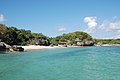
Rote Island boasts pristine white-sand beaches lined with crystal-clear turquoise waters, including Nemberala Beach, which features consistent swells attracting visitors to its natural coastal formations. The island's southern exposure to Indian Ocean swells creates dynamic wave patterns along exposed reefs, with breaks like those near T-Land forming long, barreling rides during peak conditions. Fringing coral reefs encircle much of the shoreline, harboring diverse marine ecosystems with visible fish populations and healthy coral structures observable via snorkeling in shallow bays. Inland from the coast, Rote's landscape transitions to dry savannas interspersed with rugged hills and lontar palm groves, offering expansive views and hiking opportunities across undulating terrain. These savanna ecosystems support sparse vegetation adapted to the island's extended dry periods, with lontar palms (Borassus flabellifer) dominating arid zones and providing a distinctive silhoutte against the horizon. Geological features include limestone caves and rocky outcrops formed by tectonic activity in the Lesser Sunda region, contributing to the island's varied topography. Access to these attractions often requires four-wheel-drive vehicles for inland savanna routes or boats for remote coastal reefs, as paved roads are limited beyond main settlements. The dry season, spanning May to October, features low humidity and minimal cloud cover, enhancing underwater visibility in reefs to depths exceeding 20 meters and facilitating clearer observation of marine and terrestrial features.

Cultural and Adventure Experiences

Homestays and guided village tours offer visitors direct engagement with Rotenese heritage, including observation of traditional rituals and daily customs in communities like Oeseli and Londalusi. These experiences often feature demonstrations of sasando music, played on instruments crafted from lontar palm leaves, and insights into ceremonies such as the Hus ritual, which celebrates the annual palm harvest with ancient rites preserved in rural domains. Surfing camps, established as early alternatives to Bali's increasing crowds in the late 20th century, provide structured access to world-class waves like T-Land while promoting experiential immersion for international surfers, particularly Australians. These operations have advanced sustainable models, integrating local community support and reef preservation efforts through organizations like SurfAid, which emphasize eco-friendly practices to mitigate environmental strain from seasonal visitor influxes. Diving excursions target offshore reefs teeming with marine life, complementing adventure itineraries with snorkeling and guided underwater exploration. Yoga retreats, hosted in eco-lodges such as Utopia Surf & Yoga, combine wellness sessions with surf-adjacent activities, fostering tranquility amid the island's remote setting. Critics note risks of cultural commodification, where rituals and crafts are staged for tourists, potentially diluting indigenous practices amid foreign investments reshaping local fabrics. Seasonal overcrowding at surf breaks during dry months strains water and waste resources, though Rote's relative underdevelopment limits these pressures compared to Bali.

Challenges and Controversies

Environmental Vulnerabilities

Rote Island, part of Indonesia's East Nusa Tenggara province, experiences prolonged dry seasons typically spanning eight months or more, with rainfall concentrated in only three to four months annually, exacerbating water scarcity and contributing to recurrent droughts in the Rote Ndao Regency. These conditions, influenced by regional climate patterns including the Australian monsoon trough's limited northward extension and El Niño-Southern Oscillation variability, result in low groundwater tables and reduced surface water availability, directly threatening agricultural productivity and leading to food insecurity for the island's subsistence farming communities reliant on rain-fed crops like corn and cassava. Land degradation on Rote is accelerated by soil erosion due to unsustainable agricultural practices and the absence of widespread terracing on its hilly terrain, which diminishes soil fertility and catchment capacity in an already arid environment. This erosion is compounded by the island's karstic geology and sparse vegetation cover during extended dry periods, creating positive feedback loops with water scarcity as degraded watersheds yield less recharge. Coastal ecosystems face habitat pressures, including loss of nesting sites for sea turtles such as the hawksbill (Eretmochelys imbricata), where agricultural expansion into beachfront areas disrupts breeding grounds, as evidenced by historical declines in turtle populations observed during farming activities. Rote's extensive coral reefs, spanning over 11,000 hectares, are vulnerable to degradation from localized overfishing and regional sea warming, though specific bleaching events mirror broader Indo-Pacific trends tied to ocean temperature anomalies rather than isolated global factors.

Land and Development Disputes

In 2021, PT Bo'a Development, in partnership with Nihi Hotels, initiated construction of a luxury resort adjacent to Bo'a Beach on Rote Island's southwest coast, prompting ongoing conflicts over beach access and land rights. Local residents, including indigenous Rotenese communities, have protested the project's fencing and infrastructure, which they claim blocks traditional pathways used for fishing, livestock grazing, and communal gatherings, asserting these areas fall under customary adat land tenure rather than formal titles held by developers. Developers maintain that the resort complies with Indonesian land acquisition laws, emphasizing economic advantages such as hundreds of jobs for locals in hospitality and construction, alongside infrastructure improvements like roads and utilities that could benefit surrounding villages. However, opponents, including some expatriate residents and community leaders, counter that such benefits are overstated, with short-term employment unlikely to offset long-term losses in self-determination and cultural practices, as similar tourism ventures elsewhere in Indonesia have led to community displacement and diluted traditional governance structures. Tensions escalated in October 2025 with public demonstrations and media coverage highlighting fears of privatized beaches eroding communal resource use, echoing broader resistance to large-scale tourism on the island. Indonesian authorities, through the East Nusa Tenggara provincial government, have navigated these disputes by advocating sustainable models, including Indonesia's revised 2025 tourism law that mandates community involvement and environmental safeguards in developments. While some Rote initiatives, such as small-scale eco-tourism cooperatives, have succeeded in empowering locals through profit-sharing without alienating customary lands, critics from affected communities allege regulatory favoritism toward investors, citing lax enforcement of adat consultations and expedited permits that prioritize foreign capital over indigenous claims. These tensions underscore a pattern where development promises clash with Rotenese priorities for preserving communal access amid tourism's expansion.

Infrastructure and Access

Transportation Networks

Rote Island's primary external connections are via air and sea. David Constantijn Saudale Airport (RTI), located near Ba'a, accommodates limited domestic flights from Kupang's El Tari International Airport, with flight durations of approximately 20-30 minutes operated by airlines such as Wings Air. These services run several times weekly, subject to weather and demand, providing a quicker alternative to sea travel but with constrained capacity for passengers and cargo. Sea transport relies on ferries from Ba'a Port to Kupang's Tenau Harbor, with daily fast ferry services like Express Bahari departing Kupang at 9:00 a.m. and arriving in Ba'a around 11:00 a.m., covering the 25-kilometer strait in about 2 hours. Return trips depart Ba'a at 12:00 p.m., with fares ranging from IDR 172,000 for economy to IDR 217,000 for VIP class as of 2025; slower ferries take 4 hours or more and operate daily in the afternoon. No railway infrastructure exists on the island, and inter-village travel in remote areas often depends on small boats due to coastal geography and limited road penetration. The island's internal road network spans over 500 kilometers, with significant paving efforts since the 2010s enabling vehicular access via four-wheel-drive vehicles to key areas like surf spots in Nemberala. National government budgets have funded recent upgrades, including asphalt resurfacing and expansion, aimed at reducing isolation and supporting local mobility, though unpaved sections predominate in rural zones. Monsoon rains from December to February frequently cause erosion and washouts on unsealed paths, necessitating seasonal repairs and limiting accessibility during wet periods. These improvements have increased traffic volumes but highlight ongoing vulnerabilities to climatic disruptions.

Utilities and Modern Amenities

Electricity supply in Rote Ndao Regency primarily depends on diesel generators (PLTD), with hybrid photovoltaic-wind-diesel systems deployed in select rural villages to mitigate intermittency and fuel costs. These hybrids, such as the one operational in Oeledo since 1999, generate power for limited hours daily, serving communities like Nemberala but requiring battery storage to handle variable renewable output. Annual electricity demand has risen approximately 5% in recent years, straining diesel-dependent grids in remote areas where blackouts exceed 12 hours daily outside peak urban supply. Water access faces chronic scarcity during extended dry seasons, prompting reliance on rainwater collection via household tanks and surface runoff management, alongside shallow wells that often deplete. Lontar palm (Borassus flabellifer) sap serves as a supplementary hydration source, tapped daily for its nutrient-rich liquid in water-stressed interiors. Healthcare infrastructure consists mainly of subdistrict puskesmas clinics offering basic services, with residents in isolated villages favoring traditional herbal remedies over formal care due to distance and limited staffing. Telecommunications have improved since the mid-2010s Palapa Ring backbone rollout, enabling 4G coverage across much of the regency and facilitating mobile-based digital remittances for migrant families. Development disparities persist, with Ba'a town enjoying more consistent grid power, piped water extensions, and signal strength compared to interior villages, where self-reliant adaptations like off-grid solar prevail amid uneven state provisioning.

References

Add your contribution
Related Hubs
User Avatar
No comments yet.