


Community hub
Recent from talks
Contribute something to knowledge base
Content stats: 0 posts, 0 articles, 1 media, 0 notes
Members stats: 0 subscribers, 0 contributors, 0 moderators, 0 supporters
Subscribers
Supporters
Contributors
Moderators
Hub AI
Rowan & Martin's Laugh-In AI simulator
(@Rowan & Martin's Laugh-In_simulator)
Hub AI
Rowan & Martin's Laugh-In AI simulator
(@Rowan & Martin's Laugh-In_simulator)
Rowan & Martin's Laugh-In
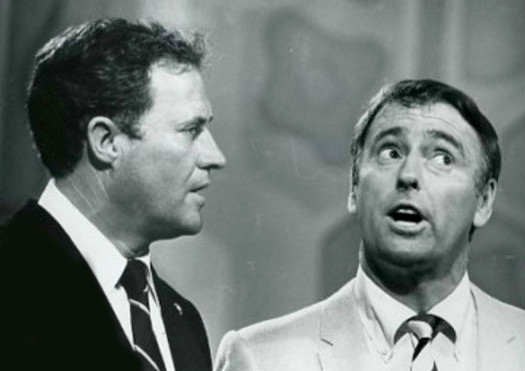
Rowan & Martin's Laugh-In (often simply referred to as Laugh-In) is an American sketch comedy television program that ran for six seasons from January 22, 1968, to July 23, 1973, on the NBC television network. The show, hosted by comedians Dan Rowan and Dick Martin, originally aired as a one-time special on September 9, 1967, and was such a success that it was brought back as a series, replacing The Man from U.N.C.L.E. on Mondays at 8 pm (ET). It quickly became the most popular television show in the United States.
The title of the show was a play on 1960s Hippie culture "love-ins" or counterculture "be-ins", terms which were derived from the "sit-ins" common in protests associated with civil rights and antiwar demonstrations of the time. In the pilot episode, Dan Rowan explained the show's approach: "Good evening, ladies and gentlemen, and welcome to television's first Laugh-In. Now for the past few years, we have all been hearing an awful lot about the various 'ins'. There have been be-ins, love-ins, and sleep-ins. This is a laugh-in and a laugh-in is a frame of mind. For the next hour, we would just like you to sit back and laugh and forget about the other ins."
Laugh-In had its roots in the humor of vaudeville and burlesque, but its most direct influences were Olsen and Johnson's comedies (such as the free-form Broadway revue Hellzapoppin'), the innovative television works of Ernie Kovacs (George Schlatter's wife Jolene Brand appeared in Kovacs' shows), and the topical TV satire That Was the Week That Was. The show was characterized by a rapid-fire series of gags and sketches, many of which were politically charged or contained sexual innuendo. The co-hosts continued the exasperated "straight man" (Rowan) and "dumb guy" (Martin) double act that they had established as nightclub comics.[page needed]
The show featured Gary Owens as the on-screen radio continuity announcer, and an ensemble cast. Ruth Buzzi appeared throughout the show's six-year run, while others appeared in at least three seasons including Judy Carne, Henry Gibson, Goldie Hawn, Arte Johnson, Jo Anne Worley, Alan Sues, Lily Tomlin, Dennis Allen, and Richard Dawson.
In 2002, Rowan & Martin's Laugh-In was ranked number 42 on TV Guide's 50 Greatest TV Shows of All Time.
Laugh-In was designed to be very lightly structured and consisted mainly of short comedic sketches. Some of these would reappear multiple times throughout an episode with variations on a theme, while others involved reoccurring characters created by the cast. In others, cast members and guest stars would simply appear as themselves, delivering jokes or reacting to a previous sketch. In addition to the announced guest star or stars of the evening, some recurring guest stars would appear unannounced multiple times through a season (which was easy to accomplish given the show's non-linear taping sessions). A trademark of the series was its (even shorter) blackout sketches, often involving rapid-fire cuts between two or more scenes or camera angles, set to a six-note musical sting (or at times, an elongated 16-note version). These were used as transitions into and out of commercials, among other places.
Each show started with a batch of sketches leading into Gary Owens' introduction, in which the cast and announced guest star(s) would appear behind open doors of the show's iconic, psychedelically painted "Joke Wall". Owens would also insert offbeat lines in his monotone, deadpan style, in the introductions and occasionally throughout the episode, generally facing a microphone to his side with one hand cupped to his ear (Owens' character loosened up and became "hipper" in later seasons).
After more short sketches leading into and out of the first commercial break, Rowan and Martin would walk in front of the show's homebase set to introduce the show and have a dialogue, generally consisting of Martin frustrating Rowan by derailing his attempt to do a proper introduction via misunderstandings or digressions.
Rowan & Martin's Laugh-In
Rowan & Martin's Laugh-In (often simply referred to as Laugh-In) is an American sketch comedy television program that ran for six seasons from January 22, 1968, to July 23, 1973, on the NBC television network. The show, hosted by comedians Dan Rowan and Dick Martin, originally aired as a one-time special on September 9, 1967, and was such a success that it was brought back as a series, replacing The Man from U.N.C.L.E. on Mondays at 8 pm (ET). It quickly became the most popular television show in the United States.
The title of the show was a play on 1960s Hippie culture "love-ins" or counterculture "be-ins", terms which were derived from the "sit-ins" common in protests associated with civil rights and antiwar demonstrations of the time. In the pilot episode, Dan Rowan explained the show's approach: "Good evening, ladies and gentlemen, and welcome to television's first Laugh-In. Now for the past few years, we have all been hearing an awful lot about the various 'ins'. There have been be-ins, love-ins, and sleep-ins. This is a laugh-in and a laugh-in is a frame of mind. For the next hour, we would just like you to sit back and laugh and forget about the other ins."
Laugh-In had its roots in the humor of vaudeville and burlesque, but its most direct influences were Olsen and Johnson's comedies (such as the free-form Broadway revue Hellzapoppin'), the innovative television works of Ernie Kovacs (George Schlatter's wife Jolene Brand appeared in Kovacs' shows), and the topical TV satire That Was the Week That Was. The show was characterized by a rapid-fire series of gags and sketches, many of which were politically charged or contained sexual innuendo. The co-hosts continued the exasperated "straight man" (Rowan) and "dumb guy" (Martin) double act that they had established as nightclub comics.[page needed]
The show featured Gary Owens as the on-screen radio continuity announcer, and an ensemble cast. Ruth Buzzi appeared throughout the show's six-year run, while others appeared in at least three seasons including Judy Carne, Henry Gibson, Goldie Hawn, Arte Johnson, Jo Anne Worley, Alan Sues, Lily Tomlin, Dennis Allen, and Richard Dawson.
In 2002, Rowan & Martin's Laugh-In was ranked number 42 on TV Guide's 50 Greatest TV Shows of All Time.
Laugh-In was designed to be very lightly structured and consisted mainly of short comedic sketches. Some of these would reappear multiple times throughout an episode with variations on a theme, while others involved reoccurring characters created by the cast. In others, cast members and guest stars would simply appear as themselves, delivering jokes or reacting to a previous sketch. In addition to the announced guest star or stars of the evening, some recurring guest stars would appear unannounced multiple times through a season (which was easy to accomplish given the show's non-linear taping sessions). A trademark of the series was its (even shorter) blackout sketches, often involving rapid-fire cuts between two or more scenes or camera angles, set to a six-note musical sting (or at times, an elongated 16-note version). These were used as transitions into and out of commercials, among other places.
Each show started with a batch of sketches leading into Gary Owens' introduction, in which the cast and announced guest star(s) would appear behind open doors of the show's iconic, psychedelically painted "Joke Wall". Owens would also insert offbeat lines in his monotone, deadpan style, in the introductions and occasionally throughout the episode, generally facing a microphone to his side with one hand cupped to his ear (Owens' character loosened up and became "hipper" in later seasons).
After more short sketches leading into and out of the first commercial break, Rowan and Martin would walk in front of the show's homebase set to introduce the show and have a dialogue, generally consisting of Martin frustrating Rowan by derailing his attempt to do a proper introduction via misunderstandings or digressions.
Recent media
Recent media