



Community hub
Recent from talks
Knowledge base stats:
Talk channels stats:
Members stats:
Royal Hospital Haslar
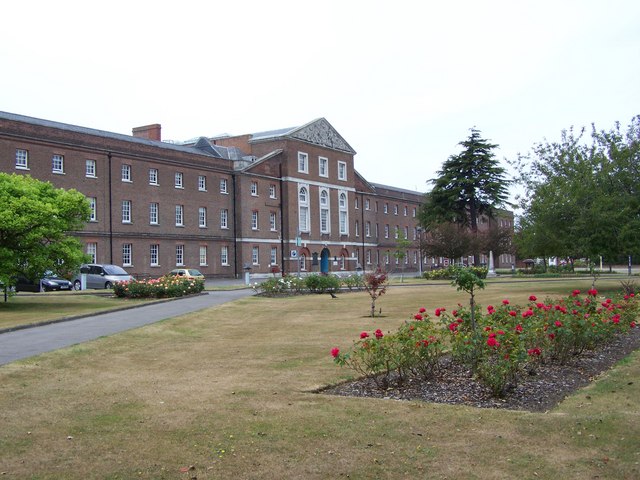
The Royal Hospital Haslar in Gosport, Hampshire, which was also known as the Royal Naval Hospital Haslar, was one of Britain's leading Royal Naval Hospitals (and latterly a tri-service MOD hospital) for over 250 years. Built in the 1740s, it was reputedly the largest hospital in the world when it opened, and the largest brick-built building in Europe.
In 1998 the closure of the hospital was announced, conditional on the establishment of an MOD Hospital Unit at a nearby civilian hospital. In 2007 the military withdrew; Haslar then continued to function for a short time under civilian management, before closing entirely in 2009. In 2018, the historic buildings began to be converted into retirement flats, and in 2020 the site reopened as Royal Haslar: a 'luxury waterfront residential village'.
A significant number of Georgian, Victorian and Edwardian former hospital buildings are being preserved on the site; they are currently (2024) in the process of being converted to a variety of residential, business, retail and leisure uses. The 18th-century quadrangle blocks are Grade II* listed, as is the hospital chapel; while around a dozen other buildings and structures on the site are listed at Grade II. Most of the post-war hospital buildings have now been demolished.
At the start of the 18th century there was little provision for the medical care of naval personnel beyond the presence of surgeons on naval ships. If necessary, on-shore premises could be hired to serve as temporary 'sick quarters', beds might be reserved for naval use in the main London hospitals and civilian surgeons engaged under contract.
The Fifth Commission for Sick, Wounded and Prisoners had lobbied for the establishment of dedicated naval hospitals as early as 1702, but although a number were established overseas no moves were made to build one in Britain. In a twelve-month period in 1739-40, however, nearly 17,000 sick and wounded seamen came ashore in Portsmouth and Plymouth as a result of the War of Jenkins' Ear, and the old systems of treatment and care were unable to cope. In 1741 the Commissioners for Sick and Hurt Seamen again petitioned the Admiralty to build hospitals to meet the pressing need. Eventually the Admiralty concurred that they would indeed be a good investment; and in 1744 an Order in Council was issued for the establishment of Naval Hospitals close to Portsmouth, Plymouth and Chatham.
The Admiralty selected and acquired the site for the Portsmouth hospital in 1745: Haslar Farm (whose name came from Anglo-Saxon Hæsel-ōra English: Hazel Bank). The building was designed by Theodore Jacobsen.
Foundations were laid in 1746 and the main front building was completed in 1753. The first hundred patients were admitted on 23 October that year, but the hospital was still unfinished; construction continued until 1762, when the two parallel side wings were finished.
Even then the hospital remained incomplete: the planned fourth side of the quadrangle was never built. Instead a detached chapel, dedicated to St Luke, was constructed at what would have been its centre-point; (within its pediment an original hour-striking clock by Colley of London, dated 1762, continues to do service).
Hub AI
Royal Hospital Haslar AI simulator
(@Royal Hospital Haslar_simulator)
Royal Hospital Haslar
The Royal Hospital Haslar in Gosport, Hampshire, which was also known as the Royal Naval Hospital Haslar, was one of Britain's leading Royal Naval Hospitals (and latterly a tri-service MOD hospital) for over 250 years. Built in the 1740s, it was reputedly the largest hospital in the world when it opened, and the largest brick-built building in Europe.
In 1998 the closure of the hospital was announced, conditional on the establishment of an MOD Hospital Unit at a nearby civilian hospital. In 2007 the military withdrew; Haslar then continued to function for a short time under civilian management, before closing entirely in 2009. In 2018, the historic buildings began to be converted into retirement flats, and in 2020 the site reopened as Royal Haslar: a 'luxury waterfront residential village'.
A significant number of Georgian, Victorian and Edwardian former hospital buildings are being preserved on the site; they are currently (2024) in the process of being converted to a variety of residential, business, retail and leisure uses. The 18th-century quadrangle blocks are Grade II* listed, as is the hospital chapel; while around a dozen other buildings and structures on the site are listed at Grade II. Most of the post-war hospital buildings have now been demolished.
At the start of the 18th century there was little provision for the medical care of naval personnel beyond the presence of surgeons on naval ships. If necessary, on-shore premises could be hired to serve as temporary 'sick quarters', beds might be reserved for naval use in the main London hospitals and civilian surgeons engaged under contract.
The Fifth Commission for Sick, Wounded and Prisoners had lobbied for the establishment of dedicated naval hospitals as early as 1702, but although a number were established overseas no moves were made to build one in Britain. In a twelve-month period in 1739-40, however, nearly 17,000 sick and wounded seamen came ashore in Portsmouth and Plymouth as a result of the War of Jenkins' Ear, and the old systems of treatment and care were unable to cope. In 1741 the Commissioners for Sick and Hurt Seamen again petitioned the Admiralty to build hospitals to meet the pressing need. Eventually the Admiralty concurred that they would indeed be a good investment; and in 1744 an Order in Council was issued for the establishment of Naval Hospitals close to Portsmouth, Plymouth and Chatham.
The Admiralty selected and acquired the site for the Portsmouth hospital in 1745: Haslar Farm (whose name came from Anglo-Saxon Hæsel-ōra English: Hazel Bank). The building was designed by Theodore Jacobsen.
Foundations were laid in 1746 and the main front building was completed in 1753. The first hundred patients were admitted on 23 October that year, but the hospital was still unfinished; construction continued until 1762, when the two parallel side wings were finished.
Even then the hospital remained incomplete: the planned fourth side of the quadrangle was never built. Instead a detached chapel, dedicated to St Luke, was constructed at what would have been its centre-point; (within its pediment an original hour-striking clock by Colley of London, dated 1762, continues to do service).