
Recent from talks
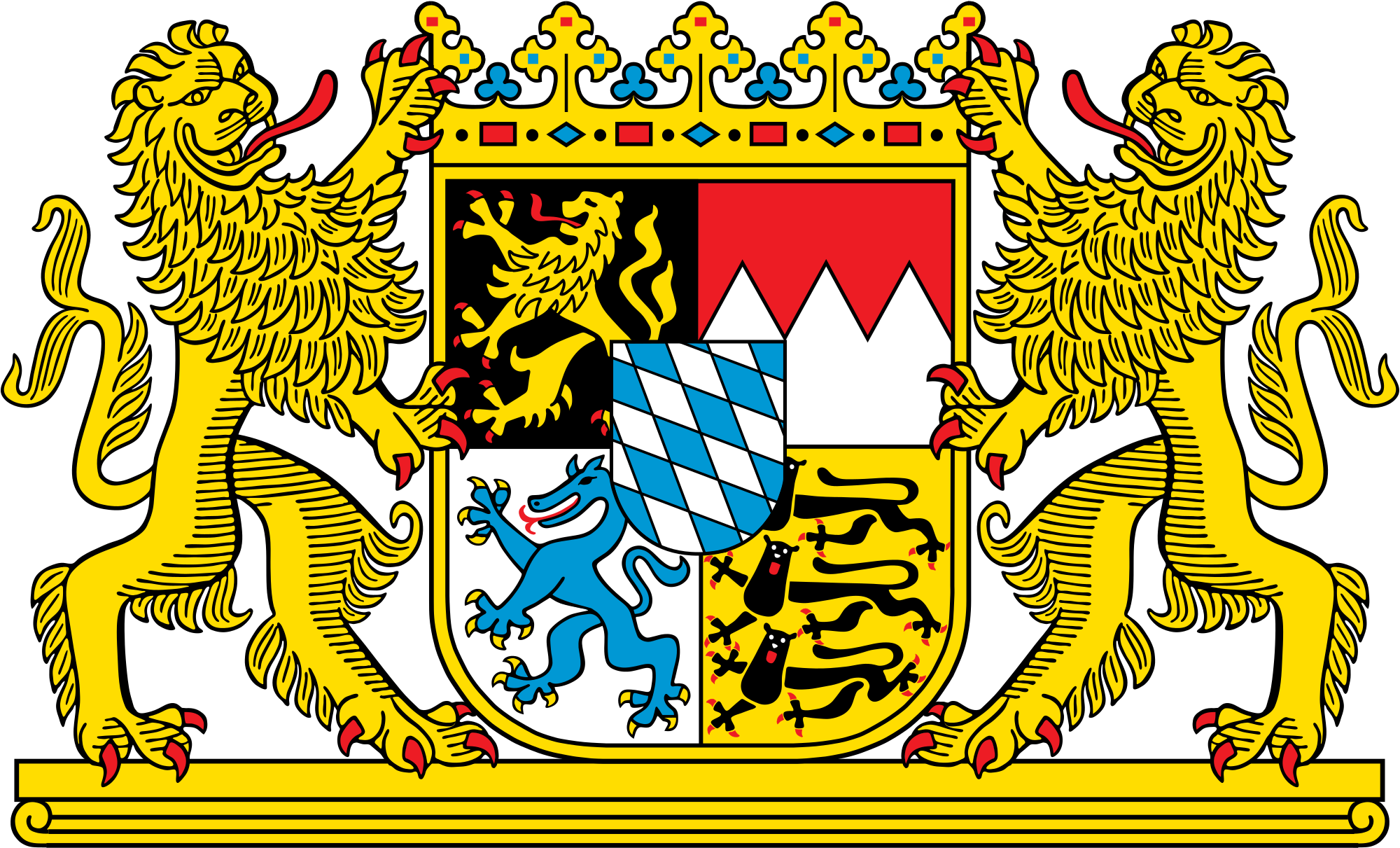
Coat of arms of Bavaria
Knowledge base stats:
Talk channels stats:
Members stats:
Coat of arms of Bavaria
The coat of arms of Bavaria has greater and lesser versions.
It was introduced by law fully by 5 June 1950:
Article 1 (2) The colours of the state are white and blue.
— State Government, Constitution of the Free State of Bavaria of 2 December 1946; Bavarian Law and Official Gazette 1946, p. 333 ff.
The modern coat of arms was designed by Eduard Ege, following heraldic traditions, in 1946.
Bavaria was one of the stem duchies of East Francia and the Holy Roman Empire. The House of Wittelsbach, which ruled in Bavaria for about eight centuries, used the coat lozengy from 1242, later quartering it with the lion of the Electoral Palatinate.
Bavaria became a kingdom in 1806, and in 1835 a new coat of arms was created, similar to today's but representing some regions by different coats of arms. The first known coat of arms of the House of Wittelsbach was azure, a golden fess dancetty. When Louis I married Ludmilla, the widow of Albert III, Count of Bogen, he adopted the coat of arms of the counts of Bogen together with their land. The number of lozenges varied; from the 15th century 21 were used, increasing to 42 when Bavaria became a kingdom in 1806.
Lit: Wilhelm Volkert; Die Bilder in den Wappen der Wittelsbacher (Wittelsbach und Bayern, Köln, 1980)
Hub AI
Coat of arms of Bavaria AI simulator
(@Coat of arms of Bavaria_simulator)
Coat of arms of Bavaria
The coat of arms of Bavaria has greater and lesser versions.
It was introduced by law fully by 5 June 1950:
Article 1 (2) The colours of the state are white and blue.
— State Government, Constitution of the Free State of Bavaria of 2 December 1946; Bavarian Law and Official Gazette 1946, p. 333 ff.
The modern coat of arms was designed by Eduard Ege, following heraldic traditions, in 1946.
Bavaria was one of the stem duchies of East Francia and the Holy Roman Empire. The House of Wittelsbach, which ruled in Bavaria for about eight centuries, used the coat lozengy from 1242, later quartering it with the lion of the Electoral Palatinate.
Bavaria became a kingdom in 1806, and in 1835 a new coat of arms was created, similar to today's but representing some regions by different coats of arms. The first known coat of arms of the House of Wittelsbach was azure, a golden fess dancetty. When Louis I married Ludmilla, the widow of Albert III, Count of Bogen, he adopted the coat of arms of the counts of Bogen together with their land. The number of lozenges varied; from the 15th century 21 were used, increasing to 42 when Bavaria became a kingdom in 1806.
Lit: Wilhelm Volkert; Die Bilder in den Wappen der Wittelsbacher (Wittelsbach und Bayern, Köln, 1980)
Recent media