Hubbry Logo
Religious textReligious textMain
Open search
Religious text
Community hub
Religious text
logo
8 pages, 0 posts
0 subscribers
Be the first to start a discussion here.
Religious text
Religious text
from Wikipedia

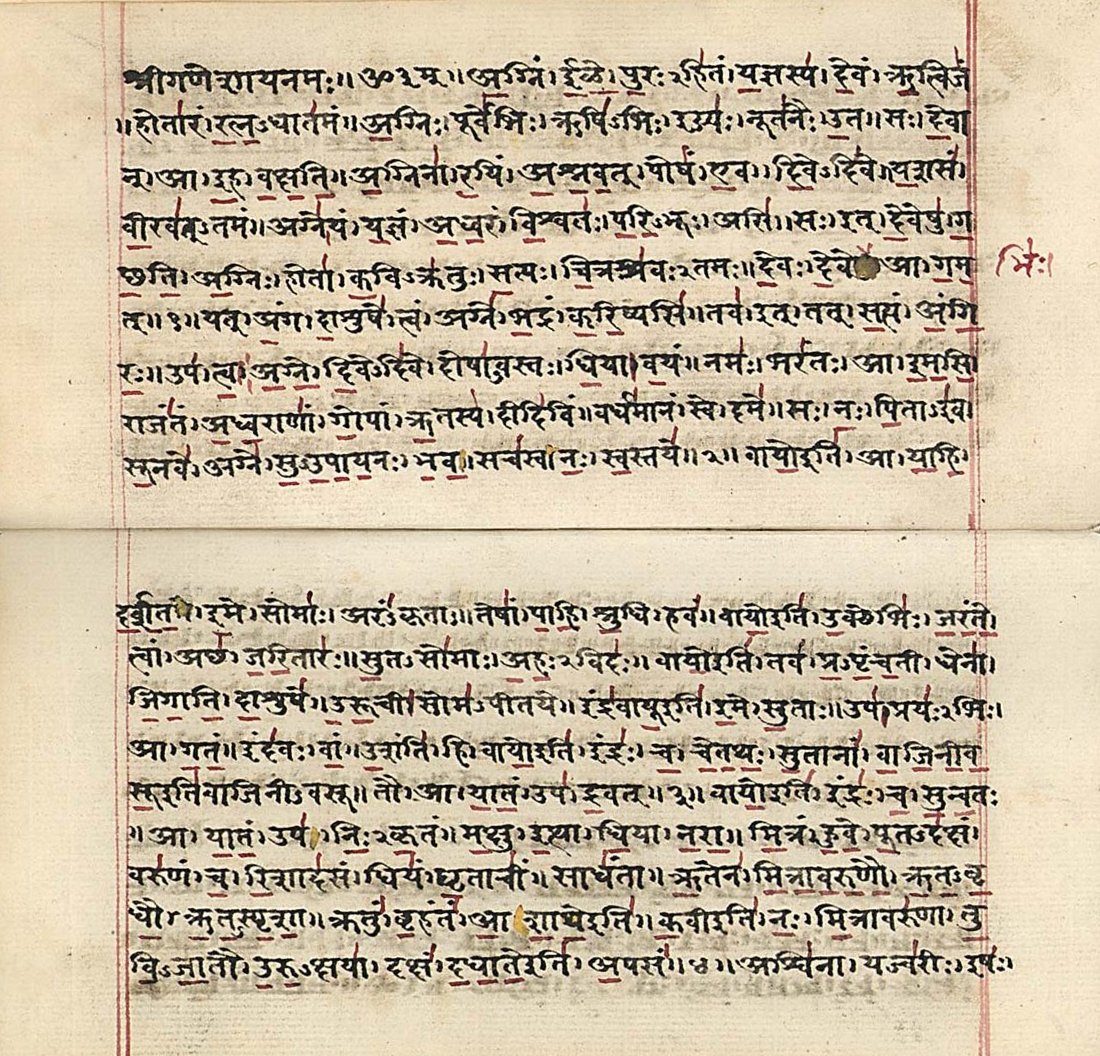
The Rigveda (Vedic chant) manuscript in Devanagari, a scripture of Hinduism, dated 1500–1000 BCE. It is the oldest religious text in any Indo-European language.
A Sephardic Torah scroll, containing the first section of the Hebrew Bible, rolled to the first paragraph of the Shema.
A page from the Codex Vaticanus manuscript (4th century CE) in the Greek Old and New Testament, currently preserved in the Vatican Library, Rome.
A page from one of the early Quranic manuscripts (7th century CE), currently preserved in the National Museum of New Delhi, India.

Religious texts, including scripture, are texts which various religions consider to be of central importance to their religious tradition. They often feature a compilation or discussion of beliefs, ritual practices, moral commandments and laws, ethical conduct, spiritual aspirations, and admonitions for fostering a religious community.

Within each religion, these texts are revered as authoritative sources of guidance, wisdom, and divine revelation. They are often regarded as sacred or holy, representing the core teachings and principles that their followers strive to uphold.[1][2][3]

Etymology and nomenclature

[edit]

According to Peter Beal, the term scripture – derived from scriptura (Latin) – meant "writings [manuscripts] in general" prior to the medieval era, and was then "reserved to denote the texts of the Old and New Testaments of the Bible".[4] Beyond Christianity, according to the Oxford World Encyclopedia, the term scripture has referred to a text accepted to contain the "sacred writings of a religion",[5] while The Oxford center of Dictionary of World Religions states it refers to a text "having [religious] authority and often collected into an accepted canon".[6] In modern times, this equation of the written word with religious texts is particular to the English language, and is not retained in most other languages, which usually add an adjective like "sacred" to denote religious texts.

Some religious texts are categorized as canonical, some non-canonical, and others extracanonical, semi-canonical, deutero-canonical, pre-canonical or post-canonical.[7] The term "canon" is derived from the Greek word "κανών", "a cane used as a measuring instrument". It connotes the sense of "measure, standard, norm, rule". In the modern usage, a religious canon refers to a "catalogue of sacred scriptures" that is broadly accepted to "contain and agree with the rule or canon of a particular faith", states Juan Widow.[8] The related terms such as "non-canonical", "extracanonical", "deuterocanonical" and others presume and are derived from "canon". These derived terms differentiate a corpus of religious texts from the "canonical" literature. At its root, this differentiation reflects the sects and conflicts that developed and branched off over time, the competitive "acceptance" of a common minimum over time and the "rejection" of interpretations, beliefs, rules or practices by one group of another related socio-religious group.[9] The earliest reference to the term "canon" in the context of "a collection of sacred Scripture" is traceable to the 4th-century CE. The early references, such as the Synod of Laodicea, mention both the terms "canonical" and "non-canonical" in the context of religious texts.[10]

History of religious texts

[edit]

One of the oldest known religious texts is the Kesh Temple Hymn of ancient Sumer,[11][12] a set of inscribed clay tablets which scholars typically date around 2600 BCE.[13] The Epic of Gilgamesh from Sumer, although only considered by some scholars as a religious text, has origins as early as 2150 BCE,[14] and stands as one of the earliest literary works that includes various mythological figures and themes of interaction with the divine.[15] The Rigveda, a scripture of Hinduism, is dated 1500 BCE. It is one of the oldest known complete religious texts that has survived into the modern age.[16][17]

The earliest dating of the earliest Biblical texts is the 13th-12th centuries BCE.[18][19][20] The beginning of the scribal documentation from temple and royal courts is dated to the 8th century BCE and continues until the 5th century BCE.[21] Probably in the 2nd century BC, the Biblical canon was fixed.[22]

High rates of mass production and distribution of religious texts did not begin until the invention of the printing press in 1440,[23] before which all religious texts were hand written copies, of which there were relatively limited quantities in circulation.

Authority of religious texts

[edit]

The relative authority of religious texts develops over time and is derived from the ratification, enforcement, and its use across generations. Some religious texts are accepted or categorized as canonical, some non-canonical, and others extracanonical, semi-canonical, deutero-canonical, pre-canonical, or post-canonical.[7]

"Scripture" (or "scriptures") is a subset of religious texts considered to be "especially authoritative",[24][25] revered and "holy writ",[26] "sacred, canonical", or of "supreme authority, special status" to a religious community.[27][28] The terms sacred text and religious text are not necessarily interchangeable in that some religious texts are believed to be sacred because of the belief in some theistic religions such as the Abrahamic religions that the text is divinely or supernaturally revealed or divinely inspired, or in non-theistic religions such as some Indian religions they are considered to be the central tenets of their eternal Dharma. In contrast to sacred texts, many religious texts are narratives or discussions about the specific religion's general themes, interpretations, practices, or important figures.

In some religions (e.g. Christianity), the canonical texts include a particular text (Bible) but are "an unsettled question," according to linguist Eugene Nida. In others (Hinduism, Buddhism), there "has never been a definitive canon".[29][30] While the term scripture is derived from the Latin scriptura, meaning "writing", most sacred scriptures of the world's major religions were originally a part of their oral tradition, and were "passed down through memorization from generation to generation until they were finally committed to writing", according to Encyclopaedia Britannica.[26][31][32]

In Islam, the Sunnah are the traditions and practices of the Islamic prophet Muhammad that constitute a model for Muslims to follow. The Sunnah is what all the Muslims of Muhammad's time evidently saw, followed, and passed on to the next generations.[33] According to classical Islamic theories,[34] the Sunnah are documented by hadith (the verbally transmitted record of the teachings, deeds and sayings, silent permissions or disapprovals attributed to Muhammad), and alongside the Quran (the book of Islam) is the divine revelation (wahy) delivered through Muhammad[34] that make up the primary sources of Islamic law and theology.[35][36] However, sects of Islam differ on which hadiths (if any) should be accepted as canonical (see criticism of hadith).

See also

[edit]

References

[edit]

Further reading

[edit]
[edit]
Revisions and contributorsEdit on WikipediaRead on Wikipedia
from Grokipedia
Religious texts, also termed scriptures, constitute written compositions deemed sacred or authoritative within religious traditions, purportedly conveying , imperatives, doctrinal tenets, historical narratives, and prescriptions to guide adherents' beliefs and conduct. These works typically emerge from initial oral transmissions, later inscribed on durable media such as clay tablets or , with the oldest attested examples from Mesopotamian scripts around 3400–3500 BCE. Central to their function, religious texts furnish foundational frameworks for ethical systems, communal identities, and spiritual practices across faiths, influencing everything from legal codes to cosmological views; for instance, the underpin and rites, the and inform Jewish and and law, the dictates Islamic and worship, while the structures Buddhist and monastic discipline. Their dissemination historically relied on scribal copying across scrolls and codices, fostering interpretive traditions but also introducing variants through or deliberate adaptation, as evidenced in traditions spanning millennia. Notable characteristics include claims of inerrancy or divine origin by believers, juxtaposed against empirical scrutiny revealing compositional layers, anachronisms, and intertextual borrowings that suggest human authorship over supernatural dictation; such tensions underpin controversies over authenticity, canon formation, and hermeneutics, where textual criticism—prioritizing manuscript evidence and linguistic analysis—often prioritizes verifiable transmission histories over unsubstantiated revelatory assertions. These texts have profoundly shaped civilizations, inspiring art, philosophy, and conflict, yet their causal influence stems from social endorsement rather than inherent veridicality, as adherence correlates more with cultural inertia than independent empirical validation.

Terminology and Definition

Etymology and Nomenclature

The term scripture, a primary English designation for religious texts, derives from scriptura ("a writing" or "sacred writings"), which stems from scribere ("to write"). This entered in the early 14th century, initially denoting the sacred writings of the , though the concept encompasses texts across religions that originated orally before transcription. Nomenclature for such texts differs by tradition, often highlighting attributes like revelation, recitation, or compilation. In , the collective corpus is termed the Bible, from Greek ta biblia ("the books"), a neuter of biblion ("book" or "papyrus roll"), reflecting its multi-volume structure finalized in canons by the 4th century CE. refers to its scriptures as the Tanakh, an acronym coined in the from ("teaching" or "law," the Pentateuch), ("prophets"), and ("writings"), distinguishing it from the broader Christian . In , the central text is the Qur'an, from Arabic qirāʾah ("recitation"), based on the verb root q-r-ʾ ("to read" or "proclaim"), as it was orally revealed to between 610 and 632 CE before compilation under Caliph around 650 CE. Hindu nomenclature divides texts into Shruti ("what is heard," eternally revealed Vedic hymns composed circa 1500–500 BCE) and Smriti ("what is remembered," later interpretive works like the epics). These terms underscore causal distinctions in transmission—divine audition versus human remembrance—rather than uniform "sacred writing."

Core Characteristics and Classification

Religious texts, also termed sacred scriptures, constitute writings designated by religious communities as authoritative sources of , , moral guidance, and practice, often predicated on assertions of , , or eternal verity. These assertions typically involve claims of direct divine communication to prophets or seers, as in the Quran's dictation to over 23 years from 610 to 632 CE, or indirect inspiration through human authors guided by supernatural agency, as posited for the Hebrew Bible's composition spanning circa 1200–100 BCE. Empirically, such claims derive from internal textual self-attestations and subsequent communal traditions rather than independent corroboration, with historical analysis revealing human editorial processes, including redactions evident in the Dead Sea Scrolls' variants from the dated to the 3rd–1st centuries BCE. Their authority thus hinges on faith-based acceptance within traditions, functioning causally to unify believers through shared interpretive frameworks rather than verifiable propositional truth. Key characteristics include literary heterogeneity, encompassing narrative histories (e.g., Genesis's creation accounts), legal prescriptions (e.g., Leviticus's ), prophetic oracles, and hymnic poetry, alongside phonological and rhythmic structures facilitating oral transmission and memorization, as seen in the Vedic chants' metrical forms composed circa 1500–500 BCE. Preservation mechanisms emphasize immutability, with practices like the Islamic hafiz tradition ensuring verbatim recall of the Quran's 114 surahs, or scribal fidelity in Jewish scrolls prohibiting alterations since the Second Temple period (circa 516 BCE–70 CE). These texts exert causal influence on adherents' cognition and behavior by embedding normative paradigms, evoking emotional responses through evocative language, and serving performative roles in , where reinforces communal identity over individualistic reading. Scholarly scrutiny, drawing from , highlights interpolations and anachronisms—such as the Pentateuch's JEDP sources documented in 19th-century biblical scholarship—undermining literalist interpretations while affirming their role as cultural artifacts shaping civilizational ethics. Classification frameworks derive from both confessional and academic perspectives, with the latter prioritizing typological distinctions over theological endorsements. Primary categories align with religious families: Abrahamic traditions feature "revealed" corpora like the Tanakh (24 books finalized circa 100 CE), Christian Bible (66–73 books varying by canon, e.g., Protestant exclusion of deuterocanonicals post-16th-century Reformation), and Quran, unified by monotheistic emphasis on covenantal law and eschatology. Indic religions yield wisdom-oriented compilations, such as Hinduism's Vedas (Rigveda oldest layer circa 1500 BCE) and Upanishads, or Buddhism's Tripitaka (Pali Canon assembled 1st century BCE), stressing dharma and soteriological paths without singular prophetic mediation. East Asian systems, like Confucianism's Analects (compiled 5th–3rd centuries BCE), integrate ethical aphorisms over theophany. Sub-classifications distinguish "primary" canons—core texts mandating adherence, e.g., Quran's inerrancy in Sunni Islam—from "secondary" commentaries (e.g., Talmud's 63 tractates expounding Mishnah from 200 CE), or "revealed" verbatim dictation versus "inspired" human articulations subject to compilation, as differentiated in Islamic versus Christian scholarship. These schemas reflect causal historical divergences in revelation modes, with empirical linguistics tracing Indo-European roots in Vedic hymns versus Semitic structures in Abrahamic texts, underscoring human authorship amid divine pretensions.

Historical Development

Origins in Ancient Civilizations

In , the Sumerian civilization produced some of the earliest recorded religious texts during the third millennium BCE, as writing emerged around 3200 BCE primarily for administrative and ritual purposes. The , inscribed on clay tablets from around 2600 BCE, praises the temple of the god and describes cosmic creation, representing an early hymnal form tied to temple worship. , daughter of and high priestess of , composed the Sumerian Temple Hymns circa 2300 BCE, a collection of 42 poems exalting deities and sanctuaries across and Akkad; these are attributed to her as the world's first known named author of . In , the , carved into the interiors of pyramids at during the late (circa 2400–2300 BCE), constitute the oldest extensive corpus of religious writings, comprising over 700 spells intended to ensure the pharaoh's ascent to the and union with gods like and . Found in the pyramids of kings such as (Fifth Dynasty, reigned circa 2350 BCE), these hieroglyphic inscriptions detail funerary rituals, cosmology, and resurrection motifs, evolving from earlier oral traditions but fixed in stone for permanence. The Vedic texts of ancient originated in oral composition among Indo-Aryan pastoralists migrating into the subcontinent, with the —containing 1,028 hymns to deities such as , , and —dated to approximately 1500–1200 BCE based on linguistic analysis and astronomical references. These were transmitted verbatim by priestly families (shakhas) for centuries before being written in scripts like around 500 BCE or later, emphasizing ritual sacrifice () and natural forces as divine. In , the (circa 1600–1046 BCE) of ancient yielded oracle bone inscriptions on turtle plastrons and ox scapulae, dating from the 14th to 11th centuries BCE, which record divinations querying ancestral spirits and deities on matters like harvests, battles, and royal health through . Over 150,000 fragments excavated at reveal a script of 4,000–5,000 characters, blending ritual queries with historical annotations, and reflect ancestor veneration central to Shang religion. These pioneering texts across civilizations—predominantly polytheistic, ritual-oriented, and elite-produced—arose from the convergence of oral mythologies with nascent writing systems, serving to codify sacred lore, legitimize rulers as divine intermediaries, and guide communal amid agrarian uncertainties.

Transmission Across Eras

![Codex Vaticanus manuscript][float-right] The transmission of religious texts across eras primarily relied on oral followed by meticulous scribal copying in form, with variations arising from or intentional despite efforts at standardization. In ancient Indian traditions, the were composed orally between approximately 1500 and 1200 BCE and preserved through verbatim techniques for over a before being committed to writing around 500 BCE or later, with the earliest surviving manuscripts dating to 1350-1450 CE; this oral system emphasized phonetic fidelity via methods like pada-patha (word-by-word ) to minimize alterations. For the Hebrew , transmission involved rigorous scribal practices from the Second Temple period onward, culminating in the standardized between the 6th and 10th centuries CE by Jewish scholars who employed vowel points, accents, and marginal notes (masorah) to ensure letter-for-letter accuracy, as evidenced by the near-identical (1008 CE) and (c. 930 CE); earlier proto-Masoretic features like cancellation dots appear in (3rd century BCE to 1st century CE), indicating continuity amid minor spelling inconsistencies faithfully copied rather than corrected. The Christian New Testament's transmission featured over 5,800 Greek manuscripts from the CE onward, alongside versions in other languages, but introduced thousands of textual variants—estimated at 400,000 by some scholars—stemming from unintentional scribal slips (e.g., homoioteleuton omissions) or deliberate changes for clarity or , though the vast majority (about 99%) are minor and do not affect core doctrines, as determined through comparing families like Alexandrian and Byzantine texts. In Islamic tradition, the Quran transitioned from oral recitation during Muhammad's lifetime (d. 632 CE) to written fragments, with initial compilation under Caliph (d. 634 CE) and standardization under (r. 644-656 CE), who commissioned copies in the dialect and ordered the burning of divergent variants to enforce uniformity, per historical accounts; surviving early manuscripts like the Birmingham folios (c. 568-645 CE) align closely with the Uthmanic , though scholarly debates persist on the completeness of this process and the implications of destroyed alternatives.

Influence of Printing and Modern Scholarship

The invention of the movable-type by in the mid-15th century marked a pivotal shift in the dissemination of religious texts, enabling and affordability that surpassed manuscript copying. The , the first major book printed using this technology, was completed around 1455 in , , with an estimated print run of 150 to 180 copies, primarily on paper. This innovation reduced production costs dramatically, allowing religious works to reach broader audiences beyond monastic scriptoria and elite patrons, thereby fostering increased and direct with scriptures among laypeople. The press profoundly accelerated the Protestant Reformation beginning in 1517, as reformers like leveraged it to distribute vernacular translations and polemical tracts rapidly across . Luther's German , printed in 1522, sold over 5,000 copies in weeks, undermining control over interpretation by empowering individual readers to access texts without clerical mediation. Printing also standardized textual variants through repeated editions, though it initially amplified errors if based on flawed manuscripts, while facilitating cross-regional comparisons that highlighted discrepancies in transmission. efforts similarly utilized presses for Catholic defenses, producing thousands of pamphlets and books to counter Protestant gains. Modern scholarship, emerging from Enlightenment-era and intensified in the , applied to reconstruct original forms of religious texts using empirical methods like collation and linguistic analysis. For the Bible, scholars identified over 5,800 Greek New Testament manuscripts by the 20th century, revealing thousands of variants but confirming high fidelity in core doctrines through stemmatic reconstruction, as advanced by figures like Karl Lachmann in the 1830s. Higher criticism, or the historical-critical method, scrutinized authorship and composition, positing multiple sources for the Pentateuch (e.g., Julius Wellhausen's 1878 ) based on stylistic inconsistencies and anachronisms, challenging traditional Mosaic attribution while relying on archaeological corroboration where available. In non-Christian traditions, similar approaches yielded mixed results; for the , textual criticism remains underdeveloped compared to , with early manuscripts like the Sana'a (dated to the ) showing erased variants and non-Uthmanic readings, contradicting claims of verbatim preservation despite orthodox assertions of divine safeguarding. Vedic scholarship employed comparative Indo-European to date hymns to circa 1500–1200 BCE, revealing oral compositional layers preserved through mnemonic techniques before 19th-century editions. These methods, while empirically grounded in paleography and , often reflect secular presuppositions that prioritize naturalistic explanations, occasionally overreaching into speculative reconstructions absent direct evidence, as critiqued by defenders of traditional transmissions.

Composition and Authorship

Processes of Oral and Written Formation

Religious texts across traditions frequently originated through oral processes, where teachings, hymns, and narratives were composed, memorized, and recited by specialists before systematic writing. This oral phase relied on mnemonic devices, repetition, and communal to maintain , though scholarly indicates variability in accuracy depending on cultural practices and transmission contexts. In ancient societies lacking widespread , oral transmission preserved core religious content, often embedding formulaic phrases and rhythmic structures to aid recall, as evidenced in textual repetitions and stylistic features. The Vedic corpus of exemplifies rigorous oral formation, with the hymns likely composed between 1500 and 1200 BCE by rishis and transmitted verbatim through generations via specialized pathas (recitation modes) and poetic meters, without initial writing until around 500 BCE or later. Preservation techniques, including ghana-patha for error detection, enabled high fidelity, as confirmed by consistent manuscripts despite millennia of orality. Similarly, early Buddhist s were orally disseminated after the Buddha's death circa 483 BCE, recited at councils like the First Buddhist Council, and committed to writing in around the 1st century BCE, reflecting a shift driven by fears of loss amid monastic decline. For the Hebrew Bible, oral traditions underpin much of the Pentateuch and prophetic texts, with narratives circulating among storytellers before into written form starting around the 10th-6th centuries BCE, as inferred from linguistic layers and formulaic elements suggesting performance origins. The traditio-historical method highlights how oral variants were integrated during exilic and post-exilic periods, though remains inferential from the literary final product. In , the Quran's formation began with oral revelations to from 610 to 632 CE, memorized by companions (huffaz) and partially inscribed on materials like bones and leaves; full written compilation occurred under Caliph circa 632-634 CE, verified against memorizers, and standardized by around 650 CE to resolve dialectal variants. Transition to writing often followed oral stabilization, prompted by sociopolitical disruptions like wars or leadership changes, enabling broader dissemination but introducing scribal variations analyzable through . While oral methods fostered interpretive flexibility and communal authority, writing imposed fixity, with early codices like those of the or Buddhist Agamas demonstrating deliberate efforts to codify oral corpora against entropy. Scholarly consensus, drawn from comparative and manuscript studies, underscores that no religious text emerged fully written from ; rather, layered oral-written interplay shaped their canonical forms, with reliability hinging on institutional safeguards rather than inherent medium superiority.

Evidence of Authorship Claims

Authorship claims for religious texts generally posit divine revelation or inspiration channeled through human figures, yet verifiable evidence derives from manuscript analysis, linguistic stylometry, and corroborative historical records, which often reveal extended human composition and redaction rather than instantaneous dictation. For the Bible, traditional attributions include Mosaic authorship of the Pentateuch around the 13th century BCE and apostolic origins for New Testament books, but historical-critical scholarship identifies multiple anonymous sources for the Pentateuch (e.g., Yahwist, Elohist, Deuteronomist, Priestly) spanning the 10th to 5th centuries BCE, based on stylistic variances, duplicate narratives, and post-Mosaic anachronisms like references to the Kingdom of Israel. New Testament epistles show scholarly consensus on seven authentic Pauline letters (Romans, 1–2 Corinthians, Galatians, Philippians, 1 Thessalonians, Philemon) via linguistic and thematic consistency, while the Gospels remain anonymous internally, with traditional names (Matthew, Mark, Luke, John) assigned by late 2nd-century church fathers amid debates over pseudonymity in disputed texts like 2 Thessalonians. The asserts direct revelation to from 610 to 632 CE via the angel , with no human authorship beyond transcription, supported by Islamic traditions of oral by companions and initial compilation into a under Caliph (r. 632–634) to preserve recitations post-Yamama battle losses, followed by Uthman's standardization around 650 CE to resolve dialectal variants. Empirical support includes radiocarbon-dated fragments like the Birmingham manuscript (circa 568–645 CE) overlapping 's lifetime, though variants in lower texts of the Sana'a palimpsest (early ) indicate editorial interventions, and the absence of complete 7th-century codices or non-Islamic contemporary attestations leaves reliance on later biographical sources prone to hagiographic . Revisionist views, drawing on Syriac influences and late 7th-century political consolidation under Abd al-Malik, propose elements predating or postdating , challenging unitary revelation claims. Hindu , particularly the , claim apauruṣeya status—eternal and authorless—revealed to rishis (seers) who perceived cosmic truths, with oral composition dated linguistically to 1500–1200 BCE or earlier, transmitted verbatim through mnemonic techniques until inscription after 500 BCE. Evidence of collective authorship emerges from over 400 attributed hymn composers, internal chronological layers via archaic vs. later , and lack of unified doctrinal evolution, contradicting singular revelation; classical philosophy explicitly denies human authorship while acknowledging compositional antiquity, though without manuscripts predating the (4th century CE). Across traditions, while textual stability is empirically robust via scribal and oral safeguards, divine authorship assertions evade falsification, hinging on unverifiable metaphysical premises amid human evidentiary traces like interpolations and harmonizations.

Canonical Authority and Status

Criteria for Inclusion in Canons

Criteria for inclusion in the canons of religious texts typically hinge on attributions of divine origin, alignment with established doctrine, and validation through communal transmission and usage, though these standards emerged variably without universal formalization. In Abrahamic traditions, emphasis often falls on prophetic or apostolic provenance, doctrinal orthodoxy, and antiquity, as discerned by early authorities; for instance, Jewish rabbis at the around 90 AD prioritized texts in Hebrew deemed prophetic and consistent with the , excluding later Greek works like the Wisdom of Solomon despite their circulation. Similarly, early Christian councils, such as the in 393 AD, evaluated books by apostolic authorship (direct or via associates like Mark to Peter), harmony with the "" (core creedal beliefs), and (broad acceptance across churches), leading to the 27-book canon formalized by Athanasius's festal letter in 367 AD.
  • Apostolic or prophetic origin: Texts required linkage to founders, such as Paul's epistles verified by his travels and martyrdom circa 64-67 AD, or books tied to figures like (active 740-700 BC).
  • Orthodoxy: Content must affirm and salvation history without contradictions, rejecting Gnostic gospels like (dated post-100 AD) for dualistic elements diverging from eyewitness accounts.
  • Communal reception: Widespread reading in , as with Revelation's inclusion despite debates over its apocalyptic style, confirmed by its use in Asian churches by the .
In , the Quran's canonization under Caliph around 650 AD focused on mutawatir transmission—verses mass-memorized by companions like , who recited directly from (d. 632 AD)—prioritizing recitational fidelity over variant codices, with seven canonical (readings) later standardized by Ibn Mujahid in 935 AD based on chains of narration (isnad) traceable to the . This excluded non-revealed materials like collections, emphasizing verbatim divine dictation over interpretive expansion. Eastern traditions exhibit looser criteria, often rooted in oral perpetuity rather than closure. Hindu Vedas, comprising (compiled circa 1500-1200 BC), were deemed shruti ("heard")—eternal revelations apaurusheya (authorless) perceived by rishis in trance—accepted via unbroken Brahmanical recitation and ritual efficacy, without councils; later smriti like gained authority through alignment with Vedic cosmology but remain secondary. Buddhist (Tipitaka), finalized at councils like the Third Buddhist Council in 250 BC under , included suttas attributed to Gautama (d. circa 400 BC) or disciples, vetted for doctrinal consistency with early recitations and exclusion of later expansions. These processes reflect causal dynamics of preservation: empirical verification via memorization chains countered textual corruption, while biases in rabbinic or caliphal selections favored interpretive continuity over innovation.

Variations in Authority Across Traditions

In Judaism, the —comprising the Five Books of as the Written Torah and the and as the Oral Torah—holds supreme , regarded by Orthodox as directly revealed by to at circa 1312 BCE, providing comprehensive guidance for , , and . This dual structure ensures interpretive flexibility while maintaining textual primacy, with rabbinic consensus deriving from fidelity to these sources rather than individual innovation. Christian traditions exhibit significant variations in biblical authority. Protestants, following the Reformation principle of sola scriptura formalized by figures like Martin Luther in the 16th century, affirm the Bible (Old and New Testaments, 66 books in most canons) as the sole infallible source for doctrine and practice, rejecting extra-scriptural traditions as binding. In contrast, Roman Catholics and Eastern Orthodox view Scripture as authoritative but inseparable from Sacred Tradition and the Church's magisterial teaching authority, as articulated in the Catholic Catechism (1992), where the Magisterium safeguards interpretation against errors like those in early heresies. These differences stem from historical councils, such as Trent (1545–1563) affirming tradition's co-equal role. In , the constitutes the paramount authority, believed by Muslims to be the verbatim, uncreated word of God revealed to between 610 and 632 CE through the angel , superseding prior scriptures like the and Gospels, which are seen as corrupted. Its 114 surahs are deemed infallible and immutable, serving as the primary source for law, with collections (e.g., , compiled circa 846 CE) providing secondary interpretive authority through prophetic example. This textual absolutism contrasts with more contextual applications in jurisprudence schools like Hanafi or Maliki. Hindu traditions prioritize the as shruti ("that which is heard"), eternal revelations received by ancient rishis and compiled between 1500 and 500 BCE, embodying apaurusheya (non-human) knowledge on ritual, cosmology, and philosophy, with authority unchallenged across orthodox schools like Mimamsa. The , as Vedanta portions, extend this but focus on metaphysical inquiry, while secondary smriti texts (e.g., epics like , circa 400 BCE–400 CE) derive derivative authority subject to Vedic consistency. Interpretive pluralism allows sectarian variations, such as elevating , but shruti remains foundational. Buddhist canons, particularly the Theravada Tipitaka (Pali Canon, redacted circa 29 BCE), record the Buddha's discourses from the 5th century BCE but lack the inerrancy of Abrahamic texts; authority resides in verifiable alignment with the Dhamma through personal insight and monastic lineage, as emphasized in the Kalama Sutta's call to test teachings empirically rather than accept on scriptural faith alone. Mahayana traditions add sutras like the Lotus (circa 1st century CE), granting provisional authority to skillful means (upaya), subordinating texts to enlightened realization over literal adherence. This experiential emphasis reflects Buddhism's non-theistic framework, where texts guide but do not dictate ultimate truth.

Interpretation and Hermeneutics

Traditional Methods of Exegesis

In , traditional exegesis of the , known as , emerged during the Second Temple period (circa 516 BCE–70 CE) and encompassed both halakhic interpretations focused on deriving legal rulings and haggadic elements emphasizing narrative expansion and moral lessons. This approach relied on rabbinic oral traditions to resolve textual ambiguities, often employing techniques like gezera shava (analogical inference from similar words) and kal va-chomer (argument from minor to major). Later systematized in the (compiled between 200–500 CE), prioritized contextual harmony within the , viewing the text as multilayered yet unified. The medieval framework of PaRDeS structured Jewish into four levels: peshat (literal or plain meaning), remez (allegorical hints), derash (homiletical inquiry), and sod (mystical secrets), as articulated by figures like (1040–1105 CE) who emphasized peshat to counter overly speculative readings. This method preserved textual integrity by grounding interpretations in grammar, historical context, and authoritative rabbinic consensus, avoiding individualistic conjecture unless supported by tradition. In , patristic exegesis from the early church (1st–5th centuries CE) integrated Jewish midrashic influences with typological readings, where Old Testament events prefigured Christ, as seen in the writings of Paul (circa 50–60 CE) and later formalized by (circa 185–254 CE) through allegorical methods to reconcile apparent contradictions. (354–430 CE) outlined a fourfold sense: literal (historical events), tropological (moral application), allegorical (Christological typology), and anagogical (eschatological ), insisting that interpretations align with the "rule of faith" derived from apostolic tradition to prevent . This approach, dominant through the , treated Scripture as divinely inspired yet requiring ecclesiastical oversight for valid application. Islamic , the of the , traditionally favored tafsir bi'l-ma'thur (interpretation by transmission), drawing exclusively from the itself, prophetic (compiled circa 8th–9th centuries CE), and reports from the Prophet Muhammad's companions (sahaba, d. 632–694 CE) to ascertain unambiguous meanings. Early scholars like (d. 687 CE) exemplified this by linking verses to specific historical occasions of revelation (), ensuring fidelity to the text's linguistics and abrogative principles (naskh), where later revelations supersede earlier ones. While tafsir bi'r-ra'y (by reasoned opinion) permitted analogy () under strict conditions, traditionalists like the restricted it to avoid innovation (), prioritizing consensus () among qualified jurists. In Hinduism, Vedic interpretation via the Mimamsa school (developed from circa 200 BCE) focused on ritual efficacy (yajnika), analyzing hymns through phonetic precision (shiksha) and etymological derivation (nirukta) to uphold orthopraxic duties, as systematized by Jaimini in the Mimamsa Sutras (circa 300 BCE). Advaita Vedanta, from Shankara (circa 788–820 CE), employed shravana (hearing), manana (reflection), and nididhyasana (meditation) to discern non-dual (advaita) essence beneath literal rituals, cross-referencing Upanishads for philosophical coherence. These methods preserved the Vedas' apaurusheya (authorless) status by emphasizing oral guru-shishya transmission and intrinsic textual self-sufficiency over external imposition. Across traditions, such exegesis historically balanced literal fidelity with doctrinal utility, often critiquing overly rationalistic deviations as seen in Karaite Judaism or Mu'tazilite Islam, which prioritized unaided reason but faced rejection for diverging from received authority.

Contemporary Analytical Approaches

The historical-critical method, dominant in 20th- and 21st-century , examines texts through empirical reconstruction of their historical origins, employing to posit underlying documents, to categorize oral genres, and to discern editorial layers, often drawing on linguistic and comparative evidence from ancient Near Eastern parallels. This approach, refined since the by scholars like , prioritizes the socio-historical milieu over theological intent, yielding insights such as the Documentary Hypothesis for the Pentateuch, which divides it into J, E, D, and P sources dated roughly 950–500 BCE based on stylistic and thematic variances. Critics, including evangelical and Catholic theologians, argue it presupposes methodological naturalism, fragmenting unified texts and sidelining claims of by favoring secular that dismisses or as later accretions. Literary criticism treats religious texts as autonomous artistic wholes, analyzing narrative structure, , and without diachronic dissection, as seen in studies of biblical parables or Quranic surahs for their poetic coherence and implied reader response. Emerging post-1970s amid reactions to historical fragmentation, this method highlights synchronic elements like irony in Job or symbolism in Vedic hymns, enabling appreciation of texts' enduring literary power independent of verifiable . Social-scientific approaches integrate , , and to model ancient behaviors, interpreting texts through lenses like systems in or kinship structures in Confucian classics, with models derived from Mediterranean or agrarian societies circa 1000 BCE–100 CE. These methods, advanced since the 1980s by figures like Bruce Malina, elucidate implicit cultural codes—such as collectivism over —but risk by applying modern theories to pre-modern contexts lacking direct ethnographic analogs. Canonical criticism, developed by Brevard Childs in the 1970s, counters historical-critical atomization by prioritizing the final canonical shape as the interpretive norm, viewing texts like the Hebrew Bible's tripartite structure (, Prophets, Writings) as a theological unity shaped by communal reception rather than isolated origins. This approach, applied to corpora, emphasizes function within faith communities, though detractors note it underplays empirical evidence of redactional history in favor of confessional presuppositions. Overall, these methods, while advancing textual comprehension via interdisciplinary data, often reflect academia's secular tilt, prompting calls for balanced integration with evidential corroboration to avoid ideologically driven skepticism.

Preservation and Textual Integrity

Manuscript Traditions and Discoveries

Manuscript traditions of religious texts encompass both ancient written copies and significant archaeological discoveries that illuminate textual transmission. For the Hebrew Bible, the Dead Sea Scrolls, discovered between 1946 and 1956 near Qumran by Bedouin shepherds, include fragments from nearly every book, dating to the 3rd century BCE to 1st century CE, providing manuscripts over 1,000 years older than previously known versions and demonstrating substantial textual consistency with later Masoretic texts. The Aleppo Codex, completed around 920 CE in Tiberias, represents a key Masoretic exemplar, though portions were lost after 1947 riots; the Leningrad Codex, dated to 1008 or 1009 CE in Cairo, stands as the oldest complete Masoretic manuscript of the Tanakh. In Christian traditions, manuscripts cluster in the 4th century CE, with , produced in the early 300s CE, offering the oldest largely intact Greek Bible including both Old and s, missing only parts of Genesis, , and . , dated to 330–360 CE and rediscovered at St. Catherine's Monastery, contains the complete alongside much of the , underscoring early formats over scrolls. For the Quran, early parchment fragments attest to rapid written dissemination post-632 CE. The , two folios held at the , yielded radiocarbon dates of 568–645 CE, overlapping the lifetime of (c. 570–632 CE) with 95% probability. The Sanaa palimpsest, found in 1972 at the , features an upper text from the early CE overwritten on a lower erased layer radiocarbon-dated to 388–535 CE in some folios, revealing textual variants in the lower script diverging from the standard Uthmanic recension. Vedic texts, foundational to , prioritize oral transmission over written manuscripts, with the composed orally between 1500–1200 BCE and preserved verbatim through mnemonic techniques across generations. The oldest surviving manuscript, discovered in , dates to approximately 1040 CE, reflecting late commitment to writing despite millennia of fidelity in traditions. These discoveries highlight differential preservation strategies: Jewish and Christian texts emphasize codices and scrolls with variant analyses via textual criticism, while Islamic and Hindu traditions stress early standardization and oral memorization, respectively, influencing claims of textual integrity.

Textual Criticism Techniques

Textual criticism techniques, often termed lower criticism, systematically evaluate variants to reconstruct the original wording of religious texts, distinguishing accidental errors from intentional alterations and prioritizing empirical evidence over doctrinal assumptions. These methods apply to diverse traditions, including the , , , and Vedic corpus, where thousands of s exist but autographs are lost. Scholars collate readings from primary witnesses—such as the 5,800+ Greek s dated from the 2nd to 15th centuries—and secondary sources like ancient versions and patristic citations to identify variants, which number over 400,000 for the alone, though most affect or word order without altering meaning. External evidence forms the foundation, assessing a manuscript's date, provenance, and quality; for instance, uncials like (circa 330–360 CE) carry greater weight due to their antiquity and independence from later Byzantine recensions. Manuscripts from diverse regions, such as Egyptian papyri or Alexandrian codices, help detect localized scribal habits, while scribal quality—evident in error rates—is gauged by consistency in copying. Internal evidence complements this by applying transcriptional probability, positing that scribes tended to harmonize parallels, expand abbreviations, or clarify ambiguities, thus favoring shorter or more difficult readings () as likely original. Intrinsic probability evaluates coherence with the author's style, context, and , rejecting variants that introduce anachronisms or stylistic inconsistencies. Stemmatics, or the genealogical method, classifies manuscripts into textual families by shared unique errors, constructing a stemma codicum to trace archetypes; applied to texts, it identifies major branches like the Alexandrian (e.g., , 4th century) and Western types, revealing contamination where copies derive from multiple ancestors. This approach, refined by scholars like Karl Lachmann in the , proves effective for closed traditions but faces challenges in contaminated witnesses, prompting quantitative tools like cladistic analysis for error patterning. Eclectic textual criticism, dominant in modern editions such as the Nestle-Aland (28th edition, 2012), selects readings variant-by-variant based on combined evidence rather than privileging one manuscript, yielding apparatuses documenting alternatives like the Comma Johanneum interpolation in 1 John 5:7-8 absent from pre-16th-century Greek manuscripts. In Quranic studies, techniques reveal early variants in manuscripts like the Sana'a (7th century), including word substitutions and omissions, though standardization under Caliph circa 650 CE minimized divergences, with later (readings) preserving sanctioned differences in pronunciation or synonyms affecting fewer than 1% of text substantively. Vedic adapts stemmatics to oral-written hybrid transmission, cross-verifying samhita (continuous recitation) against padapatha (word-for-word) and krama paths in over 30 recensions, where shared mnemonic errors delineate shakhas (branches), as in manuscripts from the 11th century onward showing regional phonetic shifts but core stability. Conjectural emendation, used sparingly when manuscripts unanimously err, proposes readings based on linguistic parallels, as in restoring hapax legomena via comparative Semitics, but remains controversial in traditions asserting inerrant transmission. Digital tools now enhance , employing algorithms to score variant viability across corpora, improving precision over manual methods. Despite claims of preservation in some faiths, empirical analysis consistently uncovers human transmission flaws, underscoring the necessity of these techniques for accurate reconstruction.

Evidential Assessment

Historical and Archaeological Corroboration

Archaeological evidence provides varying degrees of corroboration for the historical elements described in major religious texts, with stronger support for certain geopolitical and cultural details in the compared to more limited attestation for pre-Islamic Arabian narratives in the or the largely oral Vedic traditions. For the (encompassing the ), excavations have confirmed the existence of key figures and events from the monarchic period onward. The Tel Dan Inscription, discovered in 1993 at Tel Dan in northern and dated to the 9th century BCE, references the "House of " as a dynastic entity defeated by Aramaean forces, aligning with biblical accounts of the Davidic kingdom's conflicts in 2 Samuel and 1 Kings. Similarly, the (Moabite Stone), unearthed in 1868 and dated to circa 840 BCE, mentions Israelite King and his son, corroborating territorial disputes described in 2 Kings 3. Earlier events, such as the patriarchal narratives or , remain more contentious, with no direct artifacts confirming figures like Abraham or , though broader cultural practices find indirect parallels. The silver scrolls, discovered in 1979 near and radiocarbon-dated to the late 7th or early 6th century BCE, bear inscriptions of the priestly blessing from Numbers 6:24-26, demonstrating the antiquity and liturgical use of texts predating the Babylonian Exile. The Dead Sea Scrolls, found between 1947 and 1956 in and dated from the 3rd century BCE to the CE, include nearly complete manuscripts that closely match the , affirming textual continuity over centuries. For the New Testament, artifacts like the (inscribed with the name of the in John 18, dated to the CE) and inscriptions referencing (e.g., the from Caesarea, 1961 discovery) verify administrative figures and practices in Roman . In contrast, archaeological corroboration for the Quran's historical narratives is sparse, as many recounted events involve pre-Muhammadan prophets or miracles with minimal material traces. , such as the Birmingham folios (radiocarbon-dated to 568-645 CE), confirm textual transmission shortly after Muhammad's death in 632 CE, but they do not directly validate specific stories like the ( 54:1) or the destruction of ( 7:73-79), for which no contemporaneous epigraphic or structural has been identified in Arabian sites. Claims of alignment with Near Eastern , such as parallels to Babylonian motifs, rely more on literary than unique artifacts tied to Quranic details. Scholarly assessments note the absence of pre-Islamic archaeological data firmly linking to a major trade hub as described, with Nabataean and South Arabian inscriptions providing broader context but not specific validation. For Hindu scriptures like the , evidence is predominantly inferential, stemming from an estimated to originate between 1500 and 1200 BCE, with no inscriptions or artifacts directly attesting Vedic hymns until medieval manuscripts (e.g., the oldest surviving Rigveda palm-leaf copies from the 11th-14th centuries CE). Archaeological links to the Indus Valley Civilization (circa 3300-1300 BCE) include potential ritual symbols like proto-Shiva seals at and , suggesting continuity in practices such as phallic worship, but linguistic and material discrepancies—such as the absence of horse remains or chariot burials in early IVC layers despite Rigvedic emphasis—undermine claims of direct equivalence between Harappan and Vedic cultures. Recent interdisciplinary efforts, including decipherment projects, aim to bridge these gaps but remain speculative without confirmatory inscriptions. Limitations inherent to temper these findings: perishable materials degrade, urban overbuilding erases strata, and interpretive biases—often influenced by institutional presuppositions favoring minimalist views of biblical —affect conclusions, as seen in debates over the scale of under . Absence of evidence does not disprove events, particularly nomadic or low-impact ones, yet corroboration strengthens claims of rootedness in real without addressing theological assertions. Peer-reviewed analyses emphasize that while validates numerous place names (over 50 biblical cities confirmed) and customs, it cannot resolve supernatural elements or exhaustive inerrancy.

Claims of Supernatural Origin

Believers in Abrahamic traditions assert that the originated through , with 2 Timothy 3:16 stating that "all Scripture is God-breathed," implying direct involvement in its composition by over 40 authors across 1,500 years. Proponents cite its thematic unity and fulfilled prophecies, such as predictions of the Great's role in 44-45 (written circa 700 BCE, fulfilled around 539 BCE), as evidence of foresight beyond human capability. Similarly, Islamic doctrine holds that the was revealed verbatim to by the angel between 610 and 632 CE, with verses like 53:2-4 emphasizing its non-human source, and the text's challenge in 2:23 to produce a comparable cited as proof of inimitability. Hindu tradition describes the as apaurusheya (non-human in origin), eternally existing truths "heard" or perceived by rishis in deep around 1500-1200 BCE, rather than authored, with their phonetic precision and cosmological insights invoked as markers of transcendent knowledge. These claims often rely on internal consistency, linguistic eloquence, and historical impact—such as the Quran's preservation without variant manuscripts from its early compilation under Caliph in 650 CE—as indirect indicators of divine intervention. Apologists argue that the transformative societal effects, like the rapid post-30 CE despite persecution, transcend naturalistic explanations. However, empirical assessment reveals no verifiable, repeatable evidence for such processes; textual analysis shows human compositional patterns, including borrowings from prior Near Eastern myths in Genesis and linguistic evolutions consistent with oral transmission. Philosophical critiques emphasize that revelatory claims presuppose the supernatural worldview they seek to prove, rendering arguments circular without independent corroboration like archaeological confirmation of miracles. Methodological naturalism in scholarship attributes origins to human cognition and cultural evolution, with no falsifiable tests distinguishing divine dictation from inspired authorship; paranormal beliefs, including textual inspiration, consistently fail empirical scrutiny against scientific standards requiring observable, replicable phenomena. While proponents from faith traditions maintain subjective experiential validation, objective evaluation favors prosaic causal chains—prophets drawing from contemporary knowledge—over unverified transcendent agency, as extraordinary assertions demand proportionally robust evidence absent here.

Major Controversies

Debates on Inerrancy and Contradictions

In , the doctrine of asserts that the original manuscripts of Scripture are without error in all they affirm, including historical, scientific, and theological matters. This position gained formal expression in the , adopted by over 200 evangelical leaders in 1978, which emphasizes that any apparent discrepancies arise from human misunderstanding rather than textual faults. Defenders, such as those aligned with the International Council on Biblical Inerrancy, argue that inerrancy follows deductively from Christ's affirmation of Scripture's reliability, as seen in his teachings. Critics, including biblical scholars like Bart Ehrman, contend that numerical and narrative variances—such as differing accounts of Judas's death in Matthew 27:5 (hanging) and Acts 1:18 (falling headlong)—indicate irreconcilable contradictions, undermining claims of total accuracy. Evangelical responses to alleged contradictions often invoke techniques, contextual interpretation, or recognition of literary genres like or , positing that strict literalism misapplies the text's intent. For instance, the apparent conflict between 2 Samuel 24:1 ( inciting to census ) and 1 Chronicles 21:1 ( doing so) is reconciled by viewing as 's agent within a compatible theological framework, avoiding dual authorship errors. Scholarly debates persist over definitions, with some advocating "" (truth in salvific matters only) over inerrancy to accommodate historical-critical findings, such as evolutionary timelines conflicting with Genesis 1's sequence. These discussions highlight tensions between inductive evidence from manuscripts and deductive commitments to , with inerrantists cautioning that concessions erode scriptural authority. In , Quranic inerrancy is foundational, with 4:82 challenging skeptics to find contradictions if the text is not divine. Traditional employs abrogation (naskh), where later verses supersede earlier ones, to resolve variances like inheritance laws in 4:11-12 versus fixed shares. Academic scrutiny, however, identifies unresolved issues, such as the creation timeline in 41:9-12 (earth in two days, mountains and sustenance in four, heavens in two, totaling eight) conflicting with the six-day narrative elsewhere, prompting debates on whether these represent stages or errors. Muslim scholars like have acknowledged challenges to the "standard narrative" of perfect preservation amid variant readings in early manuscripts, though orthodox views maintain inerrancy through interpretive lenses. Judaism approaches Torah inerrancy differently, eschewing strict verbal inerrancy in favor of interpretive traditions that embrace apparent contradictions as opportunities for deeper insight. Rabbinic sources, such as the , resolve discrepancies—like varying numbers or Reuben's actions in Genesis 35:22 versus tradition—through midrashic harmonization or supplementation, viewing the text as divinely inspired yet human-transmitted. Unlike Protestant debates, Jewish scholarship often accepts composite authorship and historical layering, as in attributions, without impugning sanctity. Hindu traditions regarding the Vedas emphasize apauruṣeya (non-human origin) but do not uniformly claim inerrancy akin to Abrahamic texts; internal variances, such as differing cosmogonies in hymns, are attributed to ritualistic or philosophical multiplicity rather than error. Commentators like those in the Mimamsa school prioritize Vedic injunctions over speculative contradictions, accepting Smriti texts' conflicts as secondary to shruti authority. These debates underscore religion-specific : monotheistic faiths grapple with literal precision, while polytheistic or experiential traditions tolerate interpretive pluralism.

Societal Impacts and Ethical Critiques

Religious texts have profoundly influenced societal structures by providing frameworks that promote prosocial behaviors such as charity and community cohesion. Empirical studies indicate that adherence to scriptural teachings correlates with higher levels of and charitable giving; for instance, religious practice is linked to increased and donations, contributing to societal welfare. Globally, a median of 77% of respondents across 36 countries view religion's societal impact as predominantly positive, associating it with enhanced values and social harmony derived from scriptural . These effects stem from texts emphasizing virtues like in the (e.g., the Good Samaritan parable) and justice in the Quran (e.g., obligations), which have historically spurred institutions like hospitals and educational systems. Conversely, interpretations of religious texts have justified oppression and violence, leading to historical conflicts and discriminatory practices. Passages in the Bible, such as those in Deuteronomy endorsing conquest, and in the Quran, like Surah 9:5 on fighting non-believers, have been cited to rationalize wars and persecutions, including the Crusades and jihadist movements. Scholarly analyses note that when religious authorities wield power, scriptural literalism can entrench hierarchies, as seen in caste reinforcements from Vedic hymns or gender subjugations in Abrahamic texts, fostering societal divisions. Modern extremism, such as Islamist terrorism invoking Quranic verses, exemplifies how texts can amplify violence amid perceived grievances, with over 360 million Christians facing persecution partly due to rival scriptural claims. Ethical critiques of religious texts often center on their endorsement of practices incompatible with contemporary human rights standards, including slavery and corporal punishment. The Bible's Leviticus 25:44-46 permits owning foreigners as property, while the Quran's Surah 4:24 allows concubinage, drawing secular philosopher condemnations for moral relativism tied to divine commands rather than universal reason. Critics argue these elements inhibit moral development by prioritizing obedience over empathy, with conservative religious adherence linked to lower ethical flexibility in studies. However, defenders contend that contextual exegesis mitigates such issues, viewing critiques as anachronistic impositions from biased secular academia, which often overlooks religion's role in curbing worse societal ills like unchecked tribalism. Debates persist on whether texts inherently foster immorality or if misapplications bear responsibility, with empirical data showing religiosity's net positive on personal ethics despite interpretive flaws.

References

Add your contribution
Related Hubs
User Avatar
No comments yet.