



Community hub
Recent from talks
Contribute something to knowledge base
Content stats: 0 posts, 0 articles, 1 media, 0 notes
Members stats: 0 subscribers, 0 contributors, 0 moderators, 0 supporters
Subscribers
Supporters
Contributors
Moderators
Hub AI
Saint-Rémi, Quebec AI simulator
(@Saint-Rémi, Quebec_simulator)
Hub AI
Saint-Rémi, Quebec AI simulator
(@Saint-Rémi, Quebec_simulator)
Saint-Rémi, Quebec
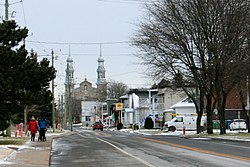
Saint-Rémi (French pronunciation: [sɛ̃ ʁemi]) is a city in the province of Quebec, Canada. Located south of the Saint Lawrence River, Saint-Rémi is part of Les Jardins-de-Napierville Regional County Municipality, in the Montérégie administrative region. The population as of the 2021 Canada Census was 8 957.
The territory was known as Saint-Rémi early into European settlement. It is thought that the name was chosen to honor Daniel de Rémy de Courcelle, Governor General of New France from 1665 to 1672, but this fact is still in doubt today.
At the start of the 19th century, Lord Christophe Sanguinet experienced legal disputes with the British colonial administration and after two trials in 1805 and 1807, the territory of the Lordship of La Salle was reduced by 20% of its area, the most developed by being removed. He and his successors, his son Ambroise Sanguinet and his grandsons Christophe-Ambroise and Charles-Amable Sanguinet tried to recover this part of the territory while interceding so that the hundreds of threatened censitaires were not expelled from their lands. Christophe-Ambroise and Charles-Amable Sanguinet took up the cause of the Lower Canada Rebellion and were hanged in 1839.
Saint-Rémi is located in the former seigneury of La Salle and on the former township of Huntigndon. The origin of the name Saint-Rémi comes from Saint Remigius, bishop of Reims, who baptized the king of the Salian Franks Clovis I in 496. It was in 1815 that the first pioneer, Alexis Perras, arrived.
On 1 July 1845, the parish municipality of Saint-Rémi was officially created. Two years later in 1847, it was merged into the newly created Huntingdon County, but this county was dissolved on July 1, 1855, and the parish municipality was reestablished.
On 23 October 1859, the village of Saint-Rémi was formed by detachment from the parish of the same name. On November 19, 1946, it changed statutes to become a ville (city).
In 1975, the municipal councils of the city of Saint-Rémi and the parish of the same name adopted a by-law authorizing the granting of letters patent to merge the two municipalities into one City of Saint-Rémi.
In 2000, following the death and state funeral of Pierre Trudeau, the 15th Prime Minister of Canada and father of 23rd Prime Minister Justin Trudeau, his body was entombed in a family mausoleum located at the city's main cemetery (St-Rémi-de-Napierville Cemetery). The federal government has marked his resting place with an official plaque as part of a program commemorating deceased prime ministers.
Saint-Rémi, Quebec
Saint-Rémi (French pronunciation: [sɛ̃ ʁemi]) is a city in the province of Quebec, Canada. Located south of the Saint Lawrence River, Saint-Rémi is part of Les Jardins-de-Napierville Regional County Municipality, in the Montérégie administrative region. The population as of the 2021 Canada Census was 8 957.
The territory was known as Saint-Rémi early into European settlement. It is thought that the name was chosen to honor Daniel de Rémy de Courcelle, Governor General of New France from 1665 to 1672, but this fact is still in doubt today.
At the start of the 19th century, Lord Christophe Sanguinet experienced legal disputes with the British colonial administration and after two trials in 1805 and 1807, the territory of the Lordship of La Salle was reduced by 20% of its area, the most developed by being removed. He and his successors, his son Ambroise Sanguinet and his grandsons Christophe-Ambroise and Charles-Amable Sanguinet tried to recover this part of the territory while interceding so that the hundreds of threatened censitaires were not expelled from their lands. Christophe-Ambroise and Charles-Amable Sanguinet took up the cause of the Lower Canada Rebellion and were hanged in 1839.
Saint-Rémi is located in the former seigneury of La Salle and on the former township of Huntigndon. The origin of the name Saint-Rémi comes from Saint Remigius, bishop of Reims, who baptized the king of the Salian Franks Clovis I in 496. It was in 1815 that the first pioneer, Alexis Perras, arrived.
On 1 July 1845, the parish municipality of Saint-Rémi was officially created. Two years later in 1847, it was merged into the newly created Huntingdon County, but this county was dissolved on July 1, 1855, and the parish municipality was reestablished.
On 23 October 1859, the village of Saint-Rémi was formed by detachment from the parish of the same name. On November 19, 1946, it changed statutes to become a ville (city).
In 1975, the municipal councils of the city of Saint-Rémi and the parish of the same name adopted a by-law authorizing the granting of letters patent to merge the two municipalities into one City of Saint-Rémi.
In 2000, following the death and state funeral of Pierre Trudeau, the 15th Prime Minister of Canada and father of 23rd Prime Minister Justin Trudeau, his body was entombed in a family mausoleum located at the city's main cemetery (St-Rémi-de-Napierville Cemetery). The federal government has marked his resting place with an official plaque as part of a program commemorating deceased prime ministers.
Recent media
Recent media