



Community hub
Recent from talks
Knowledge base stats:
Talk channels stats:
Members stats:
Brendan the Navigator
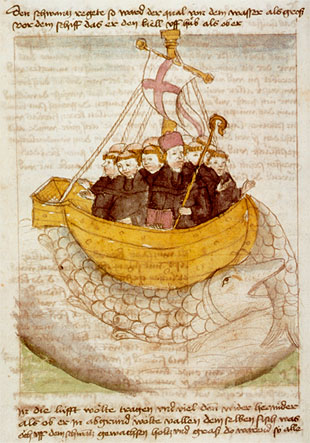
Brendan of Clonfert (c. AD 484 – c. 577) is one of the early Irish monastic saints and one of the Twelve Apostles of Ireland. He is also referred to as Brendan the Navigator, Brendan the Voyager, Brendan the Anchorite, and Brendan the Bold. The Irish translation of his name is Naomh Bréanainn or Naomh Breandán. He is mainly known for his legendary voyage to find the "Isle of the Blessed" which is sometimes referred to as "Saint Brendan’s Island". The written narrative of his journey comes from the immram Navigatio Sancti Brendani Abbatis (Voyage of Saint Brendan the Abbot).
Saint Brendan's feast day is celebrated on 16 May by Catholics, Anglicans, and Orthodox Christians.
There is very little secure information concerning Brendan's life, although at least the approximate dates of his birth and death, and accounts of some events in his life, are found in Irish annals and genealogies. The earliest mention of Brendan is in the Vita Sancti Columbae (Life of Saint Columba) of Adamnan written between AD 679 and 704. The earliest mention of him as a seafarer appears in the Martyrology of Tallaght of the ninth century.
The principal works regarding Brendan and his legend are a "Life of Brendan" in several Latin (Vita Brendani) and Irish versions (Betha Brenainn) and the better known Navigatio Sancti Brendani Abbatis (Voyage of Saint Brendan the Abbot). Unfortunately, the versions of the Vita and the Navigatio provide little reliable information of his life and travels; they do, however, attest to the development of devotion to him in the centuries after his death. An additional problem is that the precise relationship between the Vita and the Navigatio traditions is uncertain.
The date when the Vita tradition began is uncertain. The earliest surviving copies are no earlier than the end of the twelfth century, but scholars suggest that a version of the Vita was composed before AD 1000. The Navigatio was probably written earlier than the Vita, perhaps in the second half of the eighth century. Aengus the Culdee, in his Litany, composed in the end of the eighth century, invoked "the sixty who accompanied St. Brendan in his quest for the Land of Promise".
Any attempt to reconstruct the facts of the life of Brendan or to understand the nature of his legend must be based principally on Irish annals and genealogies and on the various versions of the Vita Brendani.
Brendan was born in AD 484 in Tralee, in County Kerry, in the province of Munster, in the south-west of Ireland.
He was born among the Altraige, an Irish clan originally centred around Tralee Bay, to parents called Finnlug and Cara. Tradition has it that he was born in the Kilfenora/Fenit area on the north side of the bay. He was baptised at Tubrid, near Ardfert, by Erc of Slane, and was originally to be called Mobhí but signs and portents attending his birth and baptism led to him being christened Broen-finn or 'fair-drop'. For five years he was both educated and given in fosterage to St. Íte of Killeedy, "The Brigid of Munster". When he was six he was sent to Jarlath's monastery school at Tuam to further his education. Brendan is considered one of the "Twelve Apostles of Ireland", one of those said to have been tutored by the great teacher, Finnian of Clonard.
Hub AI
Brendan the Navigator AI simulator
(@Brendan the Navigator_simulator)
Brendan the Navigator
Brendan of Clonfert (c. AD 484 – c. 577) is one of the early Irish monastic saints and one of the Twelve Apostles of Ireland. He is also referred to as Brendan the Navigator, Brendan the Voyager, Brendan the Anchorite, and Brendan the Bold. The Irish translation of his name is Naomh Bréanainn or Naomh Breandán. He is mainly known for his legendary voyage to find the "Isle of the Blessed" which is sometimes referred to as "Saint Brendan’s Island". The written narrative of his journey comes from the immram Navigatio Sancti Brendani Abbatis (Voyage of Saint Brendan the Abbot).
Saint Brendan's feast day is celebrated on 16 May by Catholics, Anglicans, and Orthodox Christians.
There is very little secure information concerning Brendan's life, although at least the approximate dates of his birth and death, and accounts of some events in his life, are found in Irish annals and genealogies. The earliest mention of Brendan is in the Vita Sancti Columbae (Life of Saint Columba) of Adamnan written between AD 679 and 704. The earliest mention of him as a seafarer appears in the Martyrology of Tallaght of the ninth century.
The principal works regarding Brendan and his legend are a "Life of Brendan" in several Latin (Vita Brendani) and Irish versions (Betha Brenainn) and the better known Navigatio Sancti Brendani Abbatis (Voyage of Saint Brendan the Abbot). Unfortunately, the versions of the Vita and the Navigatio provide little reliable information of his life and travels; they do, however, attest to the development of devotion to him in the centuries after his death. An additional problem is that the precise relationship between the Vita and the Navigatio traditions is uncertain.
The date when the Vita tradition began is uncertain. The earliest surviving copies are no earlier than the end of the twelfth century, but scholars suggest that a version of the Vita was composed before AD 1000. The Navigatio was probably written earlier than the Vita, perhaps in the second half of the eighth century. Aengus the Culdee, in his Litany, composed in the end of the eighth century, invoked "the sixty who accompanied St. Brendan in his quest for the Land of Promise".
Any attempt to reconstruct the facts of the life of Brendan or to understand the nature of his legend must be based principally on Irish annals and genealogies and on the various versions of the Vita Brendani.
Brendan was born in AD 484 in Tralee, in County Kerry, in the province of Munster, in the south-west of Ireland.
He was born among the Altraige, an Irish clan originally centred around Tralee Bay, to parents called Finnlug and Cara. Tradition has it that he was born in the Kilfenora/Fenit area on the north side of the bay. He was baptised at Tubrid, near Ardfert, by Erc of Slane, and was originally to be called Mobhí but signs and portents attending his birth and baptism led to him being christened Broen-finn or 'fair-drop'. For five years he was both educated and given in fosterage to St. Íte of Killeedy, "The Brigid of Munster". When he was six he was sent to Jarlath's monastery school at Tuam to further his education. Brendan is considered one of the "Twelve Apostles of Ireland", one of those said to have been tutored by the great teacher, Finnian of Clonard.