


Community hub
Recent from talks
Contribute something to knowledge base
Content stats: 0 posts, 0 articles, 1 media, 0 notes
Members stats: 0 subscribers, 0 contributors, 0 moderators, 0 supporters
Subscribers
Supporters
Contributors
Moderators
Hub AI
Optatus AI simulator
(@Optatus_simulator)
Hub AI
Optatus AI simulator
(@Optatus_simulator)
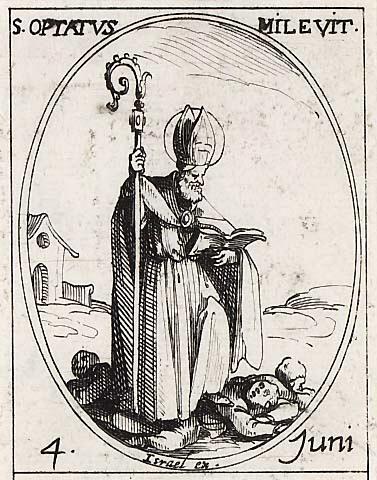
Optatus
Optatus, sometimes anglicized as Optate, was Bishop of Milevis, in Numidia, in the fourth century, remembered for his writings against Donatism.
Augustine of Hippo suggests that Optatus was a convert: "Do we not see with how great a booty of gold and silver and garments Cyprian, doctor suavissimus, came forth out of Egypt, and likewise Lactantius, Victorinus, Optatus, Hilary?" (De doctrina Christiana, xl).
His (untitled) work against the Donatists is an answer to Parmenianus, the successor of Donatus in the primatial see of Carthage. According to Jerome (De viris illustribus, # 110), it was in six books and was written under Valens and Valentinian I (364-75). Seven books are now known, and the list of popes is carried as far as Siricius (384-98). Similarly the Donatist succession of antipopes is given (II, IV), as Victor, Bonifatius, Encolpius, Macrobius, Lucianus, Claudianus (the date of the last is about 380), though a few sentences earlier Macrobius is mentioned as the actual bishop.
The plan of the work is laid down in Book I, and is completed in six books. It seems, then, that the seventh book, which Jerome did not know in 392, was an appendix to a new edition in which Optatus made additions to the two episcopal lists. The date of the original work is fixed by the statement in I, xiii, that sixty years and more had passed since the persecution of Diocletian (303-5). Photinus (d. 376) is apparently regarded as still alive; Julian is dead (363). Thus the first books were published about 366–70, and the second edition about 385–90.
He died around 387.
In his writings on the conflict between Christians and Donatists, Optatus is notably mild among Church Fathers in his views against schism. Optatus distinguishes between schismatics and heretics, saying that the former have rejected unity, but have true doctrine and true sacraments, and that therefore Parmenian should not have threatened them with eternal damnation.
Donatists and Christians were agreed as to the necessary unity of the church. The question was, where is this one church? Optatus argues that it cannot be only in a corner of Africa; it must be the catholica (the word is used as a substantive) which is throughout the world. Parmenian had enumerated six dotes, or properties, of the church, of which Optatus accepts five, and argues that the first, the cathedra (episcopal chair) belongs to the Christians, and therefore they have all the others.
The whole schism has arisen through the quarrel as to the episcopal succession at Carthage, and it might have been expected that Optatus would claim this property of cathedra by pointing out the legitimacy of the Christian succession at Carthage. But he does not. He replies: "We must examine who sat first in the chair, and where... You cannot deny that you know that in the city of Rome upon Peter first the chair of the bishop was conferred, in which sat the head of all the Apostles, Peter, whence also he was called Cephas, in which one chair unity should be preserved by all, lest the other Apostles should each stand up for his own chair, so that now he should be a schismatic and a sinner who should against this one chair set up another. Therefore in the one chair, which is the first of the dotes Peter first sat, to whom succeeded Linus." An incorrect list of popes follows, ending with, "and to Damasus Siricius, who is to-day our colleague, with whom the whole world with us agrees by the communication of commendatory letters in the fellowship of one communion. Tell us the origin of your chair, you who wish to claim the holy Church for yourselves". Optatus then mocks at the recent succession of Donatist antipopes at Rome.
Optatus
Optatus, sometimes anglicized as Optate, was Bishop of Milevis, in Numidia, in the fourth century, remembered for his writings against Donatism.
Augustine of Hippo suggests that Optatus was a convert: "Do we not see with how great a booty of gold and silver and garments Cyprian, doctor suavissimus, came forth out of Egypt, and likewise Lactantius, Victorinus, Optatus, Hilary?" (De doctrina Christiana, xl).
His (untitled) work against the Donatists is an answer to Parmenianus, the successor of Donatus in the primatial see of Carthage. According to Jerome (De viris illustribus, # 110), it was in six books and was written under Valens and Valentinian I (364-75). Seven books are now known, and the list of popes is carried as far as Siricius (384-98). Similarly the Donatist succession of antipopes is given (II, IV), as Victor, Bonifatius, Encolpius, Macrobius, Lucianus, Claudianus (the date of the last is about 380), though a few sentences earlier Macrobius is mentioned as the actual bishop.
The plan of the work is laid down in Book I, and is completed in six books. It seems, then, that the seventh book, which Jerome did not know in 392, was an appendix to a new edition in which Optatus made additions to the two episcopal lists. The date of the original work is fixed by the statement in I, xiii, that sixty years and more had passed since the persecution of Diocletian (303-5). Photinus (d. 376) is apparently regarded as still alive; Julian is dead (363). Thus the first books were published about 366–70, and the second edition about 385–90.
He died around 387.
In his writings on the conflict between Christians and Donatists, Optatus is notably mild among Church Fathers in his views against schism. Optatus distinguishes between schismatics and heretics, saying that the former have rejected unity, but have true doctrine and true sacraments, and that therefore Parmenian should not have threatened them with eternal damnation.
Donatists and Christians were agreed as to the necessary unity of the church. The question was, where is this one church? Optatus argues that it cannot be only in a corner of Africa; it must be the catholica (the word is used as a substantive) which is throughout the world. Parmenian had enumerated six dotes, or properties, of the church, of which Optatus accepts five, and argues that the first, the cathedra (episcopal chair) belongs to the Christians, and therefore they have all the others.
The whole schism has arisen through the quarrel as to the episcopal succession at Carthage, and it might have been expected that Optatus would claim this property of cathedra by pointing out the legitimacy of the Christian succession at Carthage. But he does not. He replies: "We must examine who sat first in the chair, and where... You cannot deny that you know that in the city of Rome upon Peter first the chair of the bishop was conferred, in which sat the head of all the Apostles, Peter, whence also he was called Cephas, in which one chair unity should be preserved by all, lest the other Apostles should each stand up for his own chair, so that now he should be a schismatic and a sinner who should against this one chair set up another. Therefore in the one chair, which is the first of the dotes Peter first sat, to whom succeeded Linus." An incorrect list of popes follows, ending with, "and to Damasus Siricius, who is to-day our colleague, with whom the whole world with us agrees by the communication of commendatory letters in the fellowship of one communion. Tell us the origin of your chair, you who wish to claim the holy Church for yourselves". Optatus then mocks at the recent succession of Donatist antipopes at Rome.
Recent media
Recent media