Hubbry Logo
search
logo
2137859

Sam Edwards

logo
Community Hub0 Subscribers
Read side by side
from Wikipedia

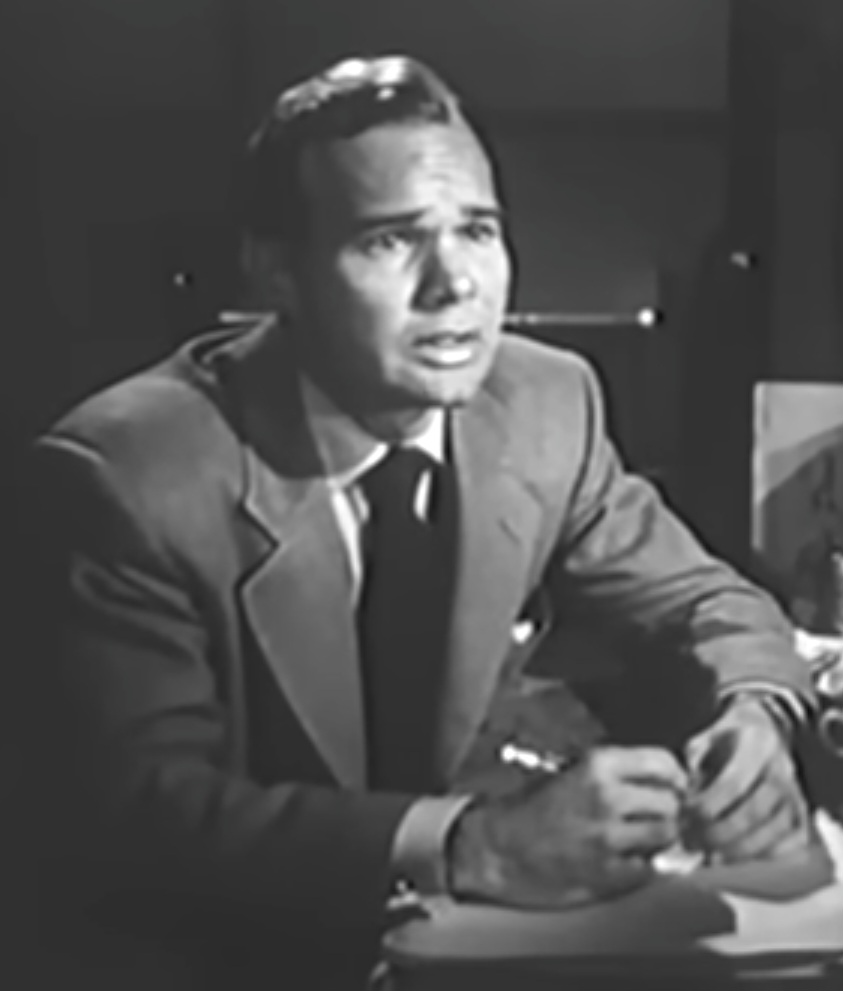
Sam George Edwards (May 26, 1915 – July 28, 2004) was an American actor. His most famous role on television was as banker Bill Anderson on Little House on the Prairie.[1][2]

Key Information

Biography

[edit]

Early years

[edit]

Born into a show business family, his first role was as a baby in his mother's arms. He appeared on radio in the 1930s in the Adventures of Sonny and Buddy one of the first radio serials ever syndicated, and later in The Edwards Family,[3] a series based on the life of Sam, brother Jack, who was also an actor, sister Florida, and his parents, Edna Park and Jack Edwards Sr. Sam was also an early cast member of one of the first radio soap operas, One Man's Family.

Death

[edit]

On July 28, 2004, Edwards died of a heart attack in Durango, Colorado.[3]

Career

[edit]

Radio

[edit]

Edwards worked on a variety of radio programs. He co-starred in the comedy The First Hundred Years on ABC in 1949[4]: 118  and landed a starring role playing Dexter Franklin opposite Janet Waldo in the long-running Meet Corliss Archer series.[4]: 222  He also had recurring or cast member roles in radio on Crime Classics,[4] Dr. Paul;[4]: 101  Father Knows Best,[4]: 115  Guiding Light,[4]: 140  Fort Laramie; Gunsmoke; Dragnet; Suspense; Escape; This Is Your FBI; The Six Shooter; Yours Truly, Johnny Dollar, and Tales of the Texas Rangers.

Film

[edit]

Edwards' first major screen role was as Chuck Ramsey in the movie serial version of Captain Midnight (1942). From 1949 to 1981, he made several film appearances, with significant roles in Twelve O'Clock High (1949), Operation Pacific (1951), Gangbusters (1954), and supporting roles in The Beatniks (1960) and Suppose They Gave A War and Nobody Came (1969). He was also seen in The Absent-Minded Professor (1961), Hello, Dolly! (1969) and The Postman Always Rings Twice (1981).

Edwards was also often heard behind animated characters both on film and records. In 1942, he voiced the adult Thumper in the animated classic Bambi. Later work for Disney was largely on LP Records, including the voices of the Cowardly Lion and Tin Woodman on their Oz series, and as Tigger, Owl, and the Heffalumps on the Winnie the Pooh records. He voiced the title character of Rod Rocket[5] in an early 1960s educational series, and did some episodes of the cult classic Jonny Quest. His last work for Disney was as Ollie Owl opposite singer Burl Ives as Sam the Eagle on their long-running America Sings attraction at Disneyland. There were numerous TV and radio commercials as well, both in front of and behind the camera.

Television

[edit]

Edwards appeared on many television series starting in the mid-1950s. Most notable of these include many episodes of Dragnet and Gunsmoke throughout their long runs. He also appeared on over 60 different series, including The George Burns and Gracie Allen Show, Straightaway, The Andy Griffith Show, Petticoat Junction, Green Acres, Mannix, Mission: Impossible, The Streets of San Francisco, Adam-12, The Red Skelton Show, Happy Days, The Dukes of Hazzard, and even Days of Our Lives. In 1969 Edwards appeared as Will Frazee on the TV series The Virginian in the episode titled "A Woman of Stone."

Selected filmography

[edit]

References

[edit]
[edit]
Revisions and contributorsEdit on WikipediaRead on Wikipedia
from Grokipedia
Sam George Edwards (May 26, 1915 – July 28, 2004) was an American actor and voice artist whose career spanned radio, film, television, and animation over six decades. He was best known for his role as banker Bill Anderson on the NBC television series Little House on the Prairie (1975–1979; 1981–1982).[1][2] Born in Macon, Georgia, into a show business family—his mother, Edna Parks Edwards, was an actress—Edwards made his debut as an infant in her arms during a stage performance. He began his professional career on radio in the 1930s, voicing characters on programs like The Great Gildersleeve and Meet Corliss Archer. Transitioning to film in 1938, he appeared in over 60 movies, often in supporting roles as everyman characters, including uncredited parts in classics like It's a Wonderful Life (1946) and The Patch of Blue (1965).[3][4] Edwards was a prolific voice actor, providing the adult voice of Thumper in Disney's Bambi (1942) and roles in other animated features. On television, beyond Little House on the Prairie, he guest-starred in series such as Perry Mason, _ Gunsmoke_, and The Andy Griffith Show. In later years, he continued working in westerns and family dramas until his retirement. Edwards died of heart complications in Durango, Colorado, at age 89.[1][5]

Early life

Family and childhood

Sam Edwards was born on May 26, 1915, in Macon, Georgia, to actress Edna Park Edwards.[1][6] His mother was a prominent vaudeville performer and leading lady, known for her work with the Edna Park Players.[7] Edwards grew up with two siblings: a brother, Jack Edwards, born in 1919, and a sister, Florida Edwards, born in 1911.[3][8] The family was immersed in the entertainment world, with Edwards' stepfather, actor Charles Ladson Edwards, also contributing to their theatrical pursuits after marrying Edna around 1917.[3][7] From infancy, Edwards was part of the family's performances; he made his stage debut as a baby, held in his mother's arms during a production of the play Tess of the Storm Country.[1][3] His childhood unfolded amid the nomadic life of a traveling show business troupe, as the family relocated frequently—from Macon to Florida, Texas, and eventually California—exposing young Edwards to the rigors and excitement of live theater and vaudeville circuits.[7] This early immersion shaped his foundational experiences in acting, fostering a natural affinity for performance within the familial environment.[1]

Beginnings in entertainment

Born into a third-generation show business family, Sam Edwards made his earliest appearances on stage as a child, leveraging his family's connections in vaudeville and theater. His mother, Edna Park, was a vaudeville actress who carried him onstage during his infancy in a touring production of Tess of the Storm Country, marking his debut around 1915. As he grew older, Edwards continued performing with the family troupe, known as "The Five Edwards," which toured the Southwest in vaudeville acts and early radio endeavors, providing him with informal, hands-on immersion in acting and performance skills without formal training.[3][1] Edwards' entry into professional radio came in the early 1930s, beginning with singing spots on WOAI in San Antonio, Texas, around 1930, where the family had relocated. He soon starred alongside his brother Jack in The Adventures of Sonny and Buddy, a pioneering syndicated serial written by their mother, which aired locally in San Antonio and was rebroadcast in Shreveport, Louisiana, from 1933 to 1934; Edwards portrayed Buddy, the adventurous younger sibling in tales of mischief and exploration. This family-oriented program honed his vocal and dramatic abilities through self-taught techniques absorbed from his parents' expertise in scripting and performing.[3][9] By 1937, the Edwards family had moved to San Francisco, where they produced their own radio content, including The Edwards Family, a comedy-drama featuring the real-life relatives portraying heightened versions of themselves in everyday scenarios; this marked Edwards' first major credited role in a networked show when it transitioned to NBC Blue later that year. Around the same time, he received his initial film credit as Buddy Edwards in the 1937 musical High Hat, though his focus remained on radio, building foundational experience in character voices and improvisation essential for his later success. These early ventures, rooted in familial collaboration, established Edwards as a versatile young performer by the late 1930s.[3][1]

Career

Radio career

Sam Edwards began his radio career in the late 1930s, drawing from family influences in entertainment to secure early roles in serialized programs. He first appeared alongside his brother Jack in the weekly serial Adventures of Sonny and Buddy, a syndicated show originating from stations in San Antonio and Shreveport during the 1930s, where the siblings often sang popular songs as part of the youthful adventures.[3] By 1937, Edwards featured in The Edwards Family, a San Francisco-based program in which the real-life family portrayed themselves in lighthearted domestic sketches.[3] The following year, in 1938, he joined the long-running soap opera One Man's Family on NBC, playing the role of Tracy Baker in the ongoing saga of the Barbour family dynamics.[3] Edwards achieved his most prominent radio success as the star of Meet Corliss Archer, a comedy series that aired from 1943 to 1954, first on NBC and later on CBS. In the show, he portrayed Dexter Franklin, the bumbling teenage boyfriend of the titular character, delivering memorable lines like "Coooorrrrr-laaaaaaaiiiiiis!" and "HOLY COW!" to capture the awkward charm of adolescence.[3] The program, adapted from a popular short story series, ran for over 600 episodes and solidified Edwards' reputation for youthful, relatable characters in the post-World War II era.[2] Throughout the 1940s and 1950s, Edwards made numerous guest appearances on procedural and dramatic radio shows, leveraging his versatile voice for a range of supporting roles. He contributed to many episodes of Gunsmoke on CBS from 1952 to 1961, including at least 83, often voicing townsfolk or minor antagonists in the Western series' tales of frontier justice.[10] Similarly, he appeared multiple times on Dragnet, the pioneering police procedural that debuted in 1949 on NBC and moved to CBS, typically as everyday citizens or suspects in Jack Webb's fact-based crime stories.[3] These roles extended to other programs like Dr. Kate, where he played Morris, showcasing his ability to embody ordinary Americans in tense narratives.[9] He also had recurring roles in shows such as Father Knows Best as Billy Smith and Speed Gibson of the International Secret Police. Edwards' radio work, spanning from 1937 onward, established him as a quintessential "everyman" voice actor, contributing to an estimated 8,000 episodes across various genres by the early 1960s and influencing the medium's transition amid television's rise.[3] His consistent portrayals of relatable, down-to-earth figures underscored the accessibility of radio drama during its golden age.[11]

Film and voice acting

Sam Edwards made his film debut in 1942, portraying Chuck Ramsey in the Columbia Pictures serial Captain Midnight, a 15-chapter adventure following an aviator combating enemy spies during World War II.[12] That same year, transitioning from his radio voice work, he provided the voice for the adult Thumper in Walt Disney's animated feature Bambi, capturing the rabbit's energetic and twitterpated personality in key scenes.[13] His contributions to animation extended to other Disney projects, including voice roles on LP records such as the Cowardly Lion in The Wizard of Oz adaptations and the Mad Hatter in Alice in Wonderland recordings, though these were primarily audio productions.[1] In live-action cinema, Edwards established himself as a reliable character actor in supporting roles, often playing earnest everyman figures or military personnel. A standout performance came in 1949's Twelve O'Clock High, directed by Henry King, where he appeared as Birdwell, a member of the U.S. Army Air Forces bomber crew amid the psychological strains of wartime leadership.[14] His film career continued with bit parts and secondary characters in over 50 productions through the decades, including uncredited appearances in classics like Hello, Dolly! (1969) and a minor role as the ticket clerk in the 1981 remake of The Postman Always Rings Twice, marking one of his final screen credits. Throughout, Edwards' work emphasized subtle, relatable portrayals that complemented ensemble casts in dramas, war films, and comedies, spanning from the 1940s postwar era to the early 1980s.[15]

Television career

Edwards began his television career in the early 1950s, transitioning from radio drama where his voice work had honed his skills in character portrayal. This background influenced his early TV performances, emphasizing nuanced vocal delivery in live-action roles.[15] He quickly became a prolific guest actor, appearing in over 60 series across Westerns, sitcoms, and dramas, often playing everyman characters like farmers, deputies, and townsfolk.[16] Throughout the 1950s and 1960s, Edwards secured multiple guest spots on prominent shows, adapting his radio-style acting to the visual medium. On Gunsmoke, he appeared in eight episodes from 1958 to 1974, portraying various supporting roles such as telegrapher Lee Binders.[16] Similarly, he guested five times on The Andy Griffith Show between 1960 and 1966, including as Jim Muggins in "A Plaque for Mayberry."[16] His recurring role as hotel clerk Hank on The Virginian spanned approximately 10 episodes from 1963 to 1970, showcasing his reliability in serialized Western narratives.[16] Edwards also featured in nine episodes of Dragnet from 1951 to 1970, contributing to the procedural's ensemble of character actors.[16] In the 1970s, Edwards continued with guest appearances in popular sitcoms, including a role as Dr. Abner on Happy Days in 1981.[17] His most notable television role came later as banker Bill Anderson on Little House on the Prairie, appearing in eight episodes from 1978 to 1983 and providing a steady presence in the show's Walnut Grove community.[16] This period marked the evolution of his career toward family-oriented dramas, building on decades of versatile supporting work.[1] Edwards' final television appearance was in 1983 on Little House on the Prairie, after which he retired from acting, concluding a three-decade run in the medium.[3]

Personal life

Marriage and family

Edwards married Beverly Motley, a former journalist, on April 19, 1969, at the Little Brown Church in Studio City, California.[3] They had met three years earlier at a celebrity tennis tournament, where Motley was covering the event for the Valley News.[3] The couple's marriage lasted 35 years, until Edwards' death in 2004, providing a stable foundation during his transition from active acting to retirement.[1] Beverly brought three young children from her previous marriage—Bill, Deborah, and Linda—who were ages 7, 5, and 4, respectively, when Edwards entered their lives.[3] Edwards legally adopted the children, and they took his surname, forming a close-knit family unit that included five grandchildren.[3][15] Prior to his marriage, Edwards was known as a confirmed bachelor, with no prior marriages.[3] In their later years, the couple relocated to Durango, Colorado, in 1980, where Edwards largely retired from film and television by the mid-1980s but continued engaging with his radio legacy by attending old-time radio conventions alongside Beverly, often performing together.[3][18] This family-supported involvement helped sustain his connection to the entertainment world without the demands of full-time work.[1]

Later years and retirement

Following the conclusion of his role as Bill Anderson on the television series Little House on the Prairie in 1983, Sam Edwards retired from professional acting after a career spanning nearly five decades.[1] His late-career guest spots included appearances on Happy Days (1981) and The Dukes of Hazzard (1979), along with voice work for Disney attractions, marking the end of his on-screen and broadcasting commitments.[3] In 1980, Edwards and his wife, Beverly, relocated from Los Angeles to Durango, Colorado, where they built a custom home, seeking a more serene environment away from the demands of Hollywood.[3] This move facilitated a deliberate shift toward a private lifestyle, allowing Edwards to step back from the public eye while occasionally traveling with his family.[3] The couple's marriage, which began in 1969, provided a stable foundation during this transition, enabling him to focus on personal fulfillment rather than professional pursuits.[18] Post-retirement, Edwards maintained a low profile in Durango but made selective public appearances, primarily at conventions celebrating the golden age of radio.[3] He and Beverly participated in events like the REPS convention, where he reprised roles such as Dexter from Meet Corliss Archer, offering fans nostalgic performances that highlighted his enduring connection to his radio roots.[3] These limited engagements contrasted sharply with his earlier high-volume career, underscoring his preference for a quieter, community-oriented retirement in the Rocky Mountains.[19]

Death and legacy

Circumstances of death

Sam Edwards died on July 28, 2004, at the age of 89, following a heart attack at Mercy Hospital in Durango, Colorado, where he had retired.[1][3] He had been admitted to the hospital after suffering the heart attack near his home in Durango.[1][20] Edwards' stepson, William Edwards, confirmed the details of his death and hospitalization.[20] No public funeral service was reported, and Edwards was cremated, with the location of his ashes remaining unknown.[21]

Posthumous recognition

Following his death in 2004, Sam Edwards' contributions to entertainment were acknowledged in several major obituaries that celebrated his portrayals of relatable "everyman" characters across media. The Los Angeles Times highlighted his voice as the adult Thumper in Disney's 1942 animated film Bambi, noting how this role captured the rabbit's youthful exuberance and contributed to the film's enduring appeal as a classic of animation.[1] Similarly, his recurring performance as the affable banker Bill Anderson on Little House on the Prairie from 1978 to 1983 was praised for embodying the honest, community-oriented figures central to the series' depiction of frontier life.[1] The New York Times echoed this sentiment, describing Edwards as a ubiquitous character actor whose work in television, including Little House on the Prairie, and voice roles in children's productions like Bambi left a lasting impression on audiences.[15] His television roles, particularly in Little House on the Prairie, continue to appear in discussions of classic family programming, as noted in contemporary obituaries that emphasized his role in sustaining the show's themes of resilience and everyday heroism.[20] Although Edwards did not receive formal awards during his lifetime, his work endures through these cultural references and archival inclusions, reflecting his subtle but pervasive impact on American entertainment. Details about his broader personal influence, beyond professional highlights, suggest opportunities for additional scholarly exploration into how such character actors shaped audience perceptions of ordinary heroism in mid-20th-century media.
User Avatar
No comments yet.